
Accessibility-Diagnosticity Framework
Affect-as-Information Theory
Agency Theory
Assimilation and Contrast Theory
Associative Network theory
Attitude Theory
Attribution Theory
Balance Theory
Bilateral Deterrence Theory
Cognitive Response Theory
Commitment-Trust Theory
Construal Level Theory
Correspondence Theory
Deontic Justice Theory
Diffusion of Innovation Theory
Elaboration Likelihood Theory
Encoding Variability Theory
Escalation of Commitment Theory
Expectancy Theory of Motivation
Expectation Disconfirmation Theory
Functional Theory of Attitude
General Theory of Marketing Ethics
Goal Setting Theory
Heuristic-Systematic Model
Information Integration Theory
Information Processing Theory
Inoculation Theory
Institutional Theory
Integrated Information Response Model
Optimal Stimulation Level Framework
Persuasive-Arguments Theory
Power Dependence Theory
Prospect Theory
Protection Motivation Theory
Reference-Dependent Theory
Regulatory Fit Theory
Regulatory Focus Theory
Relational Exchange Theory
Resource-based View
Resource Exchange Theory
Resource-matching Theory
Role Theory
Sales Call Anxiety Model
Schema-Congruity Theory
Self-Perception Theory
Signaling Theory
Social Comparison Theory
Social Exchange Theory
Social Penetration Theory
Social Network Theory
S-O-R Paradigm
Theory of Anthropomorphism
Theory of Attitude toward the Ad Formation
Theory of Reasoned Action
Accessibility-Diagnosticity Framework
The Accessibility-Diagnosticity Framework was introduced by Geeta Menon, Priya Raghubir, and Norbert Schwarz in September 1995, as documented in Volume 22 of the Journal of Consumer Research. This particular theory finds use in the field of research marketing, namely in the study of customer behavior.
This hypothesis posits that individuals exhibit more precision in their replies, particularly in the context of surveys, when the questions are associated with habitual behaviors. Specifically, the presence of a regular conduct serves to regulate alternative responses.
This theory was formulated based on three empirical observations and supplemented with relevant scholarly works, which facilitated the identification and substantiation of the underlying hypotheses.
When faced with a question related to irregular conduct, the responder will carefully evaluate alternate replies and analyze facts depending on the given context.
Furthermore, research has shown that when individuals assess someone who is similar to them, they tend to provide replies based on the frequency of occurrences. However, when evaluating someone who is dissimilar, regardless of whether their conduct is typical or atypical, the responder takes into account the context and considers alternate responses.
The paper titled “The Heuristic Value of Rates of Occurrence: A Study on Robustness” was by Menon in 1993. In this study, Menon provided evidence to support the notion that individuals exhibit more accuracy in formulating behavioral frequencies for behaviors that are regular in nature. The significance of the rate of occurrence as a heuristic is supported by the three studies outlined in this article.
The study conducted by Schwarz and Bienias in 1990, titled “The Impact of Response Alternatives,” examines the effects of response alternatives on a given phenomenon. It was shown that those who had a higher level of private self-perception, indicating a greater understanding of their own selves, exhibited a reduced susceptibility to alternative answers.
As seen in the third experiment of the hypothesis, individuals who possess a higher level of self-awareness have a greater capacity to effectively use occurrence rates.
Furthermore, the authors of this research assert that indirect relationships were more influenced by alternative replies compared to self-reports, which aligns with the findings of the second experiment in the theory.
This idea may be beneficial for organizations seeking to provide a product that caters to a consistent behavior pattern and aims to get a deeper understanding of the behavior of potential consumers.
For instance, if Company A seeks to get insights into the facial cream application habits of males, it is crucial to ascertain if this activity is habitual or sporadic. If affirmative, it is important to do research and contemplate the duration and proportion of males who are capable of and inclined to apply cream in order to guide the formulation and execution of cream-related marketing campaigns.
This hypothesis also serves as a valuable means of gaining insight into the self-perception of the target individual. Leveraging the customers’ feeling of belonging is a valuable component for enhancing the efficacy of commercial campaigns.
Affect-as-Information Theory
(content created by Thibault Bernhard)
The concepts :
a) Affect
Affect is a state of mind such as a sensation, a feeling, a mood, an emotion (optimism, depression, fear, …). Any of these states has a positive or negative aspect (translated into judgement in humans mind) and influences us or motivates us as a consequence. The strength of these states can vary on our motivation to act or to react. So there is a difference between the positive and negative states of mind that impact our reaction to it.
b) Information
Information has different meanings and is a concept used and developed in several fields. The most common definition of Information is the resolution of uncertainty. It answers several questions by a set of data providing the description of a situation, an object, a mind, anything. In our case, we have to consider information calls to the notion of perception. “Perception is the organization, identification and interpretation of sensory information in order to represent and understand the presented information or environment” (https://en.wikipedia.org/wiki/Perception) . How can raw data be perceived, analysed and transformed into a judgement by our mind? We are here not talking about the colour of a tree or the taste of a fruit, but how our mind feels and reacts to stimuli, to an exposure to this or this information. This will be explained in the following section.
II. The theory
The affect-as-information hypothesis has been developed by Norbert Schwartz in his academic paper “Feelings-as-Information theory” in 2010, but several researches about the subject have been done earlier (C .Gouaux examined in the early 70’s how variation in feelings and beliefs influenced liking, N.Schwartz & G.Clore have developed in a paper in the 80’s the informative and directive functions of affective states). According to him and previous researches, feelings as information theory conceptualized the role of subjective experiences in judgements. It assumes people attend to their feelings as a source of information to make decisions, act or react to stimuli.
According to several academic articles (view sources), there are two dimensions in this theory. First, the affective valence, which provides information about how good or bad something is, and second comes the affective arousal which signals the importance or urgency of the information.
Nowadays, this concept is mainly used in consumer research (marketing) and still used as a concept for further research in cognitive psychology.
III. Affect as information in persuasion: a model of affect identification and discounting (Dolores Albarracı ́n and G. Tarcan Kumkale)
According to Petty & Wegener (1999), people may consider affect when they are unable or unwilling to process more complex information, such as the arguments contained in the persuasive message. Also, people with low motivation and ability may fail to determine that their extraneous affective reactions are irrelevant to the judgment they are about to make, and, consequently, affect may have an influence.
The article tries to understand if there can not be a bias in the theory of affect as information while being exposed to persuasion. People’s attitudes toward the behavior advocated in a persuasive message may be informed by affect from two sources.
For example, the mere mention of the behavior being advocated may spontaneously elicit affect, and this affect may contribute to one’s reported attitude toward the behavior independently of the implications of the message content. In the findings of the experiments conducted in the article, people’s affective reactions have an effect on their evaluation of the behavior advocated, but also on the ultimate actions in the persuasion process.
IV. Affect as Information: the role of affect in consumer online behaviors ( Lan Xia, Advances in Consumer Research Volume 29, 2002)
The role of emotion/affect has been recognized as an important construct in understanding (traditional) consumer behaviors. The huge amount of time spent on the internet raises a question: how these feelings influence consumer browsing behaviors on the internet?
Consumers have different goals while browsing on the internet. The same affect may have a different impact on consumers’ behaviour depending on their online goals (task related, pure browsing without a specific goal). For example, a positive affect is likely to be interpreted as making progress towards the goal when the online goal is task related (shopping, seeking for information). As a result, people will stop the activity as soon as the goal is achieved or advanced. On the other hand, when the online goal is just browsing for no reason and enjoying, positive affect may be considered as being the goal, and people may continue their online activity for longer because enjoyment is reached.
The first study conducted in the article shows that subjects’ moods influence their online behavior. The influence of affect on behaviors interacted with evaluation criteria (derived from different purposes in the same activity). What is interesting here, is that affect as an information is in online behavior not the only criteria for continuing the online activity. The goal by surfing on the internet also has an effect on the duration of the activity. It is important to mention that the criterias shouldn’t be considered separately, but together.
The influences of mood also depend on consumers’ interpretation of their feelings given different online purposes. The model proposed in the article suggests that the influence of affect on online behaviors is moderated by consumers’ purposes of engaging an activity. They are more likely to spend more time when they are in a positive mood and enjoy themselves. However, if they are very task-oriented, a positive mood will actually have the opposite effect. Understanding how consumers behave provides marketers with insights on how to use the Internet more effectively.
V. Managerial recommendations
Affect-as-information theory shows how people rely on their feelings and how their interpretation is biased by their own understanding/analysis of situations. Companies that are aware of this, especially those who are essentially on the internet should understand which affects are causing enjoyment on people, and also what causes such feelings. As Lan Xia explained and showed in the article on online consumer behavior, understanding people’s goals by surfing on the internet is a first step in the process. Defining which activity relies on which goal will help companies understand how consumers feel, and in what way they will interpret certain stimuli. This is extendable to the real world in real brick-and-mortar shops, companies etc.
Also, companies should try to hide the advocaded persuasion message, because there is too much interpretation behind and so uncontrollable affects in peoples’ mind. To reduce the bias risk, companies should try to formulate their messages as natural as possible, to avoid consumers to understand there is a an advocaded persuasion message and interpret it with their own beliefs.
Sources: https://fr.wikipedia.org/wiki/Affect https://en.wikipedia.org/wiki/Information
https://www.researchgate.net/publication/266330418_Feelings-as-Information_The ory/link/54b868100cf2c27adc48b0f6/download
Gasper, K., & Clore, G. L. (2002). Attending to the big picture: Mood and global vs. local processing of visual information. Psychological .Science, 13, 34-40.
Gouaux, C. (1971). Induced affective states and interpersonal attraction. Journal of Personality and Social Psychology, 20, 37-43.
Martin, L. L., & Clore, G. L. (Eds.). (2001). Theories of mood and cognition: A user s handbook. Mahwah, NJ: Erlbaum.
Schwarz, N., & Clore, G. L. (1983). Mood, misattribution, and judgments of well-being: Informative and directive functions of affective states. Journal of Personality and Social Psychology, 45, 513-523.
Clore, G. L., & Storbeck, J. (2006). Affect as information about liking, efficacy, and importance. In J. P. Forgas & J. P. Forgas (Eds.), Affect in social thinking and behavior. (pp. 123-141). New York, NY, US: Psychology Press.
Lan Xia (2002), Advances in Consumer Research (2002). Affect as information: the role of affect in consumer online behaviors.
Agency Theory
(content created by Anaëlle Bernier)
1) What does it explain or suggest? Who proposed it? When was it proposed? Where (field [e.g. marketing] or subfield [e.g. branding, international marketing]) Is it mainly used?
“Agency theory originates from the problems of risk sharing between principal and agents (Daily et al., 2003).”
Agency theory is a management and economic theory that attempts to explain
relationships and self-interest in business organisations. The theory describes the relationship between two parties, one party, called the agent, represent the other party, called the principal. An agent is usually hired by the principal to perform an act or service on his behalf. The agency theory explains how best to organise relationships in which one party (principal) determines the work and which another party (agent) performs or makes decisions on behalf of the principal. This agency relationships are often complicated as disputes, disagreements and conflicts of interests do arise. Indeed, there is a difference in goals or a difference in risk aversion. The agent is using the resources of a principal. The principal has entrusted money but has little or no day- to-day input. The agent is the decision-maker but is incurring little or no risk because any losses will be borne by the principal. When the aspirations of the principal and the agent do not align, we have a principal-agent problem. This informs the need for a concept like agency theory to regulate how an agency works.
The first persons to introduce this theory are Stephen Ross and Barry Mitnick, independently and roughly concurrently. Ross is responsible for the origin of the economic agency theory, and Mitnick for the institutional agency theory, though the basic concepts underlying these approaches are similar. The first apparition of the theory was in 1972.
2) Theory application: two scientific articles using this theory have to be described in terms of contribution. How are the article’s findings explained by this theory?
Antoniadis, I., Lazarides, T., Sarrianidis, N., and Goupa H. (2008) The impact of agency problem in firm value and the Greek stock exchange market financial crisis. International Conference on Applied Economics – ICOAE 2008
This paper examines Greek Stock market in a context of agency problem during a period of the financial crisis (1999-2001). Unlike traditional agency theory implied agency problem was not a matter of separation of ownership and control, but a matter of conflict of interests between majority and minority shareholders.
Stronger corporate governance would have prevented a crisis like the one of 1999- 2001 as it would reduce the risk of expropriation of minority shareholders, and would encourage them to become more conscious about the stock market and the firms that they invest in.
Michael B. Adams (1994) Agency Theory and the Internal Audit
Agency theory provides a useful theoretical framework for the study of the internal auditing function: helps to explain and predict the existence of internal audit and explain the role and responsibilities assigned to internal auditors by the organization. Agency theory allow to predict how the internal audit function is likely to be affected by organizational change. This article outline how agency theory can provide for richer and more meaningful research in the internal audit discipline. Finally, it is considered that an agency-theory perspective to the internal audit will have substantive benefits for both academics and practitioners.
3) Managerial recommendations: how can this theory be used in companies? Give concrete examples.
The agency theory offers a solution to problems arising where there is a clash of interest between a principal and an agent. It however requires that one party concedes for the other. So, it can be used in companies to explain and resolve disputes when there is a clash of interest. Various proponents of agency theory have proposed ways to resolve disputes between agents and principals. This is termed “reducing agency loss.”
As we saw with the precedent article, agency theory can be also used in companies to improve internal audits.
Agency theory can improve the corporate governance in a company.
Assimilation and Contrast Theory
(content created by Quentin Bezza)
-
The theory of assimilation and contrast has opposite effects. Indeed, assimilation helps to reduce the perceived difference between two stimuli (emotion, detectable excitement). The stimuli are therefore considered to be more similar. On the contrary, contrast contributes to accentuate the perceived difference between the two stimuli and in this case they are perceived as more distant. It should be noted that the effects of assimilation and contrast are opposite but not incompatible; it is the difference between the two processes that gives a net result of either assimilation or contrast. Most of the psychological literature devoted to this theory aims to understand in which context one is likely to observe an assimilation effect or rather a contrast effect. The assimilation effect presupposes that the context is used as a general frame of reference, as a structure. The contrast effect, on the other hand, supposes the use of the context as a standard of comparison, and leads to a comparison between the stimulus and the standard of comparison which highlights the differences. Thus, the use of an extreme reference stimulus most often leads to a contrast effect. On the contrary, the use of an average reference stimulus produces an assimilation effect.
It was developed by Sherif, Taub and Hovland in 1961 according to the French article or in 1958 according to the English article. This theory is mainly used in marketing in advertising or also in other cases such as charitable purposes taking the example of the article by De Bruyn and Prokopec but it can also be used in psychology in order to see the affect between different people. Thus brands often use it in an advertisement to compare their product to another without ever quoting it and to show that their product is better than the competition.
-
Here are the two articles read about the theory of assimilation and contrasts : Assimilation-contrast theory in action : Operationalization and
managerial impact in a fundraising context from Arnaud De Bruyn, Sonja Prokopec (2017) and La théorie de l’assimilation-contraste peut-elle contribuer à expliquer le fonctionnement des annonces comparatives ? de Christian DIANOUX, Jean-Luc HERRMANN, Ingrid PONCIN, Helen ZEITOUN (2006).In the English article, the authors seek to influence donors who donate to a charity. Their attempt to influence is to increase the proposed donation scales based on previous donations so that donors realise that the amount they wanted to donate may have been small compared to others. This perception was therefore supposed to increase the average donation. In the end this was the case as the average donation increased by 22%. Here the theory of assimilation has been proven, however, as the authors have pointed out, it is not certain that these donors will give the same amount again.
In the French-language article, direct and indirect comparative advertisements were developed in order to establish whether direct advertising reinforced the perceived contrast between two trade marks: a “vanity” and a “prototype” and that this perceived contrast should be much less in the case of indirect comparative advertising which makes no explicit reference to a trade mark. This hypothesis has not been called into question by the results obtained, however it should not be generalised, as this study was carried out in a very specific sector (telephony). Secondly, the effect of recall may be questioned and thirdly, it should be asked whether the fact that a consumer perceives a priori the “prototypical” trademark as being prototypical in general or in a way that highlights it does not have an influence on the observed effects.
In the same vein, does the contrast or assimilation effect provoke or distort the overall evaluation of the praised brand and the overall perception of the different beliefs?
3) This theory can really be used in companies that seek to show their superiority over other brands and therefore that their product is better or, on the contrary, that in spite of received ideas, the product of a so-called inferior brand is the same or even superior to the one considered by people to be the best. This can be shown in advertisements while not disclosing the names of competing brands. Here is an example: The most concrete example is Vanish which is a stain removal product where two t-shirts with a similar stain are tested with a spray of each product and then soaked in water. By taking the t- shirt out of the water the t-shirt with the Vanish product is as good as new while the other one is far from perfect. So here the brand aims to use theory to reinforce or persuade viewers that their product is the best. For an example of the second announced theory and thus show people that they are wrong in their thinking that a product is worse, the example of the blind Pepsi/Cola test is a very good argument. Indeed, people are reluctant to drink Pepsi just because of the brand name. This is why a study was carried out on people testing a Coca-Cola drink and a Pepsi drink blindly. The results showed that the majority of people preferred Pepsi, whereas if people had been questioned without them being blind, the results would have been clearly in favour of Coca.
Associative Network theory
(content created by Keerat Onkar Singh Bhatia)
Associative networks permit one to represent background knowledge.
Marketers create intensive use of support as associate instrument to make and enhance corporate image, with international support payment exceptional USD50 billion in 2012 (IEG, 2013). This growth in support payment has been paralleled by growth in support analysis. the varied definitions of support area unit centred on the thought that the sponsor pays reciprocally for the chance to be associated with the given event. The transfer of image from the event to the complete is thus central to the productivity of any support arrangement. The existent support analysis has many shortcomings. for instance, it’s typically supported a unidirectional image transfer process, and therefore the underlying mechanism of image transfer is attributed primarily to associative network theories (which, on their own, don’t answer the why and the way of the image transfer process). Associative theories, whose roots dwell psychological feature psychology, concern propositions, cues and outcomes.To identify however complete data exists in memory, several marketers take refuge in the memory models developed by psychologists (Anderson, 1983). Most brand association analysis is frozen in hymenopteran, that area unit primarily involved with the organisation of long-term memory. analysis on hymenopteran initially emerged in psychological feature psychology within the late Nineteen Sixties. Psychological psychologists typically believe that knowledge is kept within the memory and delineated as associative networks (Collins & Loftus, 1975). One among the foremost prestigious hymenopteran, that ordered the foundation for the first development of memory models, is Quillian’s (1969) Teachable Language Comprehender (TLC) model. Quillian explained however associations are unit connected inside the network and posited that they vary in terms of their gradable level within the network. Collins and Loftus (1975) extended the tender loving care model with the thought of “spreading-activation”. They illustrated however a memory search spreads upon the activation of stimuli. once someone receives an input, a node such as that input is activated. This node before long becomes the focal node and spreads the activation to alternative nodes through the links between them. The 26 search in memory between nodes spreads move into parallel with the links from the focal node. The activated nodes then become input nodes, increasing and spreading the activation. The spreading of activation perpetually expands, and the degree of unfold depends on the gap between the to-be-activated node and therefore the first input node. Collins and Loftus (1975) additionally eliminated the strict gradable structure within the tender loving care model, exchange it with the strength of associations. Gwinner(1997) created use of the idea of human associative memory (HAM) to supply the rationale for image transfer. HAM belongs to the hymenopteran family. it’s well established that associations play a vital role within the mind of the patron once he or she is evaluating a product or event. the basic assumption of HAM theory is that consumers use such things as complete names, product attributes and event attributes as retrieval cues for info concerning product performance or event aura.
Another college of thought is that the adjustive network models (ANM) advanced by Osselaer and Janiszewski (2001). The origins of those models is copied to the classical conditioning literature, in step with that ANM strengthen associations, which are updated and evolved as cues act or vie to predict outcomes. Thus, HAM models hold that cues area unit learnt severally, while ANM hold that the change of associations takes place solely to the extent that the educational system isn’t already correctly predicting outcomes (Osselaer & Janiszewski, 2001). Our brains tend to stay our recollections in nodes, that it then connects with associated different recollections. Nodes will be linguistics (with easy meaning) or emotive (with emotional meaning). so we have a tendency to have a node for happiness, with that square measure associated all our happy recollections. Nodes can even inhibit each other (a kind or negative association). so after we square measure happiness it’s troublesome to think about unhappy things, and contrariwise. Network theory is additionally known as Associative Network Theory, the Network Model and Network Theory.One strategy that stems from network theory is influencer selling. you may try and re-invent the wheel and check out to achieve each individual potential client from scratch, otherwise you may reach bent on associate influencer, WHO is already connected to those individuals and is influencing them. this is often relationship-focused selling. as an example, maybe you sell hair care product associated you recognize an cogent blogger, Mark, WHO already tells his network regarding industrious hair care product. you may place an advertisement close to the demographic you’re making an attempt to achieve and hope for the most effective, even with a pleasant saying to require a selected psychographic into consideration, however if you’re employed with Mark to achieve his audience, you’ll have higher luck. A network isn’t forever reached through cogent bloggers, but (and usually|this will be} often the sole example individuals can think about once they think about influencer marketing). Another network might be associate association of economic planners. all of them get along doubly annually for a conference, they grasp one another and their work, and infrequently influence every other’s computer code decisions. you may reach bent on the association lead, or conference planner, and provide to present a presentation of your monetary services computer code.
It’s all regarding connections
https://e360.yale.edu/features/network_theory_a_key_to_unraveling_how_nature_works
-
Hastie, R. (1988). A computer simulation model of person memory. Journal of Experimental Social Psychology, 24, 423—147.
-
Shiffrin, R. M., & Raaijmakers, J. (1992). The SAM retrieval model: A retrospective and prospective. In A. F. Healy, S. M. Kosslyn, & R. M. Shiffrin (Eds.), Essays in honor of William K. Estes: Vol. 2. From learning processes to cognitive processes (pp. 69-86). Hillsdale, NJ: Erlbaum.
Attitude Theory
(content created by Pierre Blanc-Garin)
1) Theory description
Definition (Wikipedia): An influential model of attitude is the multicomponent model, where attitudes are evaluations of an object that have affective, behavioral, and cognitive components (the ABC model).
Attitude, as a psychological concept, was mainly theorized by Rosenberg and Hovland (1960) with the classic tripartite model. There are some critics regarding the tripartite point of view because it presents the three aspects (affective, cognitive and behavioral) to be interdependent meanwhile studies showed that cognitive and behavioral components may actually derived from affect etc.
However, this model is still interesting in laying some bases to more recent and accurate studies in particular research fields such as Monetary Intelligence or “psychological structures such as values and ideology”.
(Wikipedia)
Field: Psychology
Subfield: Consumer behavior in marketing, Monetary Intelligence, Values, Ideologies
See the Appendix for the Tripartite Model and the four functions of the consumers attitudes.
2) Theory application
“Consumer attitude toward gray market goods”
Jen-Hung Huang, B. C. Lee, S. H. Ho
As defined by Bucklin (1993), “Gray market goods are genuinely branded merchandise distinguished only by their sale through channels unauthorized by the trademark owner.”
Gray markets goods represents dozens of millions of dollars, which becomes loss for the original brands as they are sold on unauthorized channels or parallel distributions. Today, this phenomenon is global and companies needs to be prepared to counter these actions. The study as presented in this paper is willing to work from the demand perspective and how the consumers behaviours, and the attitude that lead them, could be analysed and understand.
The researchers start from the Fishbein’s extended model explaining that “behavior is determined by intentions, which are in turn determined by attitudes and subjective norms (Ajzen and Fishbein, 1980).”
Attitude is here described as “a learned predisposition to respond to an object in a consistently favourable or unfavourable way.” Concerning the attitude of the participants of the study toward gray market goods, three factors were brought to light: “price consciousness, price-quality inference (high price, high quality…), and risk aversness”.
H1 “Consumers’ price consciousness positively affects consumers’ preference for gray markets goods.”
H2 “A consumer who more strongly maintain the price-quality inference has a more negative attitude toward gray market goods.”
H3 “Consumers’ risk averseness negatively affects consumer attitude toward gray market goods.”
H4 “For products with a higher consumer involvement, consumer’s attitude and purchase intention toward gray market goods are positively related.”
Discussion:
Conceptual Model
Even though price is still considered as the main reason for consumers to buy gray market goods, the study shows that “the effect of price consciousness on consumer attitude is insignificant.” Moreover, it shows that “price-quality inference significantly and negatively affects consumer attitude toward gray market goods” which means that gray market goods attract people with “high price sensitivities” meanwhile when it comes to people concerned with quality at first, gray market goods are no longer an option.
Furthermore, the study shows that “risk averseness negatively influences consumer attitude toward gray market goods”. It is important to keep in mind that this study was operated in Taiwan, where “legal environment is more favorable for gray market distributors than [in the USA]. Moreover, the aim of the study is to be the first study of its kind and to encourage and inspire future studies on what they will need to focus on.
However, the results here are still very relevant in terms of marketing recommendations and lay a strong basis on consumers’ attitude toward gray market goods.
“Consumer attitude toward mobile advertising in an emerging market: an empirical study”
Humayun Kabir Chowdhury, Nargis Parvin, Christian Weitenberner, Michael Becke, 2006
This study takes place in Bangladesh, where researchers tried to analyse people’s attitude toward cell phone advertising via Short Message Service (SMS). The starting point was the observation that “the high penetration rate of mobile phones has resulted in the increasing use of mobile advertisements to market products and services”.
Researchers are focusing the study on four factors: entertainment, informativeness, irritation and credibility.
H1 “The perceived entertainment of mobile ads has a direct positive effect on attitude toward mobile advertising.”
H2 “The perceived informativeness of mobile ads has a direct positive effect on attitude toward mobile advertising.”
H3 “The perceived irritation of mobile ads has a direct Conceptual Model negative effect on attitude toward mobile advertising.”
H4 “The perceived credibility of mobile ads has a direct positive effect on attitude toward mobile advertising.”
Discussion:
The main findings of the study are that people are directly and positively influenced by ads credibility, which is even “the most significant factor affecting respondents’ attitude toward mobile ads”.
However, entertainment and informativeness were the two most negative factors when it was about mobile ads.
One of the main limitations of the study is that they did not considered the factor “irritation”, which is one of the main things that comes to mind when we talk about mobile ads.
3) Managerial recommendations
As it has been showed in the studies above or by the concept of attitude itself, managers must be well aware of their consumers’ attitude and how they should manage them. It shows that the consumers are not only influenced by their will or by their desire during their buying or decision processes, but they are also heavily influenced by their attitude. Actually, attitude determine intentions and thus the final behavior (Fishbein), which means that managers should work on their brand and products in order to reflect a positive image or feeling. This will eventually lead consumers to have a positive attitude toward the brand and thus it will encourage them to make a buying decision.
This feeling can be worked during every step of the Consumer Decision Journey, from the beginning during the search for information with an ergonomic and good-looking website to the brand experience during shopping with positive feeling and availability from the staff for example.
As stated on the articles, brands may insist on producing credible mobile ads to promote new products or offers. They may also want to communicate on the price-quality inference of their offer for examples.
APPENDIX Tripartite or ABC model:
-
– Affective component: refers to your feelings or emotions that are linked to an attitude object and how that influences it. Positive or negative responses to an object will lead you either to a positive or negative attitude toward it.
-
– Behavioral component: how the attitude that we have influences our actions or behavior.
-
– Cognitive component: refers to the thoughts, beliefs and attributes that we would associate with an object. Once again, a positive or negative attribute to an object will influence your attitude toward it.
The four functions of the consumer attitudes (E. Blum, Typologie du Consommateur):
• Frame of reference:
o Being in a partially unknown environment.
o The attitudes already developed toward known products will be the reference
framework of the consumer during its learning and information treatment process on new products.
-
Expression of fundamental values:
o The more the consumer will associate a central value to a product or a brand, the more he will be reluctant to change its attitude and thus will be loyal to the product or to the brand. -
Ego defence:
o In order to reduce its anxiety and to be protected from its environment, the consumer uses projection, compensation and rationalisation mechanisms. -
Adjustment:
o Allows the consumer to maximise the satisfaction from its buying or minimize the disappointment from what the object can procure him.Fishbein model
https://www.e-marketing.fr/Definitions-Glossaire/Attitude-240593.htm
Sources
https://www.cours-marketing.fr/le-consommateur/typologie-du-consommateur/lattitude-du- consommateur/ https://www.tutorialspoint.com/consumer_behavior/consumer_behavior_attitude.htm https://en.wikipedia.org/wiki/Attitude_(psychology)
Attribution Theory
(content created by Antoine Blanchard)
The Attribution Theory was proposed by Fritz Heider who is a psychologist and university professor of American psychology of Austrian origin. The Attribution Theory is a method that can be used to assess how people perceive their own behavior and that of other people. Attribution theory deals with how people give causal explanations. In his 1958 book “The Psychology of Interpersonal Relations”, Heider indicates that all behavior is considered to be determined by independent internal or external factors. Indeed, consumers generally feel the need to attribute cause to effect. In the analysis of consumer behavior, attribution theory postulates that the consumer will attribute a cause to the purchase he has just made. However, this cause was not always the one that actually triggered the buying behavior. Thus, when questioned, the consumer is, most of the time, reluctant to recognize the influence of an advertisement or a promotional offer, preferring a cause that will be based on the attributes of the product. Consciously or unconsciously, the goal is usually to provide a rational reason for the act of purchase.
The attribution theory is mainly used for the psychology and marketing fields in order to understand the behavior of the people for the first one and the consumer for the second one. By the way “Weiner’s theory has been widely applied in education, law, clinical psychology, and the mental health domain.” We can say so that this theory has been used for numerous different fields.
The first article which mention the attribution theory is : Attribution theory in the organizational sciences : The road traveled and the path ahead by PAUL HARVEY, KRISTEN MADISON, MARK MARTINKO, T. RUSSELL CROOK, TAMARA A. CROOK. 2014
This article is a meta-analysis of existing attribution theory research, indeed it deals with the examination of the predictive power of attributions in organizational contexts. The findings are that this meta-analysis reinforces existing arguments for the use of attribution theory in organizational research. As they it is written on the article, attributions have constantly demonstrated effect sizes that are comparable to more commonly utilized predictor variables of workplaces outcomes. Indeed, attributions are an integral part of individuals’ cognitive processes that are associated with critical organizational outcomes. We conclude with suggestions to help expand and optimize the contribution of attributional research to understanding and managing organizational outcomes
The second article dealing with attribution theory is the following one Comments on “Attribution Theory and Advertiser Credibility written by ROBERT A. HANSEN and CAROL A. SCOTT. 1976
Attribution theory, as Settle and Golden point out, is indeed a complex set of propositions. And, we agree with them that attribution theory with its focus on phenomenological information processing is an important development in behavioral theory which has many implications for marketing.
“However, several conceptual and methodological problems in the experiment described by Settle and Golden can mislead those unfamiliar with attribution theory into thinking that the theoretical framework has been given an adequate explication and test. Two general problem areas are addressed in this discussion: (1) the Settle and Golden explication of attribution theory and particularly the fact that their introductory remarks confuse two attributional paradigms and misuse the covariance process postulated by the theory, and (2) Settle and Golden’s interpretation of the results of their experiment. The latter discussion focuses on the fact that no data are presented to test the validity of the first
hypothesis as stated, and that the conclusion drawn concerning the second hypothesis does not appear to be fully justified by the data..”
The findings are that this theory “has important implications for marketers and researchers interested in consumer information processing in general and advertiser credibility in particular, we are not convinced that their article presents an adequate test of these implications. Attribution theory involves a series of somewhat complicated propositions and paradigms. A cursory skimming of the literature will result only in invalid.”
This theory can be used in companies because attributions are critical to management because perceived causes of behavior may influence managers’ and employees’ judgments and actions.
Indeed, “attribution theory is important for organizations because it can help managers understand some of the causes of employee behavior and can assist employees in understanding their thinking about their own behaviors. If you can understand why you behave a certain way, and why others around you do so, then you have a better understanding of yourself, others, and your organization. The perception of the causes of a certain behavior may affect the judgment and actions of both managers and employees. It may also play a significant role in motivation.”
To conclude we can say that this theory can be helpful in order to improve and better understand the relationship between people inside of a company as managers and employees.
Bibliography :
https://www.ukessays.com/essays/management/application-of-attribution-theory-to-workplace- communication-issue.php
http://eds.a.ebscohost.com.scd-rproxy.u-strasbg.fr/eds/pdfviewer/pdfviewer?vid=2&sid=87e119e1- aed5-4e44-b623-35ce862a2bb4%40pdc-v-sessmgr03
https://www.researchgate.net/profile/Gifford_Weary/publication/200003646_Current_Issues_in_At tribution_Theory_and_Research/links/5669888d08ae430ab4f7253e.pdf
Balance Theory
(content created by Bilal Chareuf)
Balance Theory states that in situations or relationships where multiple elements are involved, people will seek to balance them. Within the context of corporate social responsibility, these elements include the consumer, the business, and the value or social issue the business supports.
Two central and associated thematic statements were most fully articulated in The Psychology of Interpersonal Relations (1958). One of these relates to the concept of Balance theory as formulated by Heider.
The theory in marketing is a tendency toward balanced states in human relationships. Heider demonstrates that this hypothesis extends to consumer-psychological perspectives, such as product ownership.
- First article: Updating Heider’s Balance Theory in Consumer Behavior: A Jewish Couple Buys a German Car and Additional Buying–Consuming Transformation Stories, Arch WOODSIDE (Boston College) and Jean-Charles CHEBAT (Ecole des Hautes Etudes Commerciales)
Why would any Jew buy a BMW, Mercedes, or Volkswagen? Historical events influence people’s emotions and change their behaviors when real people are not guilty of the facts, such as the example of a Jewish family buying a German car when the German brand is not responsible for Hilter’s actions, but there is an imbalance in the balance of buying behaviors.
Second article: Balance Theory, Unit Relations, and Attribution: The Underlying Integrity of Heiderian, Theory By: Christian S. Crandall, Paul J. Silvia, Ahogni Nicolas N’Gbala, Jo-Ann Tsang, Karen Dawson
One important debate at the crossroads of social psychology and political science is the issue of ideology and prejudice. From a perspective known as principled racism, Sniderman, Tetlock, and their colleagues have argued that apparently negative attitudes toward Blacks come from a relatively benign source: the application of a consistent ideology about individual freedom and individual responsibility and a desire to avoid government intrusion in all areas of life. They have argued that these ideological beliefs, which are formed without reference to race, lead to policy attitudes that others might characterize as racist. One of the most important underlying themes of these policy attitudes is attributions for the cause of poverty, unemployment, crime, and so on. Attributions of individual responsibility are an essential component of political ideology, people who hold individual Blacks responsible for their plight tend to have negative attitudes toward Blacks. Antiblack attitudes are justified by attributing individual responsibility for negative components of the stereotype (Crandall & Eshleman, 2003).
- By bringing LeBron into their advertising picture, Buick has created a relationship in the minds of younger consumers between LeBron and Buick cars. On one hand, younger consumers think Buick cars are for elderly people and hold negative sentiment. On the other hand, younger consumers hold a positive view of LeBron and find him influential. By creating a relationship between Lebron and Buick, Buick has created an imbalance in the minds of these consumers, cognitive dissonance. According to the principles of Heider’s Balance Theory, younger consumers have a choice to make, assuming they want to get rid of the cognitive dissonance. In theory, these consumers will alter their attitudes toward Lebron and/or Buick in a way that returns their minds to a state of consistency and equilibrium.
Bilateral Deterrence Theory
(content created by Yu Cheng)
- Theory description
Bilateral deterrence theory is the practice of discouraging or restraining someone— in world politics, usually a nation-state—from taking unwanted actions, such as an armed attack. It involves an effort to stop or prevent an action. There are two basic types of deterrence—general and specific. General deterrence is designed to prevent crime in the general population and specific deterrence is designed to deter only the individual offender from committing that crime in the future.
The bilateral deterrence theory of publishment can be traced to the early works of classical philosophers such as Thomas Hobbes(1588-1678), Cesare Beccaria(1738-1794) and Jeremy Bentham(1748-1832).
Hobbes published Leviathan in 1651, Beccaria published Dei Delitti e delle pene( On Crimes and Punishments) in 1764, Bentham publish An introduction to the principles of Morals and Legislation in 1780.
Bilateral deterrence theory is mainly used in political science, international relations,criminology and psychology.
2.Theory application
Article 1 Bilateral deterrence and conflict spiral: A theoretical analysis Lawler, E. J. (1986)
This article explicates two theories that offer contradictory answers to this question. “Bilateral Deterrence,” predicts that (a) where actors have equal levels of power capability, the larger the mutual capability the lower the likelihood of using coercive tactics, and (b) conditions of unequal power capability produce more use of coercive tactics than conditions of equal power.
“Conflict Spiral,” makes the opposite predictions: Larger power capabilities increase use and relationships with equal power produce more coercive tactics than ones containing unequal power.
The theoretical formulations suggest the importance of distinguishing relative power (power difference between actors) from the total power (sum of each actor’s power) in a relationship and stress the cognitive processes that mediate the relationship of power capability and power use.
Article 2 Modern Deterrence Theory: Research Trends, Policy Debates, and Methodological Controversies Stephen L. Quackenbush and Frank C. Zagare(2016)
This article summarizes two synergistic variants of the classical specification of deterrence and contrasts them with competing explanatory frameworks, then examines the empirical literature on deterrence, recent theoretical developments in deterrence theory, and debates about deterrence policies. It concludes with a discussion of how the study of deterrence fits into the study of international conflict more broadly.
- Managerial recommendation
1. If employees arrive late or leave early, they will be deducted.
2. If an employee does not come to work for three days, he will be fired.
3. If an employee does not complete tasks on time, he will need to work overtime.
Cognitive Response Theory
(content created by Alan Chevereau)
I. Theory description
a. What does it explain or suggest?
In order to be able to answer this question correctly, we will define cognition. Cognition includes all mental processes related to knowledge and language. There are different cognitive sequences such as the capture of data, the organization and classification of data…
b. Who proposed it?
The model was first proposed by Anthony Greenwald.
c. When was it proposed?
Cognitive Response Theory was proposed in 1968.
d. Where? (field [e.g. marketing] or subfield [e.g. branding, international marketing])
The cognitive response model affects all areas where the human being is present. To begin with psychology, philosophy, languages, anthropology, as well as neurosciences and therefore inevitably marketing.
Cognitive marketing helps brands and their customers to simplify their purchase decision but also to understand how the message has been perceived by customers.
e. Is it mainly used?
This is mainly used indeed. One of the most widely used methods of examining changes in consumer perception and belief is the result of learning through advertising. Marketers use tools to assess the relevance of their ads, how they have been perceived by consumers. Their reactions can then be used to improve marketers’ learning.
II. Theory application:
a. Two scientific articles using this theory have to be described in terms of contribution
The first article using this theory is Consumers’ cognitive response to website change (2017) by Jeremy Ainswortha & Paul W. Ballantine. The authors proposed different web pages to participants. Then they observed the cognitive changes according to each web page.
The second article using this theory is Cognitive Response Involvement Model of the Process of Product Evaluation Through Advertising Exposure and Trial (1990) by Michael A. Kamins, Henry Assael & John L. Graham. The authors sought to expose participants to advertising content and evaluated cognitive responses based on the degree of exposure.
b. How are the article’s findings explained by this theory?
Article 1: The authors found that the web site changes have a negative impact on participants’ cognitive response. This is the opposite to what the authors have imagined.
Article 2: The study shows that exposure to high amounts of advertising has negative repercussions on the cognitive perception of the participant. Conversely, less exposure has a more positive impact. Here too, the results surprised the authors.
III. Managerial recommendations:
a. How can this theory be used in companies? Give concrete examples.
This theory is used in marketing to assess consumer perception of advertising messages.
Concretely, we can take an example with an advertisement broadcast on Facebook (advertising budgets related to social networks are taking a larger and larger margin). Cognitive Response Theory will examine the cognitive processing of advertising messages by consumers is the evaluation of their responses, the thoughts that come to them by reading, watching and hearing.
Commitment-Trust Theory
(content created by Quentin Dekeyser)
Theory description:
This theory is proposed by Robert M. Morgan and Shelby D. Hunt. It was proposed and published in the “Journal of Marketing”, volume 58 during July 1994. This theory was in page 20 to 38.
This theory tries to understand if commitment and trust were playing an important role in successful relationship between companies. They reach this point by understanding that good competition is somehow lead by successful relationship. To do so they define what is in general the relationship marketing, because it does not have the same definition for different sector or organizations. They proposed “Relationship marketing refers to all marketing activities directed toward establishing, developing, and maintaining successful relational exchanges” to include all kind of relationship marketing. They theorize that instead of considering normal factors for successful relationship, commitment and trust are main factors for successful ones.
To propose the theory, they put them between five antecedents and outcomes. They are “relationship Termination Costs”, “Relationship Benefits”, “Shared Value”, “Communication”, and “Opportunistic Behavior” as antecedents and “Acquiescence”, “Propensity to Leave”, “Cooperation”, “Functional Conflict”, and “Uncertainty” as outcomes. They defined them to be clearly understandable. They really put commitment and trust at the centre of all good relationship. By doing so, they explain and show how one is related to the other, vice versa, but also how one without the other will not be enough to pull out the success in the relationship.
They propose 13 hypotheses by linking the antecedents and the moderating variable to the antecedents, proposing for some a good impact and other negatives. They propose their “Rival model” and use as a sample “independent automobile tire retailers. The overall size of the sample was 204 different people.
The results they obtained, are characterized by effective and ineffective relationship on qualitative dimensions. All hypotheses, except one, are possible due to the p<0.01. They found that all link (hypotheses) between antecedent and relationship commitment and trust are supported. They also found that commitment and trust have an important impact on the outcomes
They conclude by showing, with the two model (KMW and Rival), that commitment and trust re clearly influencers for a good relationship marketing.
Theory application:
Role of electronic trust in online retailing: a re-examination of the commitment-trust theory. By Avinandan Mukherjee and Prithwiraj Nath. Published in the European Journal of Marketing, n°41, 2007.
This paper tries to put in context the commitment and trust theory. They choose the online customer relationship management as the context. They want to see if the antecedents and outcomes still the same. They obtain the results that, in an online context, antecedents and outcomes may change because of the different nature to the previous research. They add as antecedents to trust, two factors, “Privacy” and security”. They lead to the fact that some antecedents can have negative effect. It permits to gives a new view of the commitment-trust theory in a digital context.
It finally led to better insight for managers in online context and by quoting the paper “The issue of trust is therefore increasingly recognized as a critical success factor in the emerging retail “marketspace”.”
A study of supply chain partnerships based on the commitment-trust theory by Mei-Ying Wu, Yung-Chien Weng, I-Chiao Huang. Published in Asia Pacific Journal of Marketing and Logistics, 2012.
They use the commitment-trust theory in the context of Supply-chain in Hight-tech companies in Taiwan. They found that as the first theory, the commitment and trust is key factors to success in the high-tech supply chain area. It leads them to win-win situation and increase their competitivity in the market.
This text is simply a demonstration that the commitment trust theory is always accepted in many sector and companies.
Managerial recommendation:
In all type of relationship, B2B to B2C and more, commitment and trust are key to success and to successful relationship.
We can recommend to every type of sector and companies to believe and participate in each relationship it will know.
When marketers want to create a relationship and engage customers, they must put commitment and trust them, as the customers must believe in the company and give to it.
Between two competitors, the relationship must be proposed at 100% because without trust or commitment neither of the companies will be successful.
Construal Level Theory
(content created by Héméra Denni)
1. Theory description: What does it explain or suggest? Who proposed it? When was it proposed? Where is it mainly used?
Construal Level Theory is related to social psychology and describes the relationship between psychological distance and the extent to which people’s thinking (cf Wikipedia). This theory puts forward the idea that the further the psychological distance between a person and an object or an event, the higher the level of abstraction will be. Nevertheless, the contrary is also true. Indeed, the closer the psychological distance is, the more concrete it tends to appear. So, this theory shows that the evaluation of options is influenced by the difference in the construal level. Moreover, this level theory is divided into three different axes which are the temporal, spatial and social distance. Even if in consumer behaviour studies, the temporal distance is more studied, the three of them are important.
Another idea that we need to take into account is that different standards are implicated in the evaluation of a product and moving to the act of selection and purchase. When inspecting a product, regardless of whether the intrinsic aspect has been evaluated highly in terms of quality and function, it does not necessarily mean that product will be purchased. When people go into a shop, a common occurrence is that slight differences in quality and function become irrelevant when the customer likes the design of another product.
To understand the behaviour of consumers in their purchasing process, many theories, concepts, models, etc. have been put forward. From social psychology, marketers have adopted the Construal Level Theory (CLT) to explain how psychological distance influences the thoughts and behaviour of individuals in the evaluation of a product or service.
Construal Level Theory plays an important role in situations where people need to look beyond the information they have. This article aims to briefly explain the CLT framework, its basic theoretical approach and its implications for consumer psychology. The article will find a place of interest among marketing students.
One of the main objectives of studying consumer behaviour is to gain a good understanding of consumer psychology and to better understand how individuals evaluate products or services. Numerous studies on the subject have shown that the quality and desirability of a product or service are not the only factors that influence consumer evaluation; other factors also have an impact on the result.
What might these factors be? How do you determine what other factors or the type of other factors are playing a role at a given time? To identify them, we need to understand that we are living here in the present and experiencing them. It is impossible to experience the future or other places. The same is true of the past; we cannot experience it even if memories linger. As for the future, we have hopes, we make plans and predictions.
All these elements guide our choices and decisions. Construal Level Theory (CLT) explains that individuals plan for the distant future or the point of view of others by forming abstract mental constructs. Our memories, speculations and predictions are all mental constructs. Mental constructs allow us to make predictions, remember the past, or imagine other people’s reactions to an event or object. Mental constructs help to overcome the current scenario and to imagine psychologically distant objects.
The term “construal” is derived from social psychology. It refers to the process by which people perceive, understand and interpret the environment around them. CLT describes the relationship between psychological distance and people’s thinking – in abstract or clear terms. The theory explains that people think more abstractly about objects that are farther away while they think more concretely about those that are closer.
Psychological distance is the perception one has of how close or distant an object is from oneself and when the event is to take place. It is therefore subjective and egocentric. It always starts from the present, the here and the self. An object or an event can be distanced from oneself in different ways – in time, space, social distance and hypothetically. These have different dimensions of psychological distance and are respectively called temporal, spatial, social and hypothetical distances. For example, if you plan to take a vacation in about a year, your thoughts will be abstract: “Where?”, “What to do once you get there?”, “Which type of housing do you want?”, “Going by plane or by car?”, etc.
To describe proximate events, individuals use specific low-level constructs, and for events removed in one of the dimensions explained above, abstract and high-level constructs are used. Low-level interpretations are less structured, more contextual, and include subordinate and incidental elements of events. In other words, low-level interpretations are used when individuals think in detail and focus on secondary characteristics of the event or object that are not important to the understanding of the event or object. In contrast, high- level interpretations are represented schematically and constitute the bulk of the information available to the individual. High-level constructs are also made up of superior characteristics of events. People who think at this level look at the whole picture and do not focus on details; they look at the forest and not at the trees. Thus, it can be observed that near-future events are described in clear detail while distant events are described in a summary at the cost of secondary and incidental characteristics. For instance, if you go on vacation next week, your thoughts will be more concrete: “What hotel will I stay in?”, “What are the good restaurants there?”, “What do we during the week?”
Currently, CLT is used to understand consumer decisions, organizational behaviour, government policy development and other areas. We will focus our discussion on aspects that are relevant to marketing. The usefulness of CLT can be understood from the fact that individuals from mental images of things, products, services, etc., based on the information they have and their ability to process it; they then form attitudes and behavioural intentions. To be effective, marketers must ensure that appropriate market information is conveyed to consumers by adopting the right marketing strategy.
Concerning merchandise, the role of CLT is minimal because psychological distances play a small role. However, in the case of essentially intangible services, psychological distances have a greater impact on consumers’ purchasing intentions than in the case of goods. This can be explained by differences in the perception of psychological distances by different consumers. Also, different marketing activities will have a different impact on psychological distance, resulting in different levels of consumer interpretation, leading to different consumer behaviour. Hence the relevance of CLT for marketing.
Based on CLT, different marketing strategies are designed to influence and manage consumer behaviour. Although further research is needed, it can be said that CLT plays a more important role in the marketing of services than goods. However, careful use of the marketing strategy can reduce psychological distance and can influence the final purchasing decision. Besides, CLT in the marketing sphere.
2) Theory application: two scientific articles using this theory have to be described in terms of contribution. How are the article’s findings explained by this theory?
The first article I am going to present is the following one, Seeing the Forest or the Trees: Implications of Construal Level Theory for Consumer Choice by Ravi Dhar and Eunice Y. Kim, Yale University. As many important theories that were originally tested in one field, construal level theory has expanded the notion of temporal distance to include psychological distance and has examined the broad implications of this concept for assessment and behaviour. This commentary seeks to take a step back to admire the “forest” that has been created and suggest further extensions and implications throughout the various stages of consumer decision making: pure purpose, assessment through training and receptivity of considerations, and finally context-influenced choice, comparability of options, and happiness and regret after choice.
The second articles are untitled, Construal Level Theory as an Integrative Framework for Behavioral Decision-Making Research and Consumer Psychology by Klaus Fiedler, University of Heidelberg
If we combine both articles we can highlight different common points and also some disagreements. In the articles, the CLT states that people’s mental representations of stimuli that are psychologically close are low-level and concrete while psychologically distant stimuli are high-level and abstract. CLT and Goal Pursuit, while most consumer research has focused on the timing of choice, recent research has attempted to integrate choices with consideration of their underlying goals. In the presence of several competing goals, individuals can either choose to behave consistently with one goal or behave in a way that disengages from one goal in favour of another. This depends on whether an initial action is interpreted in terms of commitment to an objective or progress toward an objective. In the presence of several competing objectives, individuals can either choose to behave consistently with one objective or to disengage from one objective in favour of another. An interesting question concerns the set of factors that can determine whether a specific action is interpreted in terms of progress towards or commitment to an objective. The fact that the CLT distinguishes between a high-level identification in which an activity is linked to its higher-level objective and a low-level identification in which the activity is linked to its lower-level means suggests that the level of interpretation would determine the interpretation of an action. An interesting implication is whether the objective that initiates the manipulation placed the participants in a higher level of interpretation, leading to an action being perceived in terms of a higher level of interpretation and thus a greater commitment to the objective. Rather than initiating the higher objective, CLT suggests that activity in the distant future will be more likely to be identified in terms of a higher level. Once individuals have determined the goals to be pursued, sets of considerations are ways to narrow down a range of options and move one step closer to the final choice and goal. Research has been conducted on the multi-step selection and decision-making process to determine the relative importance of attributes.
Previous research shows that CLT could explain the types of product attributes considered at each stage. CLT could argue that informing sets of considerations, the consumer’s mindset is at a greater psychological distance from the time of research, and therefore abstract product attributes are crucial. Conversely, at the time of the final purchase decision, it is the low-level, concrete or peripheral characteristics that could be emphasized. Similarly, the choice between two “option menus” can be made using high- level concepts, while the choice in a final purchase menu can be made with low-level concepts in mind. The main author often finds himself in a fast food restaurant that also offers healthier options, a high-level interpretation, but inevitably ends up ordering the least healthy item on the menu once at the restaurant.
The third area of the extension is preferences based on product characteristics and distance. Receptivity can be defined as the conscious and unconscious readiness of consumers to accept, process and respond to brand messages. Responsiveness is stimulated by a consumer’s needs, interests and values and fluctuates over time. An important variable that can moderate consumer receptivity is the temporal or spatial distance between the communication of the message and the actual consumption or purchase decision. This “distance” can be seen as a psychological distance; as this distance increases, the stimulus becomes increasingly abstract. To increase consumer attention to advertisements and product claims, Kim, Dhar et al. (2007) hypothesize that claims in advertisements should be consistent with the distance from which they will be seen by consumers. In other words, advertisements seen at a certain distance should focus on the central characteristics of the product while close-up ads, such as in-store messages, should focus on the secondary peripheral features of the product. As psychological distance increases, ads with higher-level central claims will produce greater responsiveness, while psychological distance decreases, ads with lower-level peripheral claims will produce greater responsiveness.
The effect of the conceptual level on responsiveness has practical implications for advertisers seeking to increase the persuasiveness and credibility of their advertisements and, therefore, increase the market share of their products. Many marketers believe that repeated exposure to the same advertising messages and claims is the best way to influence purchase intent.
The implications of CLT for consumer choice are consistent with the view of Behavioral Decision Theory (BDT), which has moved away from the notion of stable preformed preferences to a now widely accepted notion of constructed preferences leading to choices that are highly dependent on the task or contextual factors.
An interesting question to consider, therefore, is whether the effects of the local context of compromise would be mitigated when respondents are manipulated to adopt a higher, abstract, and distant perspective. In this framework, changing representation, assessment and behaviour based on psychological distance could enrich our understanding of how preferences are constructed, not only in terms of the decision task or context but also in terms of the psychological distance from the decision.
While CLT researchers have already identified interesting effects on choice, they have not extended to the choice of the underpaying consumer between non-comparable options. Most of the literature on consumer decision making focuses on the choice between two or more options that belong to the same product category and are therefore comparable to several product attributes.
One of the main findings in this area of decision making is that consumers employ some difficult strategies when choosing between non-comparable options; consumers tend to be interested in the abstract rather than concrete characteristics of colour, number of microwave cooking options, and number of cups of coffee that can be brewed.
The way options are interpreted by the consumer can play an important role in the difficulty of non-comparable choices. The difficulty of the choice task can be decreased or increased by manipulating consumers into an abstract or concrete state of mind.
The constructive thus has an impact on the difficulty of deciding on non-comparable options.
An interesting extension would be to explore the potential consequences of the difficulty of non-comparable choices. In the real world, when individuals have difficulty making a decision, they almost always have the option of not choosing and not purchasing either option or postponing the decision to a later date.
The prediction regarding the non-choice or postponement option is that consumers who are either in abstract mindsets or in choice situations presented in psychologically distant terms will experience fewer choice difficulties and therefore be less likely to choose the non-choice option than consumers in concrete mindsets and psychologically proximal scenarios.
Another potential consequence of the difficulty in making non-comparable choices is the level of satisfaction with decisions. Interpretive manipulation should be able to affect perceived ease and the ability to process abstractly or concretely, and in turn, affect decision satisfaction.
An interesting question to consider from a CLT perspective is what happens once individuals have made their decisions. But over time, or when the decision is revisited, individuals can naturally take a more distant perspective by looking at quality, core product characteristics, and other general preferences. To the extent that choice is currently focused on low-level products, individuals may feel less happy if they give up options that were superior to high-level characteristics and are therefore more likely to reconsider their decision. Unhappiness or lack of happiness in turn inevitably leads to regret. It would be interesting to explore the idea that regret of choice is moderated by the perspective, near or far, that individuals adopt when re-evaluating a past decision or selection. It is interesting to note that a testable hypothesis based on CLT is that people rely more on general beliefs even when episodic memory is available but the assessment is psychologically distant.
In conclusion, we can say that the strength of CLT theory lies in its ability to provide a parsimonious understanding of how assessments change with psychological distance. The theory’s emphasis is on differences in assessment based on changing cognitive representation, but assessments of psychologically distant objects may also differ due to motivational factors. Although the CLT offers a cognitive representation of many such phenomena, we believe that an integration of emotional and motivational considerations within the CLT framework will help us understand a greater variety of choices that are motivated by multiple considerations. For example, motivational biases such as optimism are likely to reinforce the importance of central aspects of goals that will be pursued in the distant future as opposed to resource constraints. This is particularly true for goals that are difficult to regulate and whose pursuit improves one’s self-perception. An interesting area for future consideration would be how these motivational considerations would affect assessments when more than one dimension of psychological distance is manipulated simultaneously. For example, when assessments involve both social and temporal distance, motivational considerations suggest that temporally distant choices for oneself could be considered different from temporally distant choices for others.
As noted in both articles, few recent theories have had the impact that CLT has had in the field in explaining and understanding a wide range of assessments and behaviours. For the reasons outlined here, we believe that the CLT will continue to contribute to the expansion of research on social cognition and behavioural decision theory. And from time to time, it is important and beneficial to step back and take stock of the ripple effects each tree has on the vast beauty of the CLT forest (if we take the example of the first article).
3) Managerial recommendations: how can this theory be used in companies? Give concrete examples.
CLT can be very useful managerially speaking and can be very often used to anticipate consumer behaviour. This theory can be used more in some areas than others since it works on temporal and spatial variants that are not necessarily present or salient in all areas. This reminds me of the field of tourism, for example. Indeed, the world of tourism is vast and full of variants. For example, a hotel chain could more easily need CLT than a bank or a company working in the agri-food industry.
If we refer to the article, Application of Construal-Level Theory to Promotional Strategies in the Hotel Industry, written by Jungkeun Kim, Peter B Kim and Jae-Eun Kim, in 2014, we can highlight few implications of CLT in the Hotel Industry. The results of the studies made during this research complement the previous CLT articles presented in this work, which has rarely examined influence in a tourism context, by providing evidence of CLT’s applicability in the design of hotel promotional information for travellers. This research contributes to the current knowledge by examining the impact of the conceptual level on the selection or evaluation of hotels or accommodations, as well as the impact of the conceptual level on different levels of abstraction in information descriptions.
In this paper, we found a significant impact of temporal and spatial interpretations on evaluations involving different descriptions of hotel information. Specifically, when participants were asked to imagine a trip in the distant future or to a relatively distant destination, their evaluations of a hotel described abstractly were more favourable than a hotel described credibly. On the other hand, when participants were asked to imagine a trip soon or to a relatively near destination, their evaluations of a hotel described concretely were more favourable than a hotel described abstractly.
We also found that the medium of information had a significant influence on the impact of psychological distance, which can be temporal as well as spatial, on travellers’ preferred promotional information. When participants rated a hotel based on illustrated information, their attitudes were more positive when the logical distance level was a relatively distant destination rather than a relatively close one. In contrast, when participants rated a hotel based on verbal information, their attitude was the opposite. Finally, we found that advertisements in the travel industry do not always provide effective CLT-based information when analyzing travel magazine ads. The results of an analysis of illustrated information support our hypotheses; however, the overall information, including textual information, was not carefully created to reflect CLT.
This research raises several difficult questions for industry practitioners. Given the fierce competition in the hospitality and travel sectors, where alternatives are always available, it is particularly important to maintain the attention of potential consumers at the pre- purchase stage. The findings of this study encourage marketers to consider the temporal and spatial distance of the reservists when customizing promotional information. For example, this personalization can be demonstrated on their websites. Appropriate information content or images could be displayed when website visitors check the availability of rooms for the period of their planned stay, based on their IP address. For instance, hoteliers should continue to look for creative ways to make full use of their website with effective positioning and the development of promotional information. Moreover, this research also suggests that hotel employees, or other employees for different sectors and domains, may need the training to prioritize promotional information in their interactions with potential consumers based on their distance in time and space. Given the volume of customer calls for each booking staff member, it is useful to understand the types of information (abstract or concrete) that potential customers receive in advance to initiate and process desirable sales calls that result in closing sales. Therefore, more flexible pricing options should be offered to early bookers, and sales staff should be trained to provide potential customers with product and pricing information, gradually moving from the abstract to the concrete, to complete a reservation.
In some cases, the benefits of implementing the above suggestions in the area of reservations may not outweigh the training costs. However, it is prudent to note that advertising for many hotels is designed and executed at the company or brand’s headquarters. In such cases, it would be entirely possible to train marketing managers to adapt advertisements based on the results of this research. For example, print ads published during the winter months with a summer appeal could be designed differently than print ads published in the spring with a sum call.
Besides, in many markets around the world, hotel guests pay an additional fee on their hotel bill that funds a Destination Marketing Organization (DMO) or Convention and Visitors Bureau (CVB) designed to market the area. Therefore, those responsible for designing ads in these DMOs and CVBs would also be well advised to design ads that are consistent with the results presented here. In cases where a hotel is not affiliated with a brand, chain, management company, DMO or CVB, it is interesting to note that many hotels are now using social media programming tools and email marketing programming tools that allow for efficient planning of multiple ad placements and delivery with very little effort. The hotel representative simply tells this tool when and where to send the ads. Whether through social media or email, these tools have been used to effectively manage multiple, simultaneous ad streams.
Besides, today’s computer technology makes it very easy and inexpensive for webmasters to provide personalized or tailored information based on specific cues (such as IP address). Therefore, the manager of websites would benefit from providing appropriate information based on the results of this document.
Sources: https://phys.org/news/2011-02-construal-theory-consumer-behavior-approach.html
http://www.personal.psu.edu/users/n/x/nxy906/COMPS/CLT/other/ LibermanTropeWakslak20071.pdf
https://www.alleydog.com/glossary/definition.php?term=Construal+Level+Theory+ %28CLT%29
http://www.marketexpress.in/2016/12/understanding-consumer-psychology-construal-level- theory.htmlhttps://www.researchgate.net/publication/284351190_Application_of_Construal- Level_Theory_to_Promotional_Strategies_in_the_Hotel_Industry
Contagion Theory
(content created by Tristan Cornet)
1) Theory description : What does it explain or suggest ? Who proposed it ? When was it proposed ? Where (field [e.g. marketing] or subfield [e.g. branding, international marketing]) is it mainly used ?
In the late 1800s and early 1900s, the anthropologists Frazer, Mauss and Tylor developed the laws of sympathetic magic. These laws provide a general theory of how the world works and influence the way people think and interpret information. One of the central laws of sympathetic magic is the law of contagion. This law suggests that a source (a person/object) can influence a recipient (another person/object) simply by touching them directly or indirectly. Upon contact, the source transmits some or even all of its properties to the recipient through a contagious entity or “essence”, which then remains part of the recipient even after he no longer touches himself. Anthropologists originally used this law to interpret customs and rituals in primitive cultures, but it has been shown, notably by Paul Rozin and Carl Nemeroff in the 80-90s, that it also influences behavior in Western culture. This theory is mainly used in the retail trade.
2) Theory application : two scientific articles using this theory have to be described in terms of contribution. How are the article’s findings explained by this theory ?
➢ First scientific article : Jennifer J. Argo, Darren W. Dahl & Andrea C. Morales, “Positive Consumer Contagion : Responses to Attractive Others in a Retail Context”
The purpose of this article is to determine when physical contact between a product and another person has positive effects on the consumer in the retail context, as previous research has focused primarily on negative effects. They showed that consumers react negatively to products that they think they have been in contact with other consumers or products. They will be less likely to buy them or be willing to pay less for them.
The authors therefore made three hypotheses and conducted surveys to test their hypotheses.
➔ Hypothesis 1 : Perceived contact between a very attractive (compared to average) person and a product leads other consumers to have more favorable evaluations of the affected product.
Study 1 provides the first evidence of positive contagion. Indeed, the results show that when male consumers think that a very attractive woman has touched a product (i.e., they believe she has tried it), they increase their evaluation of the product. In contrast, female consumers’ ratings did not increase significantly when they thought a very attractive woman (relative to the average) had previously touched the target product. This gender difference raises the question of whether it is only attractiveness that creates positive reactions or whether the recipient consumer and the source of contact must be of the opposite sex for positive contagion to occur, and this raises the question of whether it is only attractiveness that creates positive reactions or whether the recipient consumer and the source of contact must be of the opposite sex for positive contagion to occur, and thus leads to hypothesis 2.
➔ Hypothesis 2 : The impact of attractiveness on the effect of consumer contagion is moderated by the gender of the source of contact, so that stronger results occur when the source of contact and the recipient consumer are of the opposite gender.
|
Study 2 provides strong evidence by showing that the gender of the contact source moderated the effect of the level of attractiveness on consumer contagion outcomes. The positive contagion effects of both male and female participants, manifested by higher product ratings of the affected product, were only achieved when the contact source was of the opposite sex. Notably, the level of attractiveness did not benefit evaluations when the source of contact and the consumer recipient were of the same sex. Thus, it seems that the level of attractiveness as a source of positive contagion only works when the target consumer and the source of contact are of the opposite sex. Finally, comparisons showed |
|
that products perceived as having been touched by the moderately attractive person and the very attractive person of the same sex were rated lower than products perceived as having been touched by the very attractive person of the opposite sex were rated equivalent or higher. In addition, further comparison reveals that the positive contagion effect achieved in this study appears to have been stronger for men than for women. |
➔ Hypothesis 3 : The positive spillover effects are induced by a physical process in the context of the examined retail business.
Study 3 shows that the physical residues left behind have important implications for the attitudes and intentions of other consumers in the retail context. Indeed, for male participants, evaluations were highest when a very attractive person had previously worn the item and it had not been dry cleaned. The study found that dry-cleaning the garment reduced the positive contagion when a very attractive member of the opposite sex came into contact with the product.
Through these three field experiments, the article shows that when a very attractive person touched a product, consumers provide higher product ratings, have greater purchase intentions and are willing to pay more for the contaminated product.
The contagion effects of consumers identified by the authors highlight :
|
– The importance of managing consumer interactions with products in the store. The impact of consumers on other consumers must be considered |
|
However, this article and these studies have certain limitations as they are limited to the retail trade and the population used. Therefore, the authors recommend further research on this topic.
➢ Second scientific article : Jennifer J. Argo, Darren W. Dahl & Andrea C. Morales, “Amending the Law of Contagion : A General Theory of Property Transference”
The purpose of this article is to question and modify the theory of contagion through two amendments that the authors have issued.
➔ Amendment 1 : Physical contact is not a necessary condition for the transfer of properties from a source to a target and thus for contagion.
The authors assert that sources can transfer their properties to targets through any type of connection between them that includes, but is not limited to, space, time, and identity. Thus, there are several types of connections that allow the transfer of properties without physical contact such as spatial location, spatial proximity and/or temporal proximity. Amendment 1 proposes that the transfer of property does not only occur through actual physical contact, but can also occur whenever there is a link connecting a source to a target: visual, spatial, etc. connection.
➔ Amendment 2 : Physical contact is not a sufficient condition for contagion.
Indeed, according to the authors, consumers’ beliefs of contagion remain dormant until signs of contamination wake them up. The clues can be product-related or social clues. In the absence of clues that activate contagion beliefs, contagion will remain dormant.
These two amendments therefore emphasize that contagion beliefs remain dormant until signals of contamination activate them, and that these signals are not limited only to physical contact but to metaphysical contact.
Finally, they suggest several avenues for future research:
-
– Exploring the different contexts of contagion
-
– Better understand contamination signals
-
– Define specific categories of contagion
-
– Add information on contagion processes
3) Managerial recommendations : how can this theory be used in companies ? Give concrete examples.
This theory has allowed retail businesses to think about strategies to attract consumers and to avoid the negative effects of this theory.
Clothing retailers are now strategically designing locker room layouts, mirror placement and consumer interaction to cultivate and increase opportunities for positive contagion. More broadly, merchandising decisions focus on how touch can be facilitated.
Some companies cultivate employee attractiveness by promoting an attractive appearance with beautiful outfits, for example. But be careful not to do as the Abercrombie & Fitch brand did when it recruited attractive employees for its stores and was sued because hiring someone based on their looks is called hiring discrimination and is prohibited by law.
Today, retailers offer advertisements and promotions featuring attractive employees (often models) to attract consumers.
Cross-modal Correspondence Theory
(content created by Maxime Dersoir)
1) Theory description: What does it explain or suggest? Who proposed it? When was it proposed? Where (field [e.g. marketing] or subfield [e.g. branding, international marketing]) Is it mainly used?
Cross-modal correspondence theory explains that we tend to associate certain perceptions with others, like high pitch sound with small looking shapes or associate a hard sounding name (with consonant like k) to rough looking shapes or soft sounding names (with consonants like m) to soft looking shapes. I can also be to associate a letter with a color, or a sound and a smell (synesthesia).
This theory seems to have emerged with Erich von Hornbostel in his book “the unity of senses”, from 1927.
This theory is used in every field of marketing, as cross modal correspondence covers a lot of phenomenon. For example, it can be having to name a car with a word that feels in accordance to the shape and the type of the car. Other example includes the association between the color of a beverage and its taste, or the music played in background of a shop and its products etc.
2) Theory application: two scientific articles using this theory have to be described in terms of contribution. How are the article’s findings explained by this theory?
“Sweet and bitter near-threshold solutions activate cross-modal correspondence between taste and shapes of cups” by Jordi Picha, Erick G. Chuquichambib, Nicole T. Blayb, Guido B. Corradib,c, Enric Munarb. This study found that the taste of a beverage is often associated with the shape of the cup it’s drank from. Sweetness is associated with a curved looking glass, and bitterness with a sharper looking one for example. Here the idea of softness, sweetness is also associated with curves and round shapes, with is a common example of association known in the cross-modal theory.
“A sprinkle of emotions vs a pinch of crossmodality: Towards globally meaningful sonic seasoning strategies for enhanced multisensory tasting experiences” by Felipe Reinoso-Carvalhoa,b,⁎, Laura Gunnc,d, German Molinae, Takuji Narumif, Charles Spenceg, Yuji Suzukif, Enrique ter Horsta, Johan Wagemansb. This study shows the association between music and the taste of a product, here it was chocolate. The chocolate was perceived as sweeter when accompanied with a positive sounding music, rather than a negative sounding one.
3) Managerial recommendations: how can this theory be used in companies? Give concrete examples.
Managers should look for commonly associated shapes, sounds, tastes etc. when conceiving the image of a product. A sport car for example should be aggressive looking, and have an aggressive sounding name, as well as an aggressive sounding engine, to be overall perceived as more aggressive and so sportier. This is why most of sport cars look and sound aggressive, like Ferrari, Lamborghinis and Audi supercars for example. Dissonance my lead to issues, like it was the case for the Peugeot RCZ, the car looked aggressive, but was overall quite tame, making it disappointing for many buyers. Another example is the Chevrolet Cobalt SS, the Cobalt was regarded as a quite mundane looking car, but the SS version, although not looking very different from the regular one, was quite powerful, but as it wasn’t really showing it, buyers were frustrated because car wasn’t seen as a sport car.
All in all, it’s important to test out what names potential consumers seems to better associate with the product that is being made, but also that the characteristic of the product correspond to already existing associations. It is also very interesting to look for new associations for a product, to better pinpoint the planned image of the product.
Deontic Justice Theory
(content created by Romain Destuynder)
The deontic justice theory was written by Russell Cropanzano, Barry Goldman and Robert Folger in 2003, it tells us that injustice leads to behaviors that negatively impact society, and it pushes people to behave in ways that are not like them, whether they are actors or spectators of injustice, because justice promotes personal goals, while injustice tends to threaten them. Justice is about treating others as they should or deserve to be treated according to the standards of right and wrong. In other words, justice is in part a judgment about the morality of an outcome, process or interaction, and if individuals care about fairness, it is because injustice threatens control of resources or jeopardizes interpersonal position – not because it harms another person or violates moral principles.
- “Don’t Forget that Others Are Watching, Too!” The Effect of Conversational Human Voice and Reply Length on Observers’ Perceptions of Complaint Handling in Social Media, Ana Javornik, Raffaele Filieri & Ralph Gumann.
When dissatisfied customers express their complaints on corporate social media pages, many other consumers can observe these interactions.2 Results from two experimental studies show that when complaining online, the use of the conversational human voice (HCV) leads to more positive results (as opposed to using a corporate voice). Companies often have difficulty resolving complaints posted on their social media pages (van Laer & De Ruyter, 2010). Complaint resolution is not only relevant to the complainant, but with social media, many other consumers can see the complaints online, and make their own judgments. Complaints convey information about brands and help consumers form an opinion. The tone of and length of the company’s response influences who sees it. (Jeong, Sanders, & Zhao, 2011; van Noort & Willemsen, 2012), a phenomenon amplified by word of mouth.
The company’s previous activities in terms of communication on different media has a significant impact on what consumers think.
Résultat study 1 : A friendly response diminishes the confidence that a company will apply the procedure in a fair and diligent manner, which may be due to the more informal approach conveyed by the FHC. On the other hand, a FHC response decreases the perception of the appropriate procedure in place and, furthermore, the indirect effects of FHC on satisfaction will be negative.
Résultat study 2 : The study unexpectedly reveals that a longer response time may indirectly lead to significantly higher satisfaction with procedural justice when a high rate of CHV is employed. While duration does not directly affect any dimension justice for a high CHV response, procedural justice has a significant effect on the effect of response length on satisfaction through indirect effects. As shown by the mediations, these effects do not appear in cases of low CHV, where they are marginally and significantly negative.
Our two studies show that when a company employs a high CHV in the handling of complaints, this translates into a more positive perception of justice by observers, thanks to the effect of the CHV on interactional justice.
Managerial recommendations : Based on these two studies, the use of HCV would be well suited to handle complaints related to service failure on social media, it would help them minimize the damage that complaints can cause to their brand image. However, the effective handling of online complaints can have a major effect on business performance, as it enhances loyalty and profitability (Cambra-Fierro et al., 2015). However, organizations should keep in mind the profitability of webcare teams, as writing individualized complaints Answering these questions requires much more time and effort than using standardized answers (van Noort et al., 2015). Webcare teams are advised to avoid short answers and instead answer in a longer manner, as this increases the perception of fair interaction. From a managerial point of view, the tone and length that is used in the public response to a complaint can significantly alter the perception of those observing the exchange. People may demand justice for others because it is perceived to be the right thing to do and the standard of fairness must be upheld
- Witnessing verbal aggression: role of customers’ self-conscious émotions, Mehmet Okan, Ayse Banu Elmadag.
Aggressive customer and employee behavior can threaten the well-being of users of interactive applications. This study aims to investigate the potential relationships between witnessing verbal aggression (among employees and other customers). Individuals experience emotions (shame, embarrassment and guilt) and negative consequences for service organizations. This article shows us the consequences of aggressive communication. Emotions have an important role, shame, guilt and embarrassment are moral emotions related to oneself, which play on the person’s morale, especially when assessing morally violent behaviour.
Study 1 : The authors tested the effects of witness aggression (high severity of maltreatment) and incivility (low severity of maltreatment) on client intentions through emotion in cases where the source of maltreatment was other clients or staff. Results showed that clients felt more inhibited emotions and their positive intentions towards service the organization decreased more when witnessing aggression between employees than when no abuse was present Clients also felt more inhibited emotions and their positive intentions towards service the organization decreased more when other clients were present aggression compared to when no abuse was present.
Study 2 : That focused on the condition of abuse, the effects, and the source of the source of the abuse. The results revealed important two-way interactions between the aggression and the source of the person’s moral abuse. They also showed significant interactions between aggression and empathic tendencies on the person’s consciousness.
Managerial recommendations :
Emotions are entirely social and relational and have the power to destroy the relationship between a client and an organization. Service managers and staff can try to re-establish social ties between the service organization and clients who witness verbal abuse, whether or not it occurs between clients or staff. Verbal aggression is a serious and visible form of behaviour, so service managers should try to prevent outbursts of aggression and avoid interactions, especially during social service experiences (such as in restaurants). During verbal assaults between employees or between clients, managers can actively intervene as a means of demonstrating to client witnesses that they maintain consistent impartiality (impartiality being reassuring to bystanders), and finally, after the incident, managers can provide explanations of the incident to clarify and justify the act.
Diffusion of Innovation Theory
(content created by Anshul Dhawan)
What does it explain or suggest?
Answer: Diffusion of Innovation Theory explains that valuable change model of technological innovation which changes itself to adapt to the needs of all types of the customers. It mainly focuses on the importance of the communication and the network between the customers and the company. In other words, it means the process in which people are ready to adapt.
to the new innovations, ideas, products, etc. In the beginning this process is mainly stressed on the few people known as early innovators (early innovators are those people who like to try new product or technology which is not highly common in the market or in simple words people who purchases a new product which is different from the product normally used or is common in the market). These early innovators first use the product then when they like the product they refer it to others and due to this product is diffused to all types of customers and reaches its maximum point of saturation. There are mainly five types of customers category which are innovators, early adopters, early majority, late majority, and laggards and these categories are shown in the bell curved diagram below.
1. Innovators: These are the people who appreciate new technologies and take very less time to try new products for their own personal uses.
2. EarlyAdopters: Thesearethepeoplewhoareeagertotrynewproducts and are the first people to use it and tell others to buy it if they like it.
3. Early Majority: These are the people who avoid risks and only buy the product when they get to know about it from a reliable source or the people they trust. They only buy the product when they are sure about it.
4. Late Majority: These are the people who buy the product very late or often under the pressure of other people that everyone is buying so they must buy it too. They are very sensitive to price.
5. Laggards: These are the people who do not want to adapt new things and like to do the things the way they used to and do not want to try something new. They are happy in the way things are going and they want it to be the same in that way.

Who proposed it? When was it proposed?
Answer: The Diffusion of Innovation Theory for the first time was discussed in 1903 by the French sociologist Gabriel Trade and later modified and proposed by Everett Rogers in 1962.
Where (field [e.g. marketing] or subfield [e.g. branding, international marketing]) Is it mainly used?
Answers: This therry is used in various sectors like communication, agriculture, public health, criminal justice, social work, and marketing. Mainly this theory used in the field of marketing for the communication with the customers or for marketing the new product in the market and promoting the new product for its adaptation in the market. To spread the product in the market it is important to identify the adapters and with the help of them gaining the trust of other customers.
Theory application: two scientific articles using this theory have to be described in terms of contribution. How are the article’s findings explained by this theory?
Answers: I read few articles related to the Diffusion of Innovation Theory but the two articles which i liked the most and have shown the proof of the Diffusion of Innovation Theory are “Evaluating the adoption of evidence-based practice using Roger’s diffusion of innovation theory: a model testing study” and “Consumer adoption of the Uber mobile application: Insights from diffusion of innovation theory and technology acceptance model” in these articles they have shown how with the help of The Diffusion of Innovation Theory the new innovated products were launch and adopted by the consumers. In the first article they have said that Despite the emergence and development of evidence-based practice (EBP) in recent years, the adoption of EBP continues to be limited. This study used Roger’s diffusion of innovation theory to find the factors that increased the EBP adoption and choosed the process by which such adoption occurs, and develop an EBP adoption model. In this they first launched the product at a nursing college in Iran and asked the people to use it to launch it in the first stage and make people adapt to the new EBP system for daily life. After that they made a survey and asked people who have used the EBP system to fill the survey so that they can analyse the behaviour of the people and see who are adopters for this system. They identified the factors which influence the adaptation of the new system.They saw the factors like relative advantage, simplicity, observability, and trialability have positive effects on the people and are adapting to this new system. This will help them to improve the product and spread the system to other consumers also. In the second article it talked about the two theories 1. The Diffusion of Innovation Theory (DIT), 2. Technology Acceptance Model has helped the company to understand the consumer behaviour. This made Uber Mobile app to spread in the market and made it a successful innovation. In this they did the research on the people who have used the Uber mobile application for at least 12 months and because of it they identified the factors which influence the adaptation of the products. The factors identified which influence adaptation were: relative advantage, compatibility, complexity, observability, and social influence. The most important factor was social influence because of the people who used the Uber
mobile app and were happy with it, told others and due to which many people started using it and spread with everyone.
These two articles show the importance of the Diffusion of Innovation Theory and how it helps the company for adaptation and spreading of the product in the market.
Managerial recommendations: how can this theory be used in companies? Give concrete examples.
Answers: The managerial recommendations by me would be that every company who wants to launch a new product or new technology in the market should adapt this theory as it helps them to spread the product in the market. This theory helps them to identify the adopters and by identifying the adopters and analysing their behaviour the company can see which factors are helping and motivating people to buy the product and what are the problems so that they can work on them. Once the adopters like the product and start recommending it to other people like early majority, Innovators or late majority the sales of the products keep on increasing and it helps the product to reach the saturation point. For example we can see Uber Mobile app as when it was launch it was a new technology and people were happy with traditional methods for cabs but when they saw that the Uber app is more convenient and safe as some adaptors try the product and like and then told other people to give a try due to which it got spread with everyone. Now everyone likes to use Uber Mobile App for hiring a cab instead of the old method of calling and hiring a cab. Another example which we can say for this is Facebook as it first targeted the students and professional in education institutes so that they can connect with each other, but once students liked it and spread it out in the community now everyone is happy with facebook and has adopted facebook.
References:
https://cjni.net/journal/?p=1444 https://www.investopedia.com/terms/d/diffusion-of-innovations-theory.asp https://sphweb.bumc.bu.edu/otlt/mph-modules/sb/behavioralchangetheories/b ehavioralchangetheories4.html
https://www.joe.org/joe/2007october/a1.php https://www.ncbi.nlm.nih.gov/pmc/articles/PMC5797305/pdf/hpp-8-25.pdf https://www-tandfonline-com.scd-rproxy.u-strasbg.fr/doi/pdf/10.1080/10548 408.2018.1507866
Elaboration Likelihood Theory
(content created by Ornella Dionisio)
1- Theory description.
The Elaboration Likelihood Model was developed in the mid-1970s by two authors. John Cacioppo, who is the co-founder of the field of social neurosciences and Richard Petty, who is a professor of psychology at the University of Chicago.
Their theory seeks to explain how human beings deal differently with stimuli and the results of these processes on the change of attitude, and therefore behavior. According to his two authors, attitudes are formed and changed as individuals obtain and then process information related to the relationship they receive. The cognitive energy of each individual plays an important role in the processing of this information.
ELM theory claims that when a “persuader” presents information to an audience, a level of “elaboration” results. Elaboration, referred to here, refers to the amount of effort a member of that audience must put into processing and evaluating a message, remembering it, and then accepting or rejecting it. Elaboration therefore refers to a “level of effort”. In addition, elaboration can have a low or high level. For example, those who are interested in a topic will most likely take the time to read and process the informational arguments presented and will demonstrate a high level of elaboration. On the other hand, those who are less interested will make less sophisticated judgments and look for clues to guide attitude formation and thus a low level of sophistication.
Thus, when the level of elaboration is high, the individual is said to use the central processing of persuasion through argumentation, but when the level of elaboration is low, he or she is said to use the peripheral processing.
Finally, this theory seeks to explain how people process stimuli and how the attitudes they develop from them influence their behavior. In general, the user’s motivation to achieve a design goal determines the treatment route he or she takes, although the two are often used in combination. Researchers have applied the ELM theory to many fields, including advertising, marketing & consumer behavior, just to name a few. This theory has notably been used to examine source effects in advertising, the attractiveness of a product offered on the market, but also to study individuals’ buying intentions and attitudes towards brands.
2- Theory application.
The Elaboration Likelihood Model: A Meta-Theory for Synthesizing Auditor Judgment and Decision- Making Research; November 2018; Emily E. Griffith-University of Wisconsin–Madison, Christine J. Nolder-Suffolk University, Richard E. Petty-The Ohio State University.
In this scientific article, the ELM is used as a meta-theoretical framework to understand the collective results of research on auditor’s judgement and decision-making. The study focuses on two samples analyzing client cooperation and auditor’s mood. One of the main analyses focuses on motivation, which seems to have a strong impact on the effect of humor on the judgments and decisions of auditors. It is therefore the cognition of the auditors that, thanks to the ELM, emerges from this analysis. The study reveals a kind of “gap” in the existing research which neglects the role of metacognition in auditors’ judgements. Yet metacognition is said to play an extremely important and explanatory role in the judgement and decision-making behavior of auditors. The EML was used here as a synthesis framework to reconcile and understand the collective findings of research on auditors’ JDM.
Using the Elaboration Likelihood Model to Examine Online Persuasion through Website Design; March 2018; Dianne Cyr; Eric Lim; Milena M.Head-McMaster university; Agnis Stibe-EM Normandie Business School.
In this scientific article, ELM is used to analyze online persuasion through website design and therefore the dynamics of online persuasion. Indeed, little consensus exists today on how to persuade effectively in the digital domain. ELM is used in this study to try to determine the “effects of the quality of argumentation as a central pathway for influencing attitude change in relation to design and social elements as peripheral pathways for attitude change”. The study focuses on examining various indices in order to determine the relative impact of each index on the change in a user’s involvement in an issue, ultimately leading to a change in attitude, but it also tries to find out whether a change in involvement in issues is important and mediates between central and peripheral indices and attitude change. Finally, it is also about analyzing whether prior knowledge plays a role in moderating the quality of arguments as well as on design elements and connectivity, and finally whether there are differences between users with high and low knowledge of the topic of persuasion. Thanks to the ELM, it was possible to verify the three proposed analysis objectives. Thus, the quality of the argumentation has an impact on the involvement of the user, which leads to a change of attitude. The ELM has here enabled a proposal to designers to know how to use specific elements if they wish to persuade users.
3- Managerial recommendations.
This theory has many advantages and allows the understanding of many elements of individual behavior. Therefore, within companies, this theory can be useful within the marketing/advertising department. For example, the ELM can be used to distinguish, in the perception of an advertising message, the central route (attention to the content and arguments of the message) and the peripheral route (attention to accessory elements of form: models, music, humor, etc.), depending on the client’s involvement. Thus, it is possible for advertising managers to work on the elements that make the public more attentive to the advertising they are confronted with in order to be able to have an effect on their behavior and consumption patterns. Thanks to ELM theory, it is also possible for companies to examine purchase intentions, brand attitudes and advertising activities. In the age of social media, ELM theory can be used to analyze the impact of interactivity on social media on consumers’ attitudes and buying intentions.
The ELM can also be used for online purchasing analysis within a company. This would allow companies to rework the content of their website in order to be able to anticipate consumer attitudes and behaviors in a relevant way. For example, the company could offer more personalized content to its consumers, which would increase the level of persuasion.
Sources
https://en.wikipedia.org/wiki/Elaboration_likelihood_model
https://www.researchgate.net/publication/322703373_The_Elaboration_Likelihood_Model_A_Meta -Theory_for_Synthesizing_Auditor_Judgment_and_Decision-Making_Research
https://www.researchgate.net/publication/323977472_Using_the_Elaboration_Likelihood_Model_t o_Examine_Online_Persuasion_through_Website_Design
Encoding Variability Theory
(content created by Antoine Dury)
- Theory description
The theory of encoding variability explains that in a memory test, any increase in the variability of the context or the encoding process in either presentation of the same element generally improves memory performance.
For example, a subject was presented with a training list of 20 pairs of words, each pair being presented for 8 seconds on a visual aid. The subject had to read both words aloud but try to remember only the second word of the pair (the target word) for a subsequent free recall test. It was explained that the first word of the pair (the context word) was present only to influence the particular meaning given to the second word, the pairs of words being created by random selection. After the presentation of the training list, the subject was instructed to write as many of the 20 target words as they could within 2 minutes.
For the main part of the experiment, the subject was randomly assigned to one of the three experimental conditions. In all three conditions, two lists of 30 pairs of words were presented for 8 seconds each, followed by a 5-minute test of free recall of the target words from the lists. The two lists were constructed as follows: For the “equal-equal” condition, the pairs in the first lists were identical to the pairs in the second list and were presented in the same order. For the “equal-different” condition, the context word of each pair was different in the second list, but the target words were identical and presented in the same order in both lists. Finally, in the “different-different” condition, the context words and the target words were different in each list. In summary, for the “equal-equal” condition, 30 context words and 30 target words were used. For the “equal-different” condition, 60 different context words and 30 target words were used. And in the “different-different” condition, 60 different context words and 60 different target words were used.
If the variability encoding theory is true, then the subject should remember more words when presenting the third condition, the “different-different” condition.
- Who proposed it?
This theory, which appeared in the second half of the 20th century, was developed by many researchers from the 1970s onwards but it was Bower who first developed this theory in 1972, based on the work of Estes in 1959 and Martin in 1968.
Subsequently, many other researchers developed this theory and used it in their research. Among the most famous are Anderson, Glenberg and Bellezza.
- Where is it mainly used?
Today, this theory is mainly used in the experimental psychological field in order to understand the different behaviours of the human being but also in the memorial field where it is used to confirm or invalidate other theories on the functioning of the brain.
- Theory application
- Scientific articles using this theory
- First article
The first article using this theory that I have retained is that of Daniel R. Young and Francis S. Bellezza entitled Encoding Variability, Memory Organization, and the Repetition Effect published in 1982 in the Journal of Experimental Psychology: Learning memory and cognition.
The link to the article is: https://psycnet.apa.org/record/1983-22664-001
- Second article
The second article that I retained in which the theory of encoding variability appears is that of James F. Bray, Donald Robbins and William B. Witcher Jr entitled Encoding variability theory and the spacing effect in associate learning published in 1976 in the journal: Memory & Cognition.
The link to the article is: https://link.springer.com/content/pdf/10.3758%2FBF03213217.pdfhttps://link.springer.com/content/pdf/10.3758%2FBF03213217.pdf
- How are the article’s findings explained by this theory?
- First Article
In the first article, two theories are confronted: the first is the theory of encoding variability and the second is the theory of encoding constancy. After 4 different tests, the researchers come to the following conclusion: There seem to be conditions under which encoding variability or constancy can improve memory performance.
This is because encoding variability can improve recall performance as long as a new memory code or a new organizational structure for an object is not created during its second presentation. Otherwise, the memory is not improved.
- Second article
In the second article, the researchers seek to understand how important repetition of information is in the information learning process (here, word peer learning). The results are as follows: as the time lag between repetitions increases, the level of recall observed is first lower and then closer to the level that would be expected if the two presentations of a word pair were stored independently. This seems to support a notion of encoding variability because the loss of a mnemonic code ultimately leads to a “better” code in long-term memory. This code “loss” being due to a change in encoding variability of repetitions.
- Managerial recommendations
- How can this theory be used in companies?
In theory, and only in theory (see below why), here is how a business manager could use this theory in his company to improve a segment of his business: by teaching his employees in different ways about the different products sold in his shop, the manager will enable them to better remember the products and their characteristics and thus better advise customers afterwards. This will increase their sales figures and therefore the shop’s turnover.
- Concrete examples
Since this theory has been refuted several times since it was formulated, there are no concrete examples of companies that have used it to implement any strategy. Therefore, I cannot cite any example of a company that has used this theory to implement a strategy, a mode of operation, or a work technique.
Escalation of Commitment Theory
(content created by Ilyas El Hajjajy)
1/ Theory description
Initially introduced in Barry M Staw’s book “Knee-deep in the big muddy: a study of escalating commitment to a chosen course of action”, the researcher presented this theory as the tendency of individuals to maintain and reinforce the production of certain behaviors or decisions even when it turns out that these behaviors or decisions are wrong and may lead to negative consequences. Thus, he will persist in financial commitments, mostly waste of time, that lead to nothing and that will lead to serious consequences constituting an escalation of commitment. The escalation of commitment is the result of a dynamic process according to which individuals find it difficult to question the initial decisions they have been led to take, especially when these decisions prove to be wrong, the individual will seek above all to rationalize his initial decision.
The first observation of this theory was during the Vietnam War, described by former Secretary of State George Ball; in fact, during this conflict, the United States thought of an easy and lightning victory, as was always the case for its army. However, because of the unfavorable terrain and the restrictive political context, the war was long and painful. The government, unable to accept defeat, or at least to change its strategy by repatriating its soldiers, continued the fight with a deluge of means and did not experience a single small victory on the ground before its withdrawal in 1975.
2/ Theory application
The study conducted by Francesco Chirico and his team highlights the problem of escalating commitment in a company with a limited decision-making circle, particularly in the case of a family business. Escalation of commitment may explain why family businesses in difficulty are unable to recover from a crisis. Indeed, in the case of a family business where the executive management is restricted to a handful of people, if the company ever finds itself in difficulty, the directors will not dare to change their management, justifying the crisis by macroeconomic problems independent of the family business. In fact, investments will not change, adding problems to the management of the company. Finally, without any external help, the family business can only close down in the long term.
According to a study by John M. Barron, it is well observed that business leaders of big company who have made costly decisions and have not reported any setbacks, tend to remain committed to their initial decision despite negative results and heavy investments. However, it is also observed that this commitment is only maintained by the executive who made the decision. In a dynamic economy where, senior managers tend to change positions regularly, it has been observed that replacements were not influenced by the commitment of their predecessor and therefore could easily change managerial direction, especially in crisis situations.
3/ Managerial recommendation
Thus, a similarity with Murphy’s Law has been observed from this theory: bad decisions and bad investments can be prolonged in spite of the obvious bad results. These repeatedly bad decisions are only the result of the manager’s desire to finish on a good note by following the method he has always applied until now without taking into account key elements, sometimes macroeconomic, that he does not see. However, Einstein himself said: Madness is behaving in the same way and expecting a different result.
Thus, we can deduct from this theory that in a crisis situation, it is complicated to overcome the difficulties without outside intervention because, for the leaders in place, points for improvement remain opaque. To remedy this, large groups do not hesitate to change their CEO in case of crisis, as we have seen with the PSA Group which has changed CEOs 5 times in less than 15 years. The purpose of these sudden changes is to bring renewal to a company’s strategy. This also explains the explosion of consulting companies and in particular those specialized in crisis management such as Altair or Nitidis.
In the case of small companies or even family businesses where the management remains the same and follows the same logic from year to year, the escalation of commitment is all the more constraining, especially in times of crisis. In order to remedy this, not being able to afford to change managers as in large groups, small business owners must continuously train themselves to see the mistakes they may have made in the past and to better envisage the future. Especially in the case of family businesses, the new generations should not hesitate to make their contribution by making changes to family management. Some companies, such as Family Business Network France, have even specialized in training the next generations of business leaders in order to counter the effects of decision making.
Expectancy Theory of Motivation
(content created by Othmane Faridi)
1) THEORY DESCRIPTION
In 1964, a Canadian psychologist called Victor H. Vroom put forward his expectancy theory, which includes associated models, namely the valence model as well as the force model. The former tends to figure out the attractiveness which can be perceived and valence by integrating all related outcomes. The latter strives to find out
motivational factors by combinating the outcome expectancy and personal valences. Based on the combination of models above, expectancy theory can be developed and become commonly known for the public.
Valence, expectancy, and instrumentality are identified as main perspectives of motivation in Vroom’s expectancy theory. Force can be identified when an individual is pushed to take action in particular.Valence refers to the preference for following award. Expectancy refers to the predictable outcome results from specific actions. And instrumentality means the conscious that the predicted result will lead to subsequent benefit. Force is considered as the accumulation of several valences while instrumentalities and expectancies are shown in action procedure. It is believed that the expectation of an individual can decide the specific way he intend to behave. As a result, the outcome is determined by behavior and influenced by the valence. It is supposed that the motivation is determined when he is going through decision- making procedure. which includes prediction of every outcome due to their behavior. Besides. It also takes the value reflected on the predicted result into consideration. The fundamental theory supports individual’s differentiation, which means that individual cannot assess the same result in a totally same way.
Vroom’s expectancy theory is not the similar as content theories put forward by Maslow et al because Vroom’s expectancy theory fails to figure out the factors that motivates members of enterprise, however, Vroom’s theory figures out cognitive variables in the process. These factors can be a reflection of individual motivation differences in work place. In terms of management, the expectancy theory shows very useful in motivating staff morale. It figures out some key things in order to motivate employees through effort-to-performance expectancy, performance-to reward expectancy, and reward valences from different perspectives (Chan, 2013). There is no doubt that expectancy theory is the foundation of work and motivation theory (Eden, 1988). It is claimed that if individual can recognize the high productivity will lead to realization of personal goal, he will strive for doing work in a more efficient way
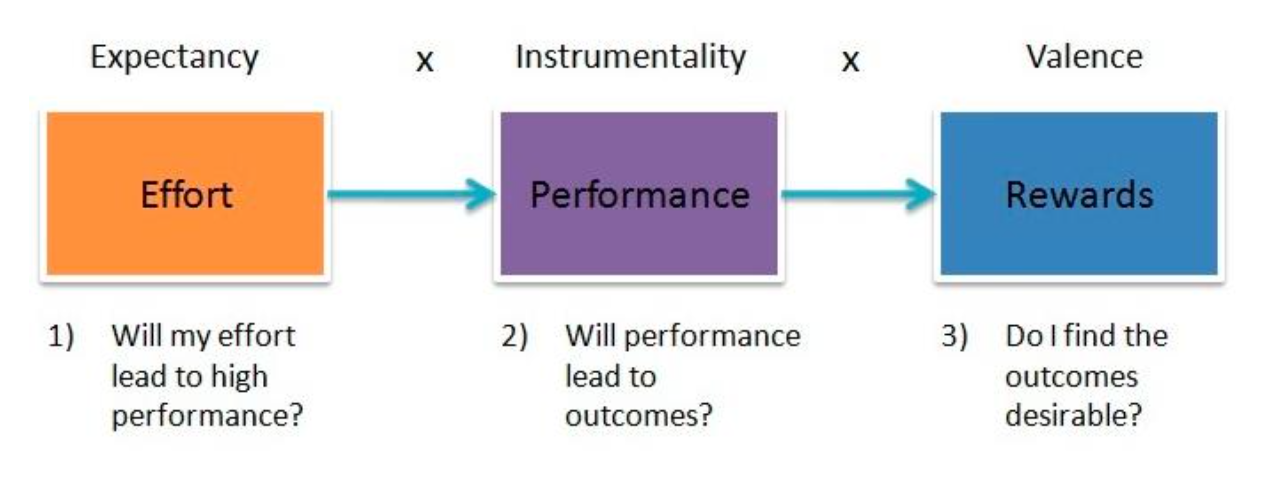
2-) Theory application: two scientific articles using this theory have to be described in terms of contribution. How are the article’s findings explained by this theory?
Porter & Lawler have emerged weaknesses of expectancy theory. So far they have emerged difficulties of using this theory practically and they have questioned on accuracy of scientific measurements which used in expectancy theory.
Porter & lawler used Vroom’s Expectancy theory as a foundation to develop their expectancy model. Similar to Vroom’s theory, Porter & Lawler concluded that an individual’s motivation to complete a task is affected by the reward they expect to receive for completing the task.
However Porter & Lawler introduced additional aspects to the expectancy theory
According to porter and Lawler, simplicity of the expectancy theory of motivation is a one of major criticism. Under the expectancy theory, it doesn’t explain individual’s different levels of efforts which they acted out.
Another default is, in this theory it assumes employees are encouraged by rewards to expand greater efforts obtaining the reward, But it has neglected reward may cause for a negative effect for the individual. As an example, by increasing his/her payment he/she may have to afford a higher tax payment.
To conclude , Porter and Lawler introduced additional aspects to the expectancy theory as they felt that Vroom’s theory was too simple.
3) Managerial recommendations: how can this theory be used in companies? Give concrete examples.
As managerial recommendations , companies could :
• PROVIDE A REASONABLE CHALLENGING ASSIGNMENT FOR THE EMPLOYEES, IN LIGHT OF THEIR SELF-CONFIDENCE, ABILITIES, EDUCATION, TRAINING, SKILLS, AND EXPERIENCE : This would be
achieved by attempting to strike a balance with the employees, where they perceives that the goals are manageable and yet stretching. Also by demonstrate both the imagination and initiative, especially in cases where the nature of the job dictates a series of routine and potentially monotonous activities.
• BY CAREFULLY CONSIDERING THE ABILITY OF THE EMPLOYESS KNOWING THEY BRING TO THE JOB DIFFERENCES IN EXPERIENCES, TALENTS, SKILLS, KNOWLEDGE, TRAINING, AND EDUCATIONAL LEVELS:
Understanding fully well that should employees perceive that he or she lacks the capacity to carry out the duties associated with the task: the motivational levels will
decline. Therefore, Proper diagnoses will be carried out not only to check the employee’s ability to perform the job at hand, but also in assessing their perception in these regard. After this, further educating training, and experimental programmes will be carried out for them.
• RECOGNIZE THAT EMPLOYEES DIFFER SIGNIFICANTLY REGARDING THEIR LEVELS OF SELF-ESTEEM AND SELF-CONFIDENCE WHEN ATTACKING A TASK:
Knowing full well that each individual assesses the probabilities associated with different courses of action in relation to outcomes that ratify perceptions of the self- concept. That people choose tasks that promises to provide feed-back congruent with their self-image. Employees with low esteem will probably lack the confidence to choose stretching goals. These must be recognised and employees should be helped in their developmental efforts. In these regard, spending time encouraging the employees as they try to achieve a desired level of performance.
• UNDERSTANDING THAT FOR MANY EMPLOYEES, THE EXPENDITURE OF EFFORTS ON THEIR PARTS LEADS TO SATISFACTION ON JOB:
Understanding that individuals wish to feel productive, involved, useful and competent. Creating an avenue where the job serves as a vehicle for the expression of the employee’s needs. Therefore, reinforcing the organizations feelings in the employees whenever possible in an effort to strengthen them ensures that the employees understand the importance of their work in fulfilling the organizations
vision. When employees get full satisfaction from performing meaningful work, motivational levels will improve.
• ENSURING EMPLOYEES RECEIVE FAIR TREATMENTS IN A PREDICTABLE MANNER:
• ADOPTING A STERN AND HONEST ATTITUDE WHILE COMMUNICATING WITH THE EMPLOYEES
• EXPANDING A SIGNIFICANT AMOUNT OF EFFORT TO ENSURE AN ALIGNMENT BETWEEN THE PERSONAL GOALS OF THE EMPLOYEES AND THOSE OF THE ORGANISATION: Determining the employees interest, aspirations and goals of both a short and long term nature, and by creatively framing the organizational vision in such a way that the employees perceive congruency between personal and organizational end would in the long run lead to improve motivational levels among
REAL CASE :
As an example , we can discuss the Apple Inc. strategy , they has always been considered the most innovative and admired company in the world. They reveal that the employees’ motivation is a key success factor. So, their employees are given incentives and rewards in order to sustain high motivation and foster creative thinking.
Apple Inc., for instance, rewards its employees by giving them a recognition bonus of 3% to 5% of their base salary, unless they fail to achieve their target. Obviously, they try to sustain employee’s motivation and commitment. Apple Inc.’s employees will receive a free iPod Shuffle or iPhone as a reward for their accomplishments.
As of July 2012, Apple Store employees have gotten pay raises of up to 25 per cent of their salary because of great performance. In addition, Apple CEO Tim Cook created a discount system. Under the new system, Apple Inc. employees received $500 off of a Mac or $250 off of an iPad. This discount, which can be used every three years, is available to all employees who have worked for the company for at least 90 days. Employees are also always getting a fixed 25 per cent discount on Apple hardware.
Apple Inc. is a good example of an organization that is not only capable of motivating employees to do some achievement, but also of making them willing to do. Apple Inc. fosters both intrinsic and extrinsic motivation through organizational factors such as a culture that encourages commitment that recognises employees’ achievements and value by offering financial and non-financial incentives. A successful company always embrace a total reward system that incorporates both financial and non-financial incentives. This is exactly what Apple Inc. has done and this approach is proven to be effective.
Expectation Disconfirmation Theory
(content created by Pauline Giraudeau)
1) Theory description: What does it explain or suggest? Who proposed it? When was it proposed? Where (field [e.g. marketing] or subfield [e.g. branding, international marketing]) Is it mainly used?
Expectation Disconfirmation theory explains the degree of satisfaction and conformity observed for the buying or usage of a product or brand compared to the expectations and predictions made on this product or brand before buying or usage (expectations regarding the performance, attributes, or value for example). These expectations are made on the basis of previous beliefs and information. If an expectation is not met, or poorly met we talk about negative disconfirmation, on the other hand if the product performs better than what was expected we talk about positive disconfirmation. Finally, if the expectation is simply met, we talk about confirmation.
This theory was proposed and developed by Richard L. Oliver in 1977 in a scientific article name “Effect of Expectation and Disconfirmation on Postexposure Product Evaluation: An Alternative Interpretation”. However, this notion of expectation and confirmation, and the idea of reaction to discrepancy, had already been studied by Anderson in 1973.
The Expectation Disconfirmation theory was initially used in the psychology and marketing fields, but since that it has been adopted in other scientific subfields, such as consumer behaviour analysis.
2) Theory application: two scientific articles using this theory have to be described in terms of contribution. How are the article’s findings explained by this theory?
Ioannis Evangelidis and Stijn M.J. Van Osselaer (2018) “Points of (Dis)parity: Expectation Disconfirmation from Common Attributes in Consumer Choice”:
In some product categories, products share common features, even if they differ on several ways (brand, prices, attributes). For example, in the laptop market, several products can have the same processor, and be sold at a different price.
This scientific article study how the fact to communicate or not about a common feature that a product of a given brand share with another competing brand can influence the consumers’ choice based on their first expectation of the product and their post evaluation of the product regarding the feature. Among other theories, they used Expectation Disconfirmation Theory to develop their hypotheses. They ran seven studies to test their hypotheses.
In terms of contribution, this article is adding insight to consumer satisfaction theories based on expectation, by showing that consumer’s choice is affected by his expectations beyond the satisfaction regarding the product after the purchase. It means that the expectation disconfirmation process can also have an impact on the scale of individual feature of a product and can occur in evaluating the product before buying it. It also highlights that this theory could also have an important impact, not only in re-buying decisions but also in trying decisions.
Regarding the practical implications, this study brings interesting insights for managers in their positioning strategy and their product policy. Choosing to communicate or not on common attributes of our product with competitors’ products is a real strategy and must be decided according to price positioning (e.g. a cheaper brand than its competitor for a product with a common attribute valuated by consumers should communicate on this feature), but also according to the nature of the attribute
Different strategies of brand to promote the unique features of their product or to bring the consumer to a comparison list to make in perspective common features with competitors and lead to a comparison.
Chinho Lin, Yu-Huei Wei and Watcharee Lekhawipat (2017) “Time effect of disconfirmation on online shopping”:
This scientific article aims at understanding better consumer’s behaviour for online purchase and re-purchase, taking time variable into account. To do so they use Expectation Disconfirmation theory to measure the impact of disconfirmation on the relation between the expectations of customers and their intention to repurchase a product over time.
Using a longitudinal study, the researchers found out that the association of expectation with satisfaction and the association of satisfaction with repurchase intention are positively correlated regardless of the time. Expectations have a negative impact on disconfirmation in both in first stage and second stage time, but disconfirmation has a positive impact on satisfaction for both times. Regardless of time, there are also important postponement effects regarding expectations, satisfaction, and intention to repurchase. Moreover, they demonstrate that disconfirmation has a moderating effect on the relationship between expectations and satisfaction in the second time stage. Finally, they show that the expectations, the satisfaction, and the re-purchase intention are more strongly associated at time t than at time t+1.
These results show that by gaining experience in online shopping, consumers use disconfirmation to formulate their re-purchase intentions, according to their degree of satisfaction. It is also one of the first study to demonstrate that disconfirmation has a moderating effect, and customer behaviour change over time in online shopping context.
This study aims helping managers to increase conversion rate and customer retention for online shopping. Online marketing managers thus have to improve the performance to increase customer satisfaction by creating a positive disconfirmation. This will likely lead the customer to re-purchase, become loyal, and spread a positive WOM.
3) Managerial recommendations: how can this theory be used in companies? Give concrete examples.
As seen in the two previous scientific articles, Expectation Disconfirmation theory effects on customer behaviour should be considered by managers in order to improve several levels of their strategy and attract new customers, retain them and increase sales.
Firstly, brands can use these insights to improve or adapt their positioning strategy compared to their competitors to meet customers’ expectations and positive disconfirmation, and thus differentiate their image and their product by offering a superior performance.
Managers could also use this information to improve their customer relationship management. In fact, by understanding better customers expectation, the brand can work on product features and focus on the ones that are the most valued by customers. By doing so they could increase the positive disconfirmation effect and thus customers’ satisfaction and start a loyal relationship with them. This could also lead to increase the customer lifetime value and the net promoter score of the brand, and in the end attract new prospects. These adaptations of the product could also be done through the promotion of the product, by identifying some keywords.
Adapting the promotion of the products would of course depend on the positioning of the brand, a brand positioned as low prices product, is perceived as a brand with a lower performance, in this case it would be better not to communicate over performance message, in the sense that it would increase the probability of negative disconfirmation and in the end lower the customer satisfaction and re-purchase intention. It is a balance marketing managers should find according to their product and positioning to maximise the perfect balance between customers’ expectations and the actual disconfirmation, the goal being to generate a positive disconfirmation to increase satisfaction over competitors products.
Functional Theory of Attitude
(content created by Aude Grevillot)
Nowadays, in our world, we can see that consumers are characterized by different behaviors. Especially in the field of marketing, behaviors are related to different factors, influencing the consumption of each one. It is therefore important to be able to be aware of what influences consumers to behave in one way or another. Various researchers have been studying this question over the last few decades. Nevertheless, one researcher has distinguished himself by analyzing attitudes.
In 1960, Daniel Katz, an American psychologist, distinguished himself from the world of research with his new behavioral approach, called “Functional Theory of Attitude”. This theory evokes the link between attitude and behavior. According to him, attitudes lead individuals to behave in a particular way towards something. This attitude describes how people behave and why they are more attracted to one thing or another.
The functional theory of attitudes proposes how attitudes facilitate social behavior. It explains that attitudes are part of the psychological functioning of individuals but also because they are crucial. Attitudes are present because they fulfill a certain function for the person. They are determined by a person’s motivations. Consumers who will have to process similar information in the future will be led to form anticipated attitudes. Attitudes would not exist if they were not useful to people. A consumer who is used to seeing a situation happen again will develop an attitude of anticipation of when it will happen.
This theory is useful in the field of marketing for the study of consumer behavior, for example, through consumer psychology. However, it can also be very useful in the field of neuromarketing.
Thanks to this theory, it is possible to classify products into 4 functions:
-
Utilitarian or Adjustment function: It is related to the elementary principles of reward and punishment, just as for a product that arouses desire or disgust.
-
Value-expression function: It reflects and communicates the core values and identity of an individual. These are values specific to consumers and to one’s self-image. It is very useful in lifestyle analysis. For example, Mont Blanc pens that express a certain taste for luxury.
-
Ego-defensive function: It is related to the protection from external threats. For example, a brand of deodorant that emphasizes the psychological inconvenience of smelling bad. Or on the contrary, a men’s perfume linked to virility (ex: “Eau Sauvage de Dior”).
-
Knowledge function: It is related to the ease of understanding the environment. Some attitudes result from a need for meaning and structure.
Several researches have been carried out during the last few years based on this theory. Some of them aim to evaluate the influence of the Functional Theory of Attitude on different factors.
- Article 1: Functional theory of attitude, Self-monitoring and Brand prominence: an analysis over advertising assessment; VALTER AFONSO VIEIRA; 2016
The objective of this research is to highlight a link between functional attitude theory, self-monitoring theory and brand prominence that could explain consumers’ evaluation of advertising. This article therefore presents the link between several theories, including Daniel Katz’s theory, and advertising assessment.
Thanks to this study, it has been shown that there is an interactive effect between the functional theory of attitude and brand prominence. The brand image has an influence on the evaluations that consumers make and therefore has an impact on loyalty and purchase intention through advertising. This result is also based on the attitude of value expression. There is also a link between the functional theory of attitude and self-control. This point highlights the idea of perceived value. As the theory explains, the intention to buy is linked to the consumer’s attitude. This result is therefore completely in line with the theory and confirms the result obtained.
The results of the article are explained by this theory by the fact that attitudes have an impact on purchase intention while influencing advertising through advertising, just as Daniel Katz mentioned in 1960.
Article 2 : Applying the Functional Theory of Attitudes to Understanding the Influence of Store Atmosphere on Store Inferences ; ANN E. SCHLOSSER ; 1998
The goal of the research is to demonstrate the link between the Functional Theory of Attitude and Store Inferences through the atmosphere of a store. Indeed, this article explains how the theory can be linked to the social appeal of the store through a pleasant atmosphere. It therefore presents the impact of the psychological perception of the atmosphere on consumer behavior. The two experiments carried out were presented by the type of social and utilitarian products evaluated and by the degree of information provided by the store.
Thanks to this study, it has been proved that the atmosphere of the store influences the perceptions of social identity products. On the contrary, store atmosphere has little effect on perceptions of utilitarian products. Nevertheless, the store atmosphere did elicit different motivations and purchase intentions.
The results of the article are explained by this theory by the fact that according to the functional theory of attitudes, arguments are more convincing as they refer to the processes that influence the behavior of transformation. If the atmosphere of a store has an impact on the appeal of social identity, then an aesthetically pleasing atmosphere has a positive influence on the perception of the quality of social identity products but not of utility products.
Functional Theory of Attitude can also be very useful in a company. Indeed, marketers can study consumer behaviors thanks to this theory. They will then be able to exploit the results and thus adapt their communication, the very popular advertising products. By focusing these products on the expression of value and people with less self-control, this will further influence purchase intent.
This theory helps marketers to understand the psychological aspect of buying behavior. It is an opportunity to understand the mind of consumers so that they adapt their messages to the developed attitude. Indeed, the more the consumer’s attitude is understood by marketers, the better the message will be perceived. The consumer develops attitudes which then develops his buying behavior. This is why it is important for companies to understand the consumer through this theory. Indeed, the goal of marketers is to know their consumers in order to develop their strategy to make the best decisions in communication or marketing. Thus it is possible to study the products facing the attitudes but also the identity of the products facing the consumers. These attitudes are also closely related to the feeling of belief or behavior such as the intention to buy for example.
Today’s consumers are in a phase of perpetual change, they no longer allow themselves to be guided only by products but also by external factors (feelings, influences, perception…) which have a direct influence on their behavior. Thanks to the fact that attitudes influence behavior through the factors previously seen (Utilitarian, Value-expression, Ego-defensive function, Knowledge function), companies can offer themselves new ways of analyzing behavior. This allows them to implement new strategies that are much more in line with the customer profile.
Moreover, for several years now, the expansion of product ranges has been influencing consumer choice. This theory is therefore important because the consumer is faced with a dilemma of product choice. This is why it is important for companies to understand their consumers in order to offer them the right product in relation to their psychological consumer attitudes.
-
To give a concrete example, let’s take the example of an American baseball jersey retailer. The company will be able to use the Functional Theory of Attitude to learn how to make it work for its products, but more importantly, for whom its products are intended. The retailer will then be able to understand the effect of its products on the consumer and thus increase, for example, its communication and advertising to best address the consumer. The retailer must especially focus on the “Utilitarian or Adjustment function”, one of the functions of the Functional Theory of Attitude. Indeed, he will have to address the right message to the right person. In this case, the consumer uses attitudes to maximize rewards and minimize punishment. The consumer will therefore buy a baseball jersey from the retailer. This jersey will be that of his favorite team, because the consumer is more inclined to buy a baseball jersey of his favorite team, to be able to better integrate into society and to connect with others. In order to reach this baseball fan, the retailer will have to send him the right publicity when he goes, for example, to see a game in a baseball stadium.
This retailer can learn from consumers and their utilitarian function of attitudes in several ways. This fan believes that today he must match the expectations of others in society, with this jersey he will be able to blend in perfectly during a game for example.
The consumer also knows that his baseball jersey has created a consumer culture and expectations among baseball fans. Thanks to this jersey vendor offering such a utilitarian attitude towards this jersey fan, he will surely be able to surpass his competitors and thus bring the consumer to be loyal to the brand. -
Another example could be the “Société Protectrice des Animaux” (SPA). This organization could use the Functional Theory of Attitude to get more donations. Indeed, Value-expression Function allows consumers to express their core values, self-concept and beliefs to others. This is why the SPA could take advantage of people around the world who have good intentions towards animals and who would like to have an impact in this society. If the SPA is able to properly reach and target people who love animals and have a valuable attitude, then this organization will get more donations to support the animal cause.
General Theory of Marketing Ethics
(content created by Yann Guebel)
1. Theory description
Ethical problems in research were, until the beginning of the 1980’s, problems linked to philosophy and morality, and were studied in order to understand how to put marketing in accordance with morality as a whole. In 1986, Shelby D. Hunt and Scott Vitell publish in the Journal of Marketing Research, an article called A General theory of marketing ethics, a theory explaining the decision-making process that leads individuals to apprehend certain types of issues involving ethical problems. The research is composed of two aspects of the decision, that is the deontological or rule-based decision and the teleological, that is the consequences- based dimension. Once the two aspects are addressed, the paper identifies a model that allows for a better description of the process undergone by researchers when doing marketing research and helps understanding the basics of marketing ethics.
This theory is mainly used at the top levels of marketing, before or while marketing is even done. It helps formulate the marketing campaign and describes what can influence the marketers while they are creating a marketing campaign, how they chose to present the products regarding their induvial values and moralities. This theory is important because it helps understand the fundamentals of marketing and the way it is designed by people for people, and that it is meant to please the mass and therefore be the most diverse possible. This also shows how individuals themselves show their morality and obey to their ethics and how it can impact their work because all of their induvial choices.
2. Theory application
The General theory of marketing ethics paved the way for many different studies in order to provide empiric data. The authors themselves tried to use the different data and feedbacks from their peers in order to reedit their work and to put it up to date with the news regarding their theory. They also tried to expand their theory to the customers. This is what they published in September 2012, in Handbook of Marketing Ethic, in an article named The General Theory of Marketing Ethics: The Consumer Ethics and Intentions Issue. The paper asks to question: “Is the H-V theory a consumer ethics theory?” and “Are intentions a valid predictor of behavior?”. They answer they give to the first question is that their theory proved to be working for customers, using a similar pattern as the one used for market researchers. Although they already proved it in another article of 1993, they show that it is relevant to use their model at this purpose and in order to better understand the customers. They see their pattern as a way to lead marketing research experiments and qualify their pattern as well- suited for the task. By doing so, they put the emphasis on the fact that knowing the customers ethics is very important for marketers and that it is crucial for marketing researchers to investigate more about the ethics and driving factors of the customers, by using their pattern for instance. As for the second question, it appears that intentions are predictor of behaviors, but this aspect has to be reviewed and tested again in order to show proof of its usability in normal life and not within the spectrum of given tests where people tend to act differently and show more ethics than on a regular basis.
The theory of ethics is also used by Leslie J. Vermillon, Walfried M. Lassear and Robert D. Winsor in their work The Hunt-Vitell general theory of marketing ethics: Can it enhance our understanding of Principal-Agent relationships in channels of distribution? published in December 2002 in the Journal of Business Ethics. This paper aims to emphasize the fact that an ethical marketing framework can be used in order to deepen and strengthen the relationship between customers and marketing researchers. The paper concludes that in distribution and sales, the sue of ethics is very important and helps creating value for the company the same way or even better than by using economic frameworks. Relationship and the way one behaves in front of one another is a good way to build relationship and to secure an income. This relationship becomes “mutually beneficial” and is highly valued and important. This theory uses the capacity of the Hunt-Vitell framework to measure the degree of involvement and ethics put into a relationship and how ethics play a significant role into building a long-term and profitable relationship.
3. Managerial recommendations
The General theory of marketing ethics allows for a variety of recommendations.
-
– First, one recommendation is the fact that it is important for companies to be involved in the conception of their marketing research and to try to comprehend the best way possible their customers but also their driving motives and beliefs. It is important that a collaborator belongs to the same state pf mind of the company as their ethics could differ from the ones of the company and therefore undermine the group coordination. On the other hand, bringing diversity but tolerance to the company could allow for a broader point of view regarding marketing matters and the ethics put in place. So, recruiting people with the capacity to respect others will sharing their values and opinions would favorize the brand in front of its customers and would allow the
company to understand them better.
-
– Second, as shown by the theory application, it appears that the theory is usable and
efficient when used on customers. It is crucial that companies use their means in order to finance more investigations about their clients. If a company can understand the purchase intention regarding a certain type of article, the company must have the feedbacks of the why people want to buy the product in order to better advertise it if it is relevant. Therefore, financing better market research seems to be useful for companies, but these researches need to use the framework of the H-V Theory in order to ensure the ethical aspect of their research and their impact on the customers.
-
– Thirdly, using the ethical framework also helps companies to ensure and maintain long-term agreements and relationships. It is crucial for companies to educate their salespersons and their relationship workers in order to make them understand and value the ethics of sales but also the ethics of their interlocutor in order to maintain these relationships. Formation here seems to be the key.
1. Theory description
Ethical problems in research were, until the beginning of the 1980’s, problems linked to philosophy and morality, and were studied in order to understand how to put marketing in accordance with morality as a whole. In 1986, Shelby D. Hunt and Scott Vitell publish in the Journal of Marketing Research, an article called A General theory of marketing ethics, a theory explaining the decision-making process that leads individuals to apprehend certain types of issues involving ethical problems. The research is composed of two aspects of the decision, that is the deontological or rule-based decision and the teleological, that is the consequences- based dimension. Once the two aspects are addressed, the paper identifies a model that allows for a better description of the process undergone by researchers when doing marketing research and helps understanding the basics of marketing ethics.
This theory is mainly used at the top levels of marketing, before or while marketing is even done. It helps formulate the marketing campaign and describes what can influence the marketers while they are creating a marketing campaign, how they chose to present the products regarding their induvial values and moralities. This theory is important because it helps understand the fundamentals of marketing and the way it is designed by people for people, and that it is meant to please the mass and therefore be the most diverse possible. This also shows how individuals themselves show their morality and obey to their ethics and how it can impact their work because all of their induvial choices.
2. Theory application
The General theory of marketing ethics paved the way for many different studies in order to provide empiric data. The authors themselves tried to use the different data and feedbacks from their peers in order to reedit their work and to put it up to date with the news regarding their theory. They also tried to expand their theory to the customers. This is what they published in September 2012, in Handbook of Marketing Ethic, in an article named The General Theory of Marketing Ethics: The Consumer Ethics and Intentions Issue. The paper asks to question: “Is the H-V theory a consumer ethics theory?” and “Are intentions a valid predictor of behavior?”. They answer they give to the first question is that their theory proved to be working for customers, using a similar pattern as the one used for market researchers. Although they already proved it in another article of 1993, they show that it is relevant to use their model at this purpose and in order to better understand the customers. They see their pattern as a way to lead marketing research experiments and qualify their pattern as well- suited for the task. By doing so, they put the emphasis on the fact that knowing the customers ethics is very important for marketers and that it is crucial for marketing researchers to investigate more about the ethics and driving factors of the customers, by using their pattern for instance. As for the second question, it appears that intentions are predictor of behaviors, but this aspect has to be reviewed and tested again in order to show proof of its usability in normal life and not within the spectrum of given tests where people tend to act differently and show more ethics than on a regular basis.
The theory of ethics is also used by Leslie J. Vermillon, Walfried M. Lassear and Robert D. Winsor in their work The Hunt-Vitell general theory of marketing ethics: Can it enhance our understanding of Principal-Agent relationships in channels of distribution? published in December 2002 in the Journal of Business Ethics. This paper aims to emphasize the fact that an ethical marketing framework can be used in order to deepen and strengthen the relationship between customers and marketing researchers. The paper concludes that in distribution and sales, the sue of ethics is very important and helps creating value for the company the same way or even better than by using economic frameworks. Relationship and the way one behaves in front of one another is a good way to build relationship and to secure an income. This relationship becomes “mutually beneficial” and is highly valued and important. This theory uses the capacity of the Hunt-Vitell framework to measure the degree of involvement and ethics put into a relationship and how ethics play a significant role into building a long-term and profitable relationship.
3. Managerial recommendations
The General theory of marketing ethics allows for a variety of recommendations.
-
– First, one recommendation is the fact that it is important for companies to be involved in the conception of their marketing research and to try to comprehend the best way possible their customers but also their driving motives and beliefs. It is important that a collaborator belongs to the same state pf mind of the company as their ethics could differ from the ones of the company and therefore undermine the group coordination. On the other hand, bringing diversity but tolerance to the company could allow for a broader point of view regarding marketing matters and the ethics put in place. So, recruiting people with the capacity to respect others will sharing their values and opinions would favorize the brand in front of its customers and would allow the company to understand them better.
-
– Second, as shown by the theory application, it appears that the theory is usable and
efficient when used on customers. It is crucial that companies use their means in order to finance more investigations about their clients. If a company can understand the purchase intention regarding a certain type of article, the company must have the feedbacks of the why people want to buy the product in order to better advertise it if it is relevant. Therefore, financing better market research seems to be useful for companies, but these researches need to use the framework of the H-V Theory in order to ensure the ethical aspect of their research and their impact on the customers.
-
– Thirdly, using the ethical framework also helps companies to ensure and maintain long-term agreements and relationships. It is crucial for companies to educate their salespersons and their relationship workers in order to make them understand and value the ethics of sales but also the ethics of their interlocutor in order to maintain these relationships. Formation here seems to be the key.
-
Goal Setting Theory
(content created by Tiphaine Guénec)
The “Goal setting Theory” is one of the many theories related to motivation. It was written by Edwin Lock in the 1960s. It tries to explain how specific and challenging goals, linked to adequate feed- back, can improve and increase task performance.
In this way, and to keep it simple, clear objectives help guide the employer on the tasks that need to be accomplished and the efforts that need to be made to accomplish them.
The theory can be characterized along three axes:
-
The main source of professional motivation is the will to work towards the achievement of the objective. Easy, general and vague objectives are less important motivating factors than clear, specific and difficult objectives.
Indeed, the latter lead to greater production and better performance. This also helps to avoid misunderstandings. -
Goals should be clear, specific, realistic, attainable and challenging in a way that gives the in- dividual a sense of pride and triumph when they are achieved, and prepares them for the next goal. The more challenging and realistic the goal is, the greater the personal benefit to be gained and the greater the passion, willingness and motivation to achieve it.
-
There must be feedback on the results because it will guide the employee’s behavior and con- tribute to better performance.
Feedback is a way to gain recognition, even a reputation in some cases, but also to clarify situations and resolve complications related to the achievement of the objective.Articles :
-
New Directions in Goal-Setting Theory , Edwin A. Locke1 and Gary P. Latham2 (1) R.H. Smith School of Business, University of Maryland
(2) Rotman School of Management, University of TorontoIn this article, “Goal-Setting” can be used in all areas where an individual or group has potential or direct control over outcomes. It also explains the relationship of traits (passion (desires) and tenacity), vision, goals and personal effectiveness to small business sales and employment growth, with a graphic.
-
Goal-Setting Theory of Motivation, Fred C. Lunenburg, Sam Houston State University
This article highlights the fact that Individual Goal-setting is not as important as Group Goal-setting. Moreover, it also relates the importance of deadlines, which are truly perceived as factors of high motivation and allow for regular reviews of the situation regarding the achievement of goals. Finally, objectives are most effective when used to assess performance.
Managerial contributions of the theory :
In the work mode, this is a technique used to encourage employees to do their work quickly and efficiently, avoiding clumsiness or misunderstandings.
It logically leads to better performance by increasing motivation and effort, but also by increasing and improving the quality of feedback. Moreover, according to Lock, managers have to give : clarity, chal- lenge, commitment, feedback and explain task complexity (it means give accurate time to do this task as well) to make better efficiency. By the way, this theory is really good to help people doing their best and achieve high expectation/objectives.
In this way managers can first identify the purpose of the goal, then meet employees, using the SMART model to develop a plan, make sure that all employees have all they need to achieve this goal and give them regular feedback.
Nevertheless, this theory has limitations in its study : if management and the organization are trying to achieve goals that are difficult to achieve, then performance may decrease due to incompatible actions.
Objectives that far exceed an employee’s abilities and skills can most likely have a negative effect on the employee’s performance and motivation to achieve the objective, which explains why some em- ployees become less efficient and less committed to their work.
More complex and difficult goals can lead to risky behavior in trying to achieve the goals on time.
Heuristic-Systematic Model
(content created by Yilu Hao)
1) Theory description: What does it explain or suggest? Who proposed it? When was it proposed? Where (field [e.g. marketing] or subfield [e.g. branding, international marketing]) Is it mainly used?
-
The heuristic-systematic model of information processing (HSM) attempts to
explain how people receive and process persuasive messages.The model states that individuals can process messages in one of two ways: heuristically or systematically.
-
The developer and main researcher of the HSM was Shelly Chaiken. Under her direction, the HSM has undergone several major revisions. As she noted in 1980 and 1987, the model specified the two modes of heuristic and systematic processing.
-
Research into information processing, especially in persuasive messaging, has a natural application in advertising. For instance, HSM has been used in Internet webpage considerations.The HSM has also been applied in medical decision-making contexts.
2) Theory application: two scientific articles using this theory have to be described in terms of contribution. How are the article’s findings explained by this theory?
Article 1: Using a Heuristic-Systematic Model to assess the Twitter user profile’s impact on disaster tweet credibility.(www.elsevier.com/locate/ijinfomgt)
Drawing on HSM as the theoretical lens, this study is the first to view Twitter’s information as both systematically processed information (tweets) and heuristically processed information (twitters). This study offers an important test case for using the HSM as a means to explore other crucial issues related to disaster communication in online media.
Article 2: Examining the influence of online reviews on consumers’ decision-making: A heuristic–systematic model.(www.elsevier.com/locate/dss)
They provide a more detailed examination on the effects of systematic and heuristic factors. As such, this research can contribute to a better understanding of how online reviews exert influence in both theory and practice.
In addition, They find that source credibility and perceived quantity of reviews (heuristic factors) have direct impacts on purchase intention. The two heuristic factors further demonstrate positive influences on argument strength. This result is consistent with the proposition of bias effect in the heuristic–systematic model, which elucidates the interrelationship between heuristic and systematic factors. Based on those findings, they discuss implications for both researchers and practitioners.
3) Managerial recommendations: how can this theory be used in companies? Give concrete examples.
This model can be use in the process of companies’ web design. The company can know which characteristics of a website were highly valued by use the heuristic-systematic model to test a amount of websites.
The company can recruit some people to participate in the test, observe the characteristics of the web pages that participants like to choose, and summarize them. For example, websites with official domain extensions (e.g., .gov) were considered more likely to have desirable characteristics. Then the company can according to these characteristics to design their own website page. It can help companies get more consumers attention.
Information Integration Theory
(created by Catherine Havé)
General information about the Information Integration Theory (IIT)
The Information Integration Theory (IIT) was proposed by Norman H. Anderson, a cognitive psychologist, in 1981. This theory is mainly used in marketing, communication and psychology and especially in subfields like person cognition, cognitive development, decision theory and language processing. The theory is founded on empirical evidence and, what might be a bit unusual, relies on algebraic models.
His theory explains how attitudes are formed and changed through the integration (for example mixing or combining) of new information with the existing knowledge, thoughts and cognitions. It explores the fact, that when people perceive new information, the new pieces of this will influence and affect our attitudes, but they will not replace our existing point of views. The theory helps to evaluate unobservable psychological processes involved in the making of judgements: An individual integrates information from two or more stimuli and develops a quantitative value.
In this theory a message is considered as fragments of information and each of these relevant pieces has two characteristics/qualities: value and weight. The value of the part of the information is equal to its evaluation (favorable or unfavorable) and the weight explains the information’s perceived importance. Both factors affect our opinions and mindset: information with a high value and high weight will have more influence on our attitudes than messages which are unfavorable and not important. The Information Integration Theory underlines that with new positive information, negative attitudes tend to become less negative and positive attitudes become even more positive.
The information integration process has three unobservable stages:
- – Valuation : In this first stage the stimuli are interpreted. It is the process of extracting important information from a physical stimulus translated into a psychological value: How individuals process the new information how they conclude.
- – Integration: The pieces of the new information are integrated psychologically. The cognitive algebra concept is part of this stage: It explains how the mind of the individuals are multiplying, averaging, subtracting, or adding stimuli/information together to arrive at a final conclusion.
- – Construction of the response: the concept of functional measurement helps to finally “produce” thanks to the valuation and the integration a numerical response. It refers to the process by which internal impressions are converted into an apparent and observable response.
This graphic illustrates the process:
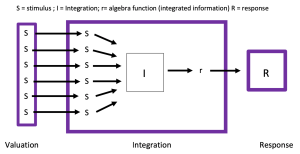
In conclusion IIT is a process whose target is to extract specific quantitative values from the decision and judgmental process of the evaluators: how multiple sources are incorporated, combined and finally result in a single quantifiable response.
Theory application: the IIT in academic articles
The Information Integration Theory is used in different academic articles to give theoretical frameworks, to contribute to researches and to help explaining results and findings.
A first article in which the ITT is applied is Integrating Advertising and Publicity from Kim, Yoon and Lee, published 2013 in the Journal of Advertising. This article investigates the integration effect of advertising and publicity with the purpose to explain the applications of an integrated marketing communication. In order to analyze the synergistic effect generated between advertising and publicity it describes the multiple benefits of different communication tools delivering a unified message. Together with the Integrated Information Response Model (IIRM; Smith and Swinyard 1982), contrast theory (Hovland, Harvey and Sherif 1957) and the confirmation effect (LaBella and Koehler 2004), the IIIT gave the theoretical framework for understanding the collective effect of advertising and publicity and was used to propose and test the hypotheses of the research. Two parts of the Information Integration Theory helped explaining the results. Primarily, the average model of the ITT explained the fact that a consumer’s attitude toward the brand after being exposed to advertising and publicity is equal to the average of the “attitude based on an ad” and the “attitude based on a publicity”. Furthermore, the characteristic “weight” of an information in the ITT (= information’s perceived importance) plays an important role in explaining the results of Kim, Yoon and Lee. It is expected that a consumer will deduct the weight of advertising and publicity if it is contrary to what they were exposed in an earlier stage.
Theory application: the IIT in academic articles
The Information Integration Theory is used in different academic articles to give theoretical frameworks, to contribute to researches and to help explaining results and findings.
A first article in which the ITT is applied is Integrating Advertising and Publicity from Kim, Yoon and Lee, published 2013 in the Journal of Advertising. This article investigates the integration effect of advertising and publicity with the purpose to explain the applications of an integrated marketing communication. In order to analyze the synergistic effect generated between advertising and publicity it describes the multiple benefits of different communication tools delivering a unified message. Together with the Integrated Information Response Model (IIRM; Smith and Swinyard 1982), contrast theory (Hovland, Harvey and Sherif 1957) and the confirmation effect (LaBella and Koehler 2004), the IIIT gave the theoretical framework for understanding the collective effect of advertising and publicity and was used to propose and test the hypotheses of the research. Two parts of the Information Integration Theory helped explaining the results. Primarily, the average model of the ITT explained the fact that a consumer’s attitude toward the brand after being exposed to advertising and publicity is equal to the average of the “attitude based on an ad” and the “attitude based on a publicity”. Furthermore, the characteristic “weight” of an information in the ITT (= information’s perceived importance) plays an important role in explaining the results of Kim, Yoon and Lee. It is expected that a consumer will deduct the weight of advertising and publicity if it is contrary to what they were exposed in an earlier stage.
A second article in which the Information Integration Theory is used, is from the same author than the theory itself: Andrew T. Norman. He published 2012 in the journal Service Marketing Quarterly an information integration model of consumer evaluations and intentions. The article presents an investigation of the effects of branded products in service encounters on consumer’s evaluations and analyses how the quality of a product brand has an effect on the attitude toward and purchase intentions of the service brand. In the paper the author gives the example of a restaurant serving a coke as a beverage option. The ITT is used to answer the following research questions: “Can a service or product brand either enhance or damage its brand image by association with other brands in the service encounter? Are consumer perceptions and evaluations of service brands or product brands in the service encounter affected by such associations?”. Based on the ITT, the author can describe the process that consumer go through when considering multiple brands in a single context. This is shown in the results of the research. According to the ITT and the outcomes of the analysis, the effect of information on evaluation judgements is based on the two characteristics of this information: value and weight. Therefore, the positively perceived fragment of an information could have a strong or little/no impact based on the weight given on the information. In addition, Norman provides with this article a clearer application of the information integration theory within consumer research when information is weighted differently: It is shown that the level of quality for the service brand itself moderates the impact of “product quality on attitudinal evaluations and purchase intentions for a service brand”.
Managerial implications and recommendations
Managers in all companies can use the Information Integration Theory in order to rightly use their communication language. Clients as well as employees need to be addresses in a way that it is easy for them to understand what the company wants to tell them resp. what their managers want from them. Consequently, the ITT can be used to formulate messages and strategies that have a high value (favorable) and high importance for the target group. The marketing target should be comprehensible for everyone: the valuation function of the message should be considered, as well as the fact that the information should be integrated and should have as consequence the right response. The companies should concentrate on messages and communication that consumer value most.
As the ITT is focusing especially on person cognition and cognitive development, it can be frequently used in the department of the Human Resources. When integrating information about motivation of workers, a manager can multiply the ability of an individual by their effort.
SOURCES
Andrew T. Norman: Branded Products in Service Encounters: An Information Integration Model of Consumer Evaluations and Intentions. Service Marketing Quarterly, 2012.
Managerial implications and recommendations
Managers in all companies can use the Information Integration Theory in order to rightly use their communication language. Clients as well as employees need to be addresses in a way that it is easy for them to understand what the company wants to tell them resp. what their managers want from them. Consequently, the ITT can be used to formulate messages and strategies that have a high value (favorable) and high importance for the target group. The marketing target should be comprehensible for everyone: the valuation function of the message should be considered, as well as the fact that the information should be integrated and should have as consequence the right response. The companies should concentrate on messages and communication that consumer value most.
As the ITT is focusing especially on person cognition and cognitive development, it can be frequently used in the department of the Human Resources. When integrating information about motivation of workers, a manager can multiply the ability of an individual by their effort.
SOURCES
Andrew T. Norman: Branded Products in Service Encounters: An Information Integration Model of Consumer Evaluations and Intentions. Service Marketing Quarterly, 2012.
Jooyoung Kim/Hye Jin Yoon/Sun Young Lee: Integrating Advertising and Publicity. Journal of Advertising, 2013.
https://scholarworks.umass.edu/cgi/viewcontent.cgi?article=1143&context=dissertations_2 #:~:text=Information%20integration%20theory%20(IIT)%20was,to%20derive%20a%20quanti tative%20value.
https://en.wikipedia.org/wiki/Information_integration_theory http://www.cios.org/encyclopedia/persuasion/Finformation_integration_1theory.htm
Information Processing Theory
(content created by Xiaoxiao He)
1) Theory description: What does it explain or suggest? Who proposed it? When was it proposed? Where (field [e.g. marketing] or subfield [e.g. branding, international marketing]) is it mainly used?
Information processing theory is a cognitive theory that uses computer processing as a metaphor to help explain how the human mind functioned. During the first half of the 20th century, the field of psychology was dominated by behaviorism, while mental processes which are not directly observable were not a concern among behaviorists. Later around the 1950s, when computers came into existence, it gave some American psychologists the inspiration to explain the different processes the brain engages in, including attention and perception, which could be compared to inputting information into a computer, and memory, which could be compared to a computer’s storage space.
In 1956 George A. Miller was among the first to apply a step-by-step theory to information processing by relating it to the way that high-speed computers processed information. He proposed that, similar to a computer, the human mind takes in information, performs operations on it to change its form and content, stores and locates the information, and then generates output of some type. According to Miller’s theory, information processing in humans involves gathering and representing information (encoding), holding information (retention), and getting at the information when necessary (retrieval). In addition to comparing information processing of humans to that of computers, Miller made a significant contribution to the understanding of information processing with his concept of chunking as related to short-term memory. In his article “The magical number seven, plus or minus two: Some limits on our capacity for processing information”, he proposed that individuals could only store five to nine chunks, or meaningful units, of information in their short-term memory. Anything from digits to words to people’s faces were considered to be chunks of information. The concept of chunking was one of Miller’s major contributions, because it became a basic element of later theories of memory. In 1968, John William Atkinson and Richard Shiffrin associated with the Cognitive Information Processing Theory, proposing a multi-stage theory of memory. They explained that from the time information is received by the processing system, it goes through different stages to be fully stored. They broke this down to sensory memory, short-term memory, and long-term memory, which is the Atkinson- Shiffrin model.
Later in 1974 Alan Baddeley and Graham Hitch contributed more to the information processing theory through their own discoveries. They deepened the understanding of memory through the central executive, phonological loop, and visuospatial sketch pad. Baddeley later updated his model with the episodic buffer.
In addition to the three-stage information processing model, there are three more models that have been widely adopted, which are the levels of processing theory, the parallel-distributed processing model and the connectionist model.
This theory is mainly used in human, especially children’s cognitive and psychological development.
2) Theory application: two scientific articles using this theory have to be described in terms of contribution. How are the article’s findings explained by this theory?
Information-Processing Theory of Human Problem Solving by Herbert A. Simon from Carneige Mellon University in Handbook of Learning and Cognitive Processes (Volume 5): Human Information Processing Edited by William K. Estes
Information processing theories have provided explanations of the processes for solving relatively well- structured, puzzle-like problems commonly studied in psychological laboratory.
Problem-solving behavior is produced by a small set of elementary information processes, organized into strategies and programs. A system capable of performing these processes can solve problems and produce behavior hat closely resembles human behavior in the same problem-solving situations. The sufficiency of these elementary information processes for problem-solving has been demonstrated by constructing computer programs that simulate human behavior in considerable detail. Studying human information processes effectively calls fr a high temporal density of observations. Several techniques have proved themselves valuable for increasing this density, in particular, recording eye movements, and tape-recording verbal thinking-aloud protocols. Research is beginning to be undertaken on the methodological problems associated with the use of these kinds of empirical data.
Personality and Attitude Change: An Information-Processing Theory by William J. MC GUIRE, from Department of Psychology, University of California, San Diego, La Jolla, California in Social Psychology, A Series of Monographs, treatises, and texts edited by Leon Festinger and Stanley Schachter, the Psychological Foundations of Attitudes edited by Anthony G. Greenwald, Timothy C. Brock, Thomas M. Ostrom.
The formulation about personality relationships in the attitude change area falls under the information- processing rubric. The use of the information-processing approach involves predicting how an independent variable will be related to attitude change by analysis of that variable’s likely effect on learning the contents of the social influence communication. It is assumed that the extent to which a person is influenced by a message will be positively related to the extent to which he attends to and comprehends its persuasive content.
3) Managerial recommendations: how can this theory be used in companies? Give concrete examples.
The information processing theory can help companies better design training activities for employees: training content and methods should be adjusted according to different age groups inside the company, as humans get older, there is a trend for us to develop more sophisticated ways of acquiring, processing, and retaining information.
It can also help remind companies to pay attention to the information offered in their marketing campaigns: marketing department should decide the proper amount of key information to be put on their posters, as individuals could only store five to nine chunks, or meaningful units, of information in their short-term memory.
References:
- Miller, G.A. (1956). The magical number seven, plus or minus two: Some limits on our capacity for processing information. Psychological Review, 63, 81-97. (Available at http://www.musanim.com/miller1956)
- Miller, G.A., Galanter, E., & Pribram, K.H. (1960). Plans and the Structure of Behavior. New York: Holt, Rinehart & Winston.
- Information-Processing Theory of Human Problem Solving. Handbook of Learning and Cognitive Processes (Volume 5): Human Information Processing, 271-293. (Available at https://books.google.fr/books?hl=zh- CN&lr=&id=GpTcAwAAQBAJ&oi=fnd&pg=PA271&dq=Information+Processing+Theory& ots=6HvLmbGhA7&sig=FMfH48zHO2ka0mR- ROJhObTJZTw#v=onepage&q=Information%20Processing%20Theory&f=false)
- Bettman, James R. An Information Processing Theory of Consumer Choice. Journal of Marketing, 124. (Available at https://www.jstor.org/stable/1250155?seq=1)
- http://psychology.iresearchnet.com/developmental-psychology/cognitive- development/information-processing-theory/
- https://www.thoughtco.com/information-processing-theory-definition-and-examples-4797966
Inoculation Theory
(created by Camille Henrion)
Description of the Inoculation Theory
- Few elements about the Inoculation Theory
Who is proposed this Theory? The Inoculation Theory was formulated in 1964 by the US psychologist William James McGuire (1925–2007).
William James McGuire was motivated to study inoculation and persuasion as a result of the Korean War. Indeed, some US prisoners of war assumed that they were brainwashed. This is why, William James McGuire and other social scientists conversing resistance to persuasion.
What is the purpose of this Theory? The Inoculation Theory was proposed by McGuire (1964) in response to a situation where the objective was to persuade someone not to be persuaded by another. The Inoculation Theory is a model for building resistance to persuasion attempts by exposing people to arguments against their beliefs and giving them counter arguments to refute attacks.
- Inoculation Theory: Comparison with the health industry (e.g., Vaccination)
The Inoculation Theory is a biological metaphor. Indeed, in medicine, an individual is inoculated against a disease so that be becomes resistant to that disease. Such resistance is induced by pre-exposure of the individual. And Inoculation, in the social psychology sense, works the same way.
Indeed, the Inoculation Theory draws comparison with the process of vaccination. During vaccination, a weakened form of the virus is injected into an individual to build resistance to the disease. A similar process is used to “inoculate” an individual from attacks on his belief. According to the Inoculation Theory, a weaker dose of a contrary argument called the ‘inoculation message’ is given to people. Those people who have been exposed to the weaker argument develop a defence system that helps them to not change their minds when they are confronted with a stronger argument.
Academic articles about the Inoculation Theory
- How are the article’s findings explained by this theory?
The first article Persuading Others to Avoid Persuasion: Inoculation Theory and Resistant Health Attitudes (J. Compton, B. Jackson and J. A. Dimmock, 2016) explains that the inoculation theory of conferring resistance to persuasive influence has established effectiveness as a health communication strategy.
This article highlights the structure of inoculation-based health messages and describes the similarities and differences between this method of ‘counter-suggestion’ and other preparatory techniques commonly used by researchers and health practitioners. Finally, the article examines the contexts in which inoculation-based health messages might be most useful and describes how the health field can provide useful support for exploring the conceptual issues of this theory.
The second article A Meta-Analysis of Research on Inoculation Theory (John A. Banas and Stephen A. Rains, 2010) is a meta-analysis presenting 54 cases testing the effectiveness of inoculation theory in generating resistance and examining the mechanisms of this theory.
This article explains that these analyses reveled that inoculation messages were superior to support messages and controls without treatment to confer resistance.
Managerial implication of the Inoculation Theory
- Why this Inoculation Theory is needed?
Nowadays, people are constantly stimulated by a lot of information from different angles. There are a number of attempts being made on a daily basis to persuade people in one direction or another. Indeed, attitude change is a frequent marketing goal with some objective such as “inform people”; “create the desired attitude”, “persuade people” and so on.
A number of theoretical approaches to the prevention of attitude change – like the Inoculation Theory – have been developed. The theory offers a way in which resistance to persuasion can be achieved. Inoculation Theory could be defined as a message-oriented theory which assumes that messages have effects. This is why, this theory could be used in a variety of persuasive contexts and can be used by large company in their communication with publics.
- How can this Inoculation Theory be used in companies? g., Apple
Such companies like Apple used this Inoculation Theory when they launched for example their “Mac vs. PC” campaign. Indeed, this campaign followed the Inoculation Theory in targeting those who already preferred Mac computers. Those ads compared Macs and PCs. In that particular case, the Inoculation Theory is in action here because these commercials are more than likely aimed toward Apple users.
Those ads are effective because the Apple users already have a preference for Mac computers, and they do not want to change their mind. This comparison “Mac vs. PC” creates refutational preemption, showing Mac users that Macs is not the only option available on the market. The TV ads show some of the advantages that PCs have over Macs, but at the end of each commercial they repeat the fact that the Mac is the superior product for consumers. This comforts viewers that their opinion is still right, and that Macs are better than PCs. The use of Inoculation Theory in that campaign keep Mac users coming back for Apple products.
References
John A. Banas and Stephen A. Rains (2010). A Meta-Analysis of Research on Inoculation Theory. Communication Monographs Vol. 77, No.3 September 2010, pp. 281-311.
Josh Compton, Ben Jackson and James A. Dimmock (2016). Persuading Others to Avoid Persuasion:
Inoculation Theory and Resistant Health Attitudes. Front. Psychol., 09 February 2016.
Institutional Theory
(content created by Maxence Huck)
Theory description : What does it explain or suggest? Who proposed it? When was it proposed? Where (field [e.g. marketing] or subfield [e.g. branding, international marketing]) Is it mainly used ?
Institutional theory examines ways in which “organizational structures, norms, practices, and patterns of social relationships … are connected to the broader social and cultural environment” (Anagnostopolous et al., 2010).
Institutional theory is a research tradition that traces its origins back to foundational articles that discussed how organizational founding and change were driven less by functional considerations and more by symbolic actions and external influences than the theory at the time assumed (Meyer and Rowan, 1977). These articles drew on concepts of bounded rationality that are central to behavioral theories and sketched a broad range of potential research questions, but much subsequent research drew away from the firm focus on behavioral theories of organization by emphasizing environmental influences such as the diffusion of new institutionalized practices among firms.
As institutional theory has grown, some branches have moved closer to behavioral theory. Direct dialogue between the perspectives has been started by researchers who have noted that the organizational change processes examined by behavioral theory are influenced by the institutional context (Wezel and Saka-Helmhout, 2006). A growing subfield of institutional theory concerns institutional logics, which are broadly (but not universally) shared assumptions and action patterns (Thornton, 1995). At the organization level, institutional logics can be seen as sources of managerial decision-making rules, and hence institutional logics research is related to research on the BTOF and evolutionary theory.
Institutional theory has also moved into examining the founding conditions for new firms (Tolbert et al., 2011). This work questions the conventional assumption that entrepreneurs are rationally able to locate opportunities, and it instead posits that key sources of organization founding activities are institutional features of the social group to which entrepreneurs belong or the symbolic environment they face. Like population ecology, this work moves the concerns for decision-making processes and bounded rationality to the stage of organizational founding.
Theory application: two scientific articles using this theory have to be described in terms of contribution. How are the article’s findings explained by this theory?
Article N°1 : Institutional Theories of Organization
Article N°2 : An Institutional Theory View of the Family Business
This article therefore talks about the so-called common organizational forces that can be found in so-called family business through the prism of “institutional theory”. Thus the notion of institutionalism is nuanced into two groups: old and new.
This adds useful insights for the analysis of family businesses. Moreover, this so-called old institutionalism seems to encourage the study of structural changes resulting from environmental pressures.
In contrast, the new institutionalism focuses more on the symbolic nature of organizations. Proposals for elements of these theories of institutional theory in a family business context are offered.
Finally, there are kinds of parallels between institutional theory and family systems theory.
Managerial recommendations: how can this theory be used in companies? Give concrete examples.
Neo-institutionalism recognises that institutions operate in an environment containing other institutions, which is the institutional environment. Concretely this means that all institutions are influenced by their wider environment and therefore the main objective for organisations is survival.
In order to do this, organisations must do more than just succeed economically, they must also establish legitimacy within the world of institutions and thus create their name, their notoriety. Being among the best
As a result, institutions can influence the behaviour of individuals in different ways:
For example, they can, voluntarily or involuntarily, induce individuals within institutions to maximise benefits, through a normative approach, shall we say, institutions influence individuals by imposing obligations or awareness of what an individual is supposed to do. This somewhat obscures the notion of free will. This can be played out on a political, economic or legal level, for example, or on a more philosophical, normative or ethical level, and also through more competitive pressures. A company could possibly play the role of mimicry and thus copy one or more competing companies, their operating methods, for example, in order to ensure that they are more profitable or more efficient.
On the other hand, instead of acting only according to rules or obligations, individuals also act according to their convictions. This subjective aspect therefore means that individuals make certain choices because they cannot imagine any alternative.
Sources :
https://www.sciencedirect.com/topics/social-sciences/institutional-theory
https://www.sciencedirect.com/topics/economics-econometrics-and-finance/institutional-theory
Article N°1 : Institutional Theories of Organization
https://www.annualreviews.org/doi/abs/10.1146/annurev.so.13.080187.002303?journalCode=soc
Article N°2 : An Institutional Theory View of the Family Business
Integrated Information Response Model
(content created by Audrey Hurvoy)
1) Theory description: What does it explain or suggest? Who proposed it? When was it proposed? Where (field [e.g. marketing] or subfield [e.g. branding, international marketing]) Is it mainly used?
Integrated Information Response Model
We are currently in an economic as well as competitive context where all sectors must make major changes. These changes are a way to survive in a world where economy and competition are the great masters of the game. This survival is characterized by the development of companies, the expansion of businesses but also and especially the reinvention of marketing. Why talk about reinvention? In a world such as the one we know today; it is essential in the marketing field to obtain more and more information about consumers and especially detailed information. This information highlights a better knowledge of consumers and consequently precise information on the needs, motivations, attitudes or even the different behaviors of consumers. As time goes by, marketing concepts have changed, it is no longer a question of persuading the consumer to buy, but rather of satisfying the needs of these consumers, being more and more consumer-oriented and therefore less focused on the product or service offered. It is necessary for companies to adopt new approaches to marketing, such as using the marketing mix to build strong, long-term relationships with consumers, using unified messaging for example! To understand how this relationship is formed with consumers, we will look at the Integrated Information Response Model and its impact on marketing and consumers.
Smith & Swinyard,1982, discovered and put forward a way of interpreting responses to advertisements. This is called the “Integrated Information Response Model”.
This model allows both the evaluation of simple consumer responses to both high and low involvement, but also the evaluation of the effects of direct experiences on consumers by providing accurate information on the level of consumer belief resulting from advertising alongside the experience. This model makes it possible to give information that differs according to the subjects studied and thus to create strategies in adequacy with the cases studied.
2) Theory application: two scientific articles using this theory have to be described in terms of contribution. How are the article’s findings explained by this theory?
Article 1:
In the first selected article, it is possible to see a model of response to information developed in order to better understand the theory of “communication”.
The article highlights the fact that the use of an Integrated Information Response Model is an outstanding tool. The model allows new flexibility and ease in testing and measuring consumers’ belief strengths. The belief of strengths is not the only parameter that can be assessed, as the model also takes into account other attributes such as commitment, behavior and purchase intent. A good model could be able to directly test the performance of the strategies implemented by companies.
Article 2:
In the second article, this time a more psychological and social analysis is put forward. Indeed, the article defines the Integrated Information Response Model as a methodology to understand the problems of consumer behavior, but above all what are the main advantages of this theory compared to old theories less adapted.
The article talks about an old theory, the Fishbein model (photo).
This theory aims to explain the relationship between attitude and behaviour. It is used to predict how individuals will behave according to their attitudes and intentions.
In this article the Integrated Information Response Model is presented as an alternative to the Fishbein model. However, the new model offers more detailed information and therefore provides a better understanding of consumer attitudes.
3) Managerial recommendations: how can this theory be used in companies? Give concrete examples.
To understand the managerial benefits of using a tool such as the Integrated Information Response Model, you need to understand the old techniques of marketing.
Before: messages and information relayed through many broadcast channels (TV, radio, posters…) for too large segments of the population.
- The diversity of consumer needs, attitudes and behaviors were not studied.
- Communication was very expensive because no tools to analyze the effects of communication on consumers were available.
- Improvement of the media, creation of specialized media, mass communication that no longer has a direct impact.
- Marketing that is no longer targeted on the product, marketing that is increasingly focused on consumer expectations.
All these aspects lead to a problem, today the range of services and products is immense, consumers have a wide range of choices. Brands must then succeed in differentiating themselves from their competitors! Marketing messages can no longer be neglected, they must be precise and powerful, in order to respond perfectly to the targeted consumers.
What better way to respond to all this than an Integrated Information Response Model, because this model saves companies time, but not only. One of the major advantages is that this model allows marketers to clearly and effectively communicate the messages that the brand wants to convey. This across multiple channels at the same time. What better way to increase the brand image and the notoriety that goes with it. Moreover, this system allows consumers to feel that they are understood by the brand and therefore have the opportunity to interact with the brand, for example via digital interfaces. In this new digital era, consumers spend more and more time on their computers or smartphones for example. This is a great way to create points of contact with consumers. The most important goal for companies today is consumer engagement and loyalty, an Integrated Information Response Model is the best way to be able to implement the right strategy for the right customer, with the right strategy, consumers will feel listened to and understood by the brand, so they will be attached to the brand, this will contribute to a competitive advantage over competitors. Integrated Information Response Model = customer-centric strategy!
We can take two products as an example. If we compare two models of cars like the fiat 500 and the Renault Zoé, the companions will not be by far the same, although both represent small and practical cars. Indeed, in order to understand what consumers, expect from these two models, marketers will need to analyze the desires of consumers. What could be better than integrating an Integrated Information Response Model to obtain reliable information on consumer attitudes, expectations or needs. This tool saves time and will allow an accurate assessment of which consumers are likely to buy the product. A campaign adapted to each model will then be designed. For the fiat 500, a campaign based on “the class of a city dweller” and for the Zoé “the small car that respects the environment”. Without evaluating the desires of the consumers, marketers would not be able to find the right campaign.
Sources :
Article 1
Smith, R. E., & Swinyard, W. R. (1982). Information response models: An integrated approach. Journal of Marketing, 46(1), 81–93.
Article 2
Cynthia J. Frey, Boston College, Thomas C. Kinnear, The University of Michigan, “NA – Advances in Consumer Research Volume 07”, 1980
https://www.acrwebsite.org/volumes/9696/volumes/v07/NA-07
https://www.e-marketing.fr/Definitions-Glossaire/Fishbein-modele-241827.htm
https://psycnet.apa.org/record/1982-22305-001
Optimal Stimulation Level Framework
(created by Huixin Jiang)
1.Theory description:
Who proposed it? When was it proposed? The optimal stimulus level (OSL), as an individual attribute characteristic reflecting the general response of an individual to stimuli, was originally proposed by Hebb and Leuba in 1955 at the same time.
The basic view of OSLT is that there is an inverted U-shaped functional relationship between the stimulus that the individual obtains from the external environment or through internal means (such as conception, cognition) and the individual’s emotional response to the stimulus. The stimulus at the intermediate level causes the individual to feel the most Comfortable and pleasant, this stimulation level is called the optimal stimulation level.
What does it explain or suggest? 1)the individual has an optimal stimulus at an intermediate level. Any deviation from the optimal stimulus level will cause the individual to reduce or increase the stimulus input to maintain the stimulus level at the optimal state.2) At the same time, OSLT proposes that each stimulus has its own arousal potential. The arousal potential is not fixed, but decreases as the individual’s familiarity with the stimulus increases.3)OSL varies among different individuals. From the perspective of arousal potential, for repeated stimuli, the degree of arousal potential deviates from individual OSL in different individuals. Individuals with high OSL perceive the degree of boredom more strongly, and their attitude towards the stimulus is also more negative.
Where (field [e.g. marketing] or subfield [e.g. branding, international marketing]) Is it mainly used? 1)In the film industry,OSL affects individuals’ perception of violent elements. After watching violent movie trailers, individuals with high OSL have a significantly higher level of expected enjoyment of movies than individuals with low OSL. 2)in the marketing field, Individuals with high OSL are more interested in products, services and activities that may cause risks, curiosity, novel experiences and physical activity, and as consumers are more sensitive to the surrounding environment, design and layout of shopping malls , The tolerance for crowded shopping malls is higher, the perception of large-scale merchandise is more attractive, and the hedonic and practical value perceived from the shopping process is greater, and more time and money spent in the mall.
2.Theory application:
- In the first article《Customer Stimulation Needs and Innovative Shopping Behavior: The Case of Recycled Urban Places》, written by Grossbart, S. L., Mittelstaedt, R. A., and DeVere, S. P. The relationship between OSL and the adoption of innovative shopping malls by individuals was examined, and it was found that individuals with high OSL were aware of and considered shopping in innovative shopping malls, symbolic acceptance (rely on subjective judgment rather than acceptance after trial), trial experience, and The proportion of shopping in innovative shopping malls is significantly higher than that of individuals with low OSL. Moreover, in the entire decision-making process of individual innovation adoption from awareness-consideration and evaluation-symbolic acceptance-trial-adoption, for each decision stage, the probability of individuals with high OSL transferring to the next stage is significantly higher than that of individuals with low OSL.
So in this article, It is confirmed once again that the theory of OSL varies among different individuals, and that different degrees of OSL can respond to stimuli to different degrees.
- In the second article《Individual Differences, Motivations, and Willingness to Use a Mass Customization Option for Fashion Products》,written by Fiore, A.M., Lee, S.E., and Kunz, G. Individuals with high OSL are more willing to use collaborative design services, while for body scanning services, there is no significant difference in the willingness of individuals among different OSLs. When using collaborative design and body scanning services as a stimulating experience to satisfy curiosity and the need for innovation, individuals with high OSL are significantly more willing to use it than individuals with low OSL. In addition, individuals with high OSL have stronger commitments to using collaborative design services, including willingness to spend more time and money, while there is no significant difference in personal use commitments for body scanning services with different OSLs. In addition, individuals with high OSL are significantly more interested in customized experiential products than individuals with low OSL, while there is no significant difference in the interest of individuals with different OSLs in customized practical products.
So in this article, the theory has been confirmed and supplemented again. OSL varies among different individuals, and that different degrees of OSL can respond to stimuli to different degrees. Individuals with higher OSL are more interested in fitting and showing personality in terms of clothing interests
3.Managerial recommendations:
The theory of the Optimal Stimulation Level which explains that OSL varies among different individuals, and that different degrees of OSL can respond to stimuli to different degrees. Therefore, in companies, the theory can be applied diversified, for example, in product design or marketing departments, diversity and brand switching can be sought. Because consumers’ pursuit of diversity is, on the one hand, caused by the diversification of needs and the changes and problems encountered in the product selection process, on the other hand, it is also the result of the individual’s internal seeking to stimulate changes, so the company can extend its industrial chain or the extension of the brand diversity, which can attract more customers of different nature and consolidate old customers.
Persuasive-Arguments Theory
(content created by Hanchen Li)
-
Theory description: What does it explain or suggest? Who proposed it? When was it proposed? Where (field [e.g. marketing] or subfield [e.g. branding, international marketing]) Is it mainly used?
Persuasive Arguments Theory (PAT) was proposed by Vinokur and Burnstein in 1974, which argues that group-induced response shifts occur because certain persuasive arguments are not known initially by all group members. During discussion these unshared arguments are introduced to those group members who have been unaware of them, and these novel arguments then persuade the individuals to change their opinions on the issue. PAT can be mainly used in the decisions making group of the brands, that during making decision, the group members are able to be persuaded by specific and unknown arguments through PAT. For example, Company strategists often frame competitors and the general business environment in very alarming terms in order to shock managers into accepting their radical ideas -
Theory application: two scientific articles using this theory have to be described in terms of contribution. How are the article’s findings explained by this theory?
Persuasive Arguments Theory, Group Polarization, and Choice Shifts Verlin B.Hinsz, James . Davis.
The article mainly study the importance of both number and persuasiveness arguments, moreover, the authors try to explain the differences between the algebric and verbal forms of persuasive arguments theory.The university of Illinois recruited 320 introductory psychology students as a simple to design this experiment. And then, the number and persuasiveness arguments were manipulated independently, which was a powerful support for the experiment. The result of the study is consistent with the hypothesis from Hinsz and Davis, which is that the number of arguments is indeed an important component of the persuasive arguments approach, although a weighted-average version of the theory was found to be incomplete since it did not provide for the effects of number of arguments.
Persuasive Arguments Theory A Test of Assumptions Renée A. Meyers
The article includes assessing the five hypotheses about argument and argument influence, which were number of arguments, content of arguments, relationship of novelty to persuasiveness, stability of persuasiveness ratings and impact of novelty in discussion. The subject invited 73 male and female undergraduate students. The complete experiment covered by four steps, procedures, discussion arguments, persuasiveness ratings and novelty ratings.
While the results of this study are not consistent with PAT, they do not conclusively sustain a social-interactional account of group decision making either.3. Managerial recommendations: how can this theory be used in companies? Give concrete examples.
The Persuasive Arguments Theory actually can be used in decision making group in firms. For example, during the meeting, group members are able to provide as much as possible arguments that some of that are out of people’s cognition for influencing other competitors in the meeting.On the other hand, managers in companies often frame competitors and the general business environment in very alarming terms in order to shock employees into accepting their radical ideas and following their arrangement of daily operation.
Power Dependence Theory
(created by Mingtao Li)
Description
- Power-dependence theory treats power as a characteristic of a relationship and thus focuses on the relationship rather than on the individuals involved in the relationship.
- Power‐dependence theory is the name commonly given to the social exchange theory originally formulated by Richard Emerson (1962).
- The dynamics of the theory revolve around power, power use, and power balancing operations, and rest on the central concept of dependence.
- Power‐dependence theory can be applied to management.
Two articles
- “Status Threat and Ethical Leadership: A Power-Dependence Perspective”
Guangxi Zhang1 Jianan Zhong2 Muammer Ozer3 7 July 2018
Drawing on power dependence theory, the writer theorizes that experiencing status threat augments leaders’ dependence on subordinates who can provide them with status relevant resources (e.g., performance, loyalty and trust).
Emerson’s power dependence theory provides the theoretical framework for the model. This theory suggests that one party’s power over another party is the reverse of dyadic dependence. Also, the power dependence theory is an appropriate framework to explain the mechanism for how status threat gives rise to ethical leadership in two aspects.
They found that leaders who experienced more status threat were perceived to be more ethical by their subordinates, which was mediated by leaders’ perceptions of dependence on subordinates. The mediated effect was stronger (weaker) for leaders who were less (more) skilled in networking. Implications for theory on the contextual factors of ethical leadership, dependence, and status threat are discussed.
- “Extensions of Power-Dependence Theory: The Concept of Resistance
DOUGLAS D. HECKATHORN Jun. 1983
Power-dependence theory is critically examined and found to possess several deficiencies, in particular a reliance on invalid interpersonal utility comparisons.
A means is proposed for overcoming these deficiencies by reformulating power-dependence theory using concepts derived from a formal model of negotiation based on mathematical decision theory.
An aim of this paper is to explore the conceptual problems arising when strict rational decision models are employed in accounts of social interaction. In particular the focus will be on the indeterminacy of the terms of exchange in bilateral monopoly systems for classical microeconomics and on the closely related but more general problem of indeterminacy of outcome in nonzero-sum cooperative games for classical game theory. In addition, a critique of the resolution of this problem proposed by Emerson and Cook is given.
Managerial implications
As found in the first paper, leaders who experienced more status threats in the workplace were perceived as more ethical by their subordinates, which mediated the leader’s perception of dependency. The mediating effect was stronger for leaders who were not good at networking, and weaker for leaders who were better at networking.
Prospect Theory
(content created by Yuting Liang)
- Theory description: What does it explain or suggest? Who proposed it? When was it proposed? Where (field [e.g. marketing] or subfield [e.g. branding, international marketing]) Is it mainly used?
Prospect theory is a theory of behavioral economics developed by psychology professors Daniel Kahneman and Amos Tversky in 1979 in their article “Prospect Theory: An Analysis of Decision under Risk”.
This theory describes the psychology of people making decisions. Daniel Kahneman and Amos Tversky holds that when people make a decision, they usually compare the possible results with their reference points. Its mathematical curve shows that the absolute value of a loss result is greater than the absolute value of a gain result, which is called loss aversion. In general, people will overreact to the highly unlikely events, and will be slow to respond to the moderate and highly likely events.
Four theories can be extended by Prospect Theory: 1. When in return, most people are risk averse; 2. When in the loss state, most people are risk – loving; 3. Most people are more sensitive to losses than gains; 4. Most people’s judgments of gain and loss are often determined by reference points. In the face of profit, people do not want to take risks; In the face of loss, everyone is a risk taker. The change in the reference point affects people’s attitude to risk
2. Theory application: two scientific articles using this theory have to be described in terms of contribution. How are the article’s findings explained by this theory?
John A. applied this theory in his work “Neoclassical Theory Versus Prospect Theory: Evidence from the Marketplace”. According to the results of the survey in this article, prospect theory adequately organizes behavior among inexperienced consumers, while consumers with intense market experience behave largely in accordance with neoclassical predictions. In Article’s experiment, subjects who had mugs and those who had both mugs and candy bars were asked whether they would be willing to trade the candy bar for the one they had. It turns out that most people don’t. Prospect theory predicts that losses weigh more heavily than gains. Therefore, among inexperienced consumers, they are more inclined to keep their own goods rather than make risky exchanges
Barberis, N., Huang, M., & Santos, T. mentioned prospect theory in their article “Prospect Theory and Asset Prices” To what extent do the assumptions mentioned in the paper explain not only financial data, but also be used to explain experimental evidence for attitudes to high-risk gambling. This high curvature is known to be consistent with people’s attitudes towards small-scale gambling, but it also, unfortunately, predicts a rejection of large-scale gambling, which is highly attractive. In a more realistic economy with lots of risky assets, the article argues, investors’ aversion to loss is not so obvious: they are averse to changes in the value of the individual securities they own. Losses are not particularly painful for investors who have made gains, the article says. Conversely, losses that come on the heels of substantial prior losses may be more painful than average for the investor. This shows that in this case, investors take the total amount of their personal investment as their reference point, rather than just looking at the gain or loss after deducting the total amount of their investment.
3. Managerial recommendations: how can this theory be used in companies? Give concrete examples.
From the prospect theory, we know that people are usually loss-averse. Losses touch customers’ pain points more than gains. Therefore, we can take advantage of this mentality in our marketing campaigns. For example, we can use phrases like “last chance” or “hurry” to stimulate people’s psychology. This can make customers feel that they will lose out if they pass up the opportunity. Besides, sending coupons is also a good way to take advantage of Prospect Theory. Companies can generate revenue by frequently distributing coupons to encourage customers to use them
Reference:
[1]. John A. (2004): “Neoclassical Theory Versus Prospect Theory: Evidence from the Marketplace,” Evidence from the Marketplace. Econometrica, 72(2), 615-625
[2]. Barberis, N., Huang, M., & Santos, T. (2001):” Prospect Theory and Asset Prices.” The Quarterly Journal of Economics, 116(1), 1–53.
Protection Motivation Theory
(content created by Yuyao Liang)
1) Theory description:
The Protection Motivation Theory is proposed by R.W. rogers in 1975, and expanded in 1983 to be a more general theory of persuasive communication which proposes that people protect themselves based on these four factors:
The perceived severity of a threatening event,
The perceived probability of the occurrence, or vulnerability,
The efficacy of the recommended preventive behavior,
The perceived self efficacy.
Protective motivation comes from threat assessment and response assessment. Threat Assessment Assesses the seriousness of the situation and checks how serious it is. Coping assessment refers to a person’s reaction to a situation. Coping evaluation includes self-efficacy and self-efficacy. Effectiveness is the individual’s expectation that the implementation of the proposal will eliminate the threat. Self-efficacy is a belief in one’s ability to successfully carry out a recommended course of action. PMT models explain why people engage in unhealthy behaviors and provide recommendations for changing those behaviors. It has educational significance and incentive effect. Protective motivation theory is usually applied in the context of personal health. The meta-analysis of the theory of protective motivation was divided into six topics: cancer prevention (17%), exercise/diet/healthy lifestyle (17%), smoking (9%), HIV prevention (9%), alcohol consumption (8%), and adherence to drug regimen (6%). as the theme of the ethnic minorities, to study and put forward the prevention of nuclear war, wear bicycle helmets, driving safety, child abuse prevention, reduce caffeine intake, seeking treatment for sexually transmitted diseases, prevent flu, to save endangered species, improve the oral health, radon detection in the home, the prevention of osteoporosis, the use of marijuana, by 911, seek emergency help, pain management during dental surgery and recovery, the safe use of pesticides. All of these topics are directly or indirectly related to an individual’s physical health.
In addition to the study of individual health, the application of the theory of protective motivation extends to other fields. Since the late 2000s, researchers in the field of information security have begun to apply the theory of protection motivation to their research. The overall idea is to use threats or information security policies to encourage safe and protective behavior in the workplace.
2)Theory application:
Article1: Using protection motivation theory in the design of nudges to improve online security behavior (René van Bavela, Nuria Rodríguez-Priegoad, José Vilab, Pam Briggsc) This article in Germany, Sweden, Poland, Spain and Britain on representative samples of Internet users conducted an online test (n=2024), to explore notice the impact on the
safety behavior. Inspired by the Protective Motivation Theory (PMT), coping messages advise participants on how to minimize risk exposure, and threat calls highlight the potential negative consequences of not doing so. Both increase safe behavior — but responding to information is significantly more important. The message of response is just as effective as the combination of the two, but the appeal of the threat is not. Risk attitude, age and country have significant effects on behavior. Efforts that seek to promote safe behavior should focus more on responding to information, either alone or in conjunction with fear appeals. It also reveals the need for more careful use of PMT in order to understand how interventions target knowledge and beliefs about self-efficacy and response efficacy, but it will also give us more information about how small behavioral nudges may lead to greater safety effects.
Article2: Pro-environmental behavior of university students: Application of protection motivation theory(Arezu Shafiei Hamideh Maleksaeidi)
In this paper, conservation motivation theory is used as a framework to explain the pro-environmental behavior of a sample of 310 Iranian students. The analysis shows that the theory of conservation motivation and environmental attitude can explain the significant differences in pro-environmental behavior. According to outcomes, environmental attitudes, self-efficacy, and perceived costs, supporting environmental behavior and perceived intrinsic and extrinsic rewards are the direct determinants of supporting environmental behavior, while rewards indirectly affect supporting environmental behavior through environmental attitudes and response costs. At the same time, reaction efficacy indirectly affects pro-environment behavior through self-efficacy. In conclusion, considering the importance of environmental attitude and self-efficacy, taking measures and incentives to improve students’ attitude towards the necessity of environmental protection and improve students’ self-efficacy can help to increase the possibility of pro-environmental behavior in the community.
Managerial recommendations:
This theory can be applied to financial venture capital companies to analyze their motives for investment through risk analysis with customers, inform them of the risks they may take and provide plans for how to deal with the risks. Create a deep bond of trust with your customers, share their fears, when it comes to convincing them to make a choice, lean more toward your company.Matching customers with a team of one-on-one analysts to analyze their biggest challenges or immediate fears, both personal and corporate, can give the team the upper hand in the negotiation and make their persuasion more convincing.
Resource:https://www.sciencedirect.com/science/article/pii/S1071581918306475
Reference-Dependent Theory
(content created by Shiyu Lin)
Theory description
Reference description is the key point in prospect theory and behavioral economics which is proposed by Daniel Kahneman and Amos Tversky in 1979, and they first provide the model in 1991, then Munro and Sugden revised and extended this model in 2003.” When evaluating outcomes, the decision maker considers a “reference level.” Outcomes are then compared to the reference point and classified as “gains” if greater than the reference point and “losses” if less than the reference point.” which means the comparison comes for the outcome and participants will decide which one to choose from phenomenon and status. However, since the reference point maybe random, so individual decision making will affect the result. Reference dependent theory as the main principle in prospect theory and behavior economics which is the correction to the traditional prospect effectiveness can be used in goals and loss in evaluation of consumer decision making. This sort of theory can be utilized in a herd of field of gain-loss utility, such as small-stakes risk aversion, exchange behavior, and labor supply, otherwise, it still implied in pricing decision.
Theory application
Here are the two essay about the reference dependent theory in practice, one is‘ Jingwen Wu, Zhongli Wang(2019), Enterprise Pricing Strategy of Hotelling Model Based on Reference Dependence Theory, Chongqing, China’ .They went through the process to export the profit function to obtain the best solution of the pricing by moderating the customer preference and positioning the margin consumers’ identifications to get the demand function. Meanwhile, the other one is ‘ Dennis Coates, Brad R. Humphreys, Li Zhou, Outcome Uncertainty, Reference- Dependent Preferences and Live Game Attendance, April 3, 2012’they use reference dependent to motivate the uncertainty of outcome hypothesis(UOH) and the uncertainty of the outcome to predict the consumer demand on attending sports events.
Managerial recommendations
According to the definition of the theory, they focus on the reference point to analysis the consumer preference to make decisions, so, for instance, companies can exchange their role when they planning to produce new products or service in pricing. For example, they can collect all the similar products in the existing market both from external and internal, then they are supposed to do the marketing research of the consumer preference to the products and get acknowledge of the advantages and disadvantages of the existing ones to find the growth point and pain point of the product, and they can perform from the both sides- product or service supplier and demander, to evaluate the optimal solution to make the profit and own a long-term relationship with their customers.
References
[1] Mark Dean, (2015), Reference Dependent Preferences.
[2] Jingwen Wu, Zhongli Wang, (2019), Enterprise Pricing Strategy of Hotelling Model Based on Reference Dependence Theory, Chongqing Jiaotong University, Chongqing, China.
[3] Chongqing Jiaotong University, (2010), Introduction to Reference-Dependent Preferences, UC Berkeley.
[4] Ted O’Donoghuey, Charles Sprengerz, (2018), Reference-Dependent Preferences.
[5] Dennis Coates, Brad R. Humphreys, Li Zhou,(2012), Outcome Uncertainty, Reference- Dependent Preferences and Live Game Attendance.
[6] Jose Apesteguia, Miguel A. Ballester, (2008), A theory of reference-dependent behavior, Econ Theory (2009) 40:427–455.
[7] Alistair Munro, Robert Sugden, (2001), On the theory of reference-dependent preferences.
Regulatory Fit Theory
(created by Yueying Liu)
The traditional view is that evaluating the quality of an action or decision is measured by the value of the result, which includes two parts: the result benefit and the result cost. Therefore, a good decision is a combination of high result benefit and low result cost. But in addition to this result-based evaluation system, there is also a process-based evaluation system.
Higgins proposed the Regulatory Fit Theory in 2000, which discussed the impact of this process-based evaluation system on decision-making behavior. Regulatory Fit Theory proposes that when individuals with different regulatory focuses use their own preferred behavior strategies, regulatory fit is achieved. For example, individuals who promote focus tend to use desire-approaching strategies, while individuals who prevent focus tend to use vigilance-avoidance strategies. Therefore, promoting focus and desire-approaching strategies are fitted, while preventive focus and vigilance-avoidance strategies are fitted. This kind of fit has a kind of motivational power. That is, compared with the misfit, the regulatory fit will make the individual have a sense of correctness and importance of their current behavior, thereby enhancing the individual’s behavioral motivation and improving emotional experience, which has a wide range of effects on decision-making behavior and evaluation attitude. In other words, this kind of fit has a regulating effect on the individual’s behavior, so it is called “regulatory” fit. This theory is mainly used in the field of marketing, especially in the field of consumer behavior.
In the article “Transfer of value from fit”, Higgins asked the subjects to evaluate the selected coffee cups (all the coffee cups selected by the subjects are the same by the experimental arrangement). It was found that the participants who matched the regulatory focus and the selection strategy were more satisfied with their choices and their evaluation of coffee cups was 40% to 60% higher than that of the unmatched group. Additionally, after controlling factors such as the happy mood caused by the positive results and the effectiveness of the strategy, this difference in valuation was still significant. This fully shows that the regulatory fit affects the individual’s evaluation of their own behavior and the value judgment of the selected items.
In addition, in the article “Locomotion, assessment, and regulatory fit: Value transfer from how to what”, Avnet and Higgins (2003) found that when subjects with different regulatory focuses use matching strategies to choose lamps, they valued the same lamp that they selected higher and were willing to spend more money to buy it. This difference in valuation comes from the effect of regulatory fit.
Communicating with consumers is one of the important tasks of merchants. Through communication, merchants can change consumers’ attitudes and behaviors and make them accept their products, thus achieving the highest level of marketing that creates demand. The companies can adjust the advertising content and product promotion method according to the Regulatory Fit Theory.
The research of Aaker and Lee (2001) shows that consumers experience regulatory fit when they see the information that the focusing method is consistent with its regulatory focus. That is, consumers who promote the regulatory focus see the promotion focus information. For example, the advertisement emphasizes the vitamin C, energy and taste of grape juice. Conversely, consumers who prevent the regulatory focus see the prevent focus information. For example, advertisements emphasize the anti-oxidation and prevention of cardiovascular disease effects of grape juice. In this way, consumers can better recall the content of the information and evaluate the information more positively, that is, the information has stronger persuasive power.
In addition, companies can also adjust the promotion strategy based on theory. Bai (2010) pointed out that when consumers who promote the regulatory focus see the ratio price promotion information such as a 20% discount, they produce regulatory fit. While consumers who prevent the regulatory focus seeing the amount price promotion information such as offsetting the current consumption 5 dollars cash, they produce regulatory fit. It means that the ratio price promotion information is more persuasive for consumers who promote the regulatory focus, while the amount price promotion information is more persuasive for consumers who prevent the regulatory focus.
Reference List
[1] Aaker J, Lee A Y. I seek pleasures, we avoid pains: the role of self regulatory goals in information processing and persuasion. Journal of Consumer Research, 2001, 28: 33~49
[2] Crowe E, Higgins, E T. Regulatory focus and strategic inclinations: Promotion and prevention in decision-making. Organizational Behavior and Human Decision Processes, 1997,69 (2): 117~132
[3] Roney C J R, Higgins E T, Shah J. Goals and framing: how outcome focus influences motivation and emotion. the Society for Personality and Social Psychology, 1995, 21 (11): 1151~1160
[4] Avnet T, Higgins E T. Response to comments on “how regulatory fit affects value in consumer choices and opinions”. Journal of Marketing research, 2006, 43: 24~27
[5] Freitas, Antonio L, Liberman N, et al. Regulatory fit and resisting temptation during goal pursuit. Journal of Experimental Social Psychology, 2002, 38 (5): 291~98
[6] Spiegel S, Grant-Pillow H, Higgins E T. How regulatory fit enhances motivational strength during goal pursuit. European Journal of Social Psychology, 2004, 34: 39~54
[7] Higgins E T. Making a good decision: value from fit. American Psychologist, 2000, 55: 1217~1230
[8] Idson L C, Liberman N, Higgins E T. Imagining how you’d feel: the role of motivational experiences from regulatory fit. Personality and Social Psychology Bulletin, 2004, 30: 926~937
[9] Grant H, Higgins E T. Optimism, promotion pride, and prevention pride as predictors of quality of life. the Society for Personality and Social Psychology, 2003, 29 (12): 1521~1532
[10] Higgins E T. How self-regulation creates distinct values: the case of promotion and prevention decision making. Journal of Consumer Psychology, 2002, 12: 177~191
[11] Cropanzano R C, Paddock L, Rupp D E, et al. How regulatory focus impacts the process-by-outcome interaction for perceived fairness and emotions. Organizational Behavior and Human Decision Processes, 2006, 1: 1~16
[12] Avnet T, Higgins E T. Locomotion, assessment, and regulatory fit: Value transfer from “how” to “what”. Journal of Experimental Social Psychology, 2003, 39: 525~530
[13] Cesario J, Grant H, Higgins E T. Regulatory fit and persuasion: transfer from “feeling right”. Journal of Personality and Social Psychology, 2004, 86 (3): 388~404
[14] Higgins E T, Idson L C, Freitas A L, et al. Transfer of value from fit. Journal of Personality and Social Psychology, 2003, 84: 1140~1153
[15] Lee, Angela, Aaker J. Bringing the frame into focus: the influence of regulatory fit on processing fluency and persuasion. Journal of Personality and Social Psychology, 2004, 86 : 205~218
[16] Avnet T, Higgins E T. How regulatory fit affects value in consumer choices and opinions. Journal of Marketing research, 2006, 43: 1~10
Regulatory Focus Theory
Relational Exchange Theory
(content created by Medan Thomas)
Q1) Description of the theory: what does this explain or suggest? Who proposed it? When was it proposed? Where (domain [eg marketing] or subdomain [eg branding, international marketing]) Is it primarily used?
The theory of relational exchange emerged from the work of Ian Macneil (1980) on the theory of the social contract. Or he distinguishes the discrete exchange (transactional) and the relational exchange.
The theory of relationship exchange is based on the field of sociology and relationship marketing.
It can also be interpreted as an interactive process where mutual understandings have been developed, but also where agreements to achieve desired results have been made.
This theory of relational exchanges determines that relational norms allow control of the opportunism that there may be and thus allow the creation of a healthy and long-term collaboration framework. Moreover, the relational exchange agreement can be seen as a tool for correcting defects in a formal contract.
The relational contract theory takes into account the historical context as well as the social context in which the exchange relations take place, while paying particular attention to the codes or standards of conduct that govern them.
These standards are expectations that the different parties share about the behavior to be had. (Heide and John, 1992) notably on information exchange, flexibility and solidarity.
Industrial markets are more broadly concerned with long-term relationships (Hakansson 1982). This theory of relational exchange is based on informal coordination combining norms of behavior and trust which constitutes an alternative to hierarchical arrangements and to different market transactions. This informal coordination brings benefits that would not be possible otherwise
Q2) Application of the theory: two scientific papers using this theory must be described in terms of contribution. How are the conclusions of the article explained by this theory?
1) “Interimistic relational exchange conceptualization and propositional development” (C. Jay Lambe; Robert E. Spekman; Shelby D. Hunt) Revised October 1999
In this article the various authors take up the theory of relational exchange in order to develop it. Indeed, relational exchange research has previously focused on long-term relational exchange. Considering that the short-term or so-called interim relational exchanges which must be operational quickly do not allow the development of relational governance mechanisms. This implies that short-term relational exchange relies more on non-relational mechanisms than enduring relational exchange.
In addition, the article develops proposals for further research on the interim relationship exchange.
Regarding the conclusion of the article we can see that there is a difference between ERE (long- term relational exchange) and IRE (interim exchange). This is because since the time expectations in the 2 relationships are different, IREs may expect that in some cases their trading partners will become potential competitors at the end of the trade. As a result, certain things in relational exchange theory such as information sharing, solidarity or flexibility which constitute the norms of conduct are a little limited. This could warrant further research on the subject as well as the development of more appropriate relationship models for the IRE.
2) “Relational exchange norms in marketing: a critical review of Macneil’s contribution” (Bjoern S. Ivens Friedrich-Alexander University, Germany; Keith J. Blois Templeton College, Oxford University, UK)
In this article the authors develop the concept of norm contrasting with the relational exchange theory of the work developed by Macneil. They highlight the difference between the interpretation of Macneil’s concept of standard and the different use made by other marketers. The article discusses and examines the role of standards in building B2B relationships, analyzes the influence of Macneil’s work, and provides some areas for improvement.
Regarding the conclusions of the article, it appears that Macneil’s work on standards has helped to better understand and analyze the exchanges. But it is shown that there is no guidance on how the subsets of standards were chosen. Moreover, many marketers have used Macneil’s work ignoring certain characteristics advanced by Macneil indicating that the standards applicable to relational exchanges are not necessarily applicable for discreet (Transactional) exchanges.
Q3) Managerial recommendations: how to use this theory in companies? Give concrete examples.
Companies can use this theory to improve their relationships with their partners.
For this it is necessary to select the exchange partners having a good reputation, which makes it possible to reduce the risks of opportunism because a reputation is earned and the partner will not wish to harm it even though he has devoted time and effort. money to develop it.
In addition, working again with partners with whom the company has had a satisfactory experience allows you to know what to expect and to limit the risks of having a new, opportunistic or poorly qualified, problematic partner.
In addition, this theory makes it possible to question oneself in order to improve relations with one’s partners. Particularly by trying to understand why he chose to collaborate with the company. This allows you to be more attentive, and to be more attentive to the needs of the two collaborating parties.
Resource-based View
(content created by Wail Menouni)
The resource-based strategy, postulates that a substantial part of a company’s success results from the specific and scarce resources that it (the company) is able to mobilize. In this sense, this theory is in contrasts with the Harvard school of industrial economics view popularized by Michael Porter, which focus on external analysis, and the firm’s ability to cope with a turbulent competitive environment. This resource-based strategy approach was initiated by the economist Edith Penrose in 1959 and disseminated from the mid-1980s by Birger Wernerfelt and Jay Barney. RBV is applied to a wide range of areas that we can group into three main domains: marketing strategy, international, and marketing innovation.
The resource-based view has thus introduced the idea that the competitive advantage results from two essential factors: either the company has a resource whose intrinsic properties place it in a dominant position on the market, or the company has unique capacities/ way for exploiting a certain resource.
Driving a strategy that relies on resources therefore begins with the analysis of key resources. These correspond to assets that the company permanently owns or controls. These resources can be varied: financial such as self-financing capacity, human such as number and level of qualification of employees and turnover, physical such as geographic location, organizational such as certifications of quality), technological (know-how) etc.
Thus For a resource to be the source of a competitive advantage, several characteristics have been identified and regrouped into a model called VRIN:
-
Value: Resources that can bring value can be a source of competitive advantage. Keep in mind that not all resources are equally easy to obtain.
-
Rareness: Resources that are available to all competitors rarely provide any significant competitive advantage.
-
Imitability: An ideal resource cannot be obtained by competing businesses.
-
Non-substitutable: An ideal resource cannot be substituted by any other resource.
However, in 1991, Jay Barney, an American professor in strategic management evolved the VRIN framework to VRIO, giving us a complete framework. The change of the last letter of the acronym
refers to “organization”, which is the ability to exploit the resource or capability. Barney realized that the business must also be ready and able to utilize the resource to capitalize on its value.in other words it is relevant to talk about the resources available to the company, but also the skills the company has to mobilize them. A resource that meets each of these four criteria above can bring about competitive advantage to the business.
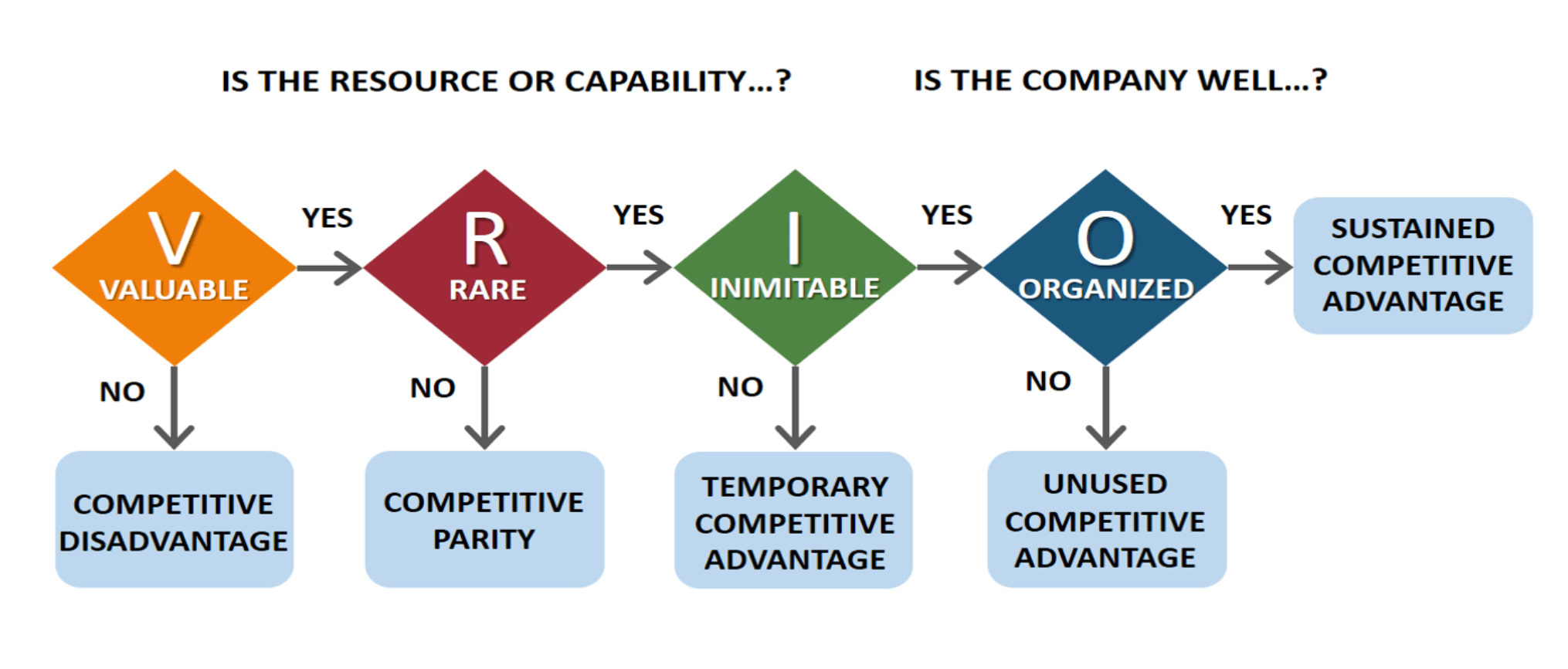
Long ago, the applications of resource-based logic in marketing have significantly grown; in the 1990s, about 19 articles in marketing referenced the Resource based theory, while in the 2000s, that number increased to 104. moreover, between 2010 and 2012 more than 50 published conceptual marketing articles talked about this theory. Which might be an indication to the growing importance of Resource based theory.
The resource- based view has generated some empirically testable hypotheses, resource- based logic have important contributions for management practice (Mosakowski, 1998). For example, it can be used to help managers in firms that are experiencing strategic disadvantages to gain strategic parity by identifying valuable and rare (vrio) resources their firm currently does not possess and pointing out that the value of these resources can be duplicated through imitation or substitution (Fuld,1995)
A way more interesting finding that can be explained by Resource based view is how likely the strategic human resource management (SHRM) is “behaving”:
Most resource-based arguments find its roots in human resources, for instance behavior of employees, routines, and learning mechanisms, that are obviously a bunch of complex social structures built over time and, thus, are difficult to understand and imitate (Amit & Schoemaker). The strong and obvious connection to the RBV serves the SHRM field in two ways: first, it foregrounds the role of human resources in questions of strategy, raising the importance of research and practice in SHRM, second, it encourages a more relevant focus for HRM, away from the HR practices themselves and toward their effect on firm resources (Delery, 1998; Wright et al., 2001).
Though this model being an Ideal type, its application within firms cannot be 100% achievable, nevertheless, a lot of companies nowadays not only apply the Resource based view by focusing on the strategic resources with VRIN attributes but also make an optimal use of ordinary resources, including resources sometimes perceived negatively. For instance, McDonald’s success relies on an optimal use of resources (marketing know-how, standardization of processes etc), but also on its ability to employ a workforce. relatively unskilled work (an ordinary resource but optimally used), and to manage a relatively high turnover while keeping its quality of service.

Another example is TIKTOK which a very know -sharing app that allows users to create and share short videos, on any topic:
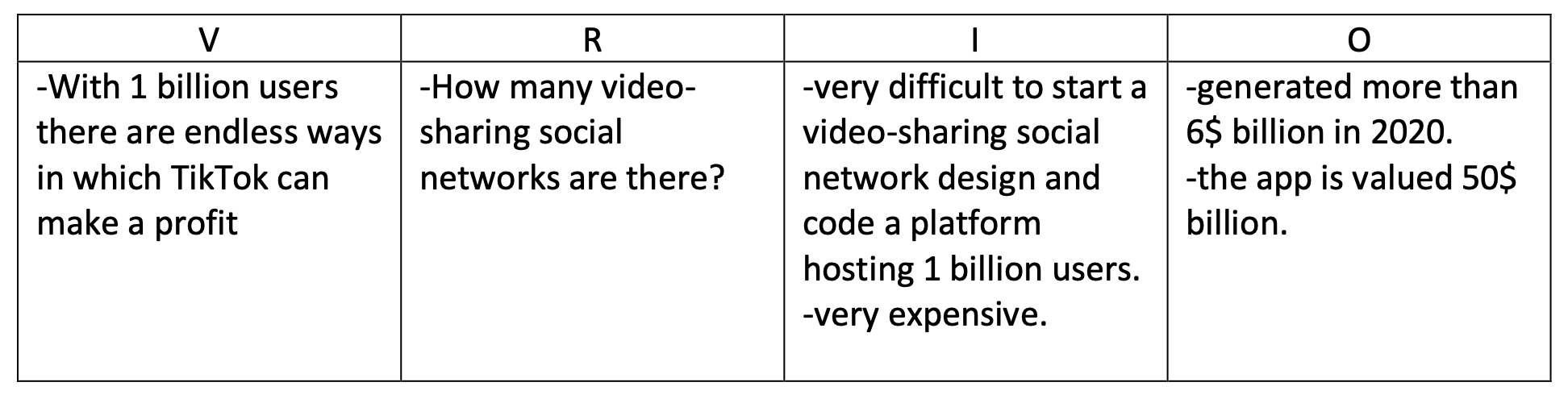
The last example is Coca-Cola which is interesting since the value created is not intrinsic to the drink itself but to the customer experience. Of course, they have the largest market share among beverage market.
Despite the variety of cola drink from other brands, what fulfills the Rarity is the fact that the brand is associated with happiness, friendship and “good vibes.
Coca cola is impossible to imitate, have invested billions over time to have a unique beverage. The beverage is so unique that it gave birth to a legend stating that only two people know the formula of Coca-Cola and both are not allowed to travel in the same plan in case it crashes. In fact, the formula is known by few people but certainly not just two. Finally, Coca-Cola has very high revenues and has always well faced the competitors.
Resource-based theory in marketing, Irina V. Kozlenkova & Stephen A. Samaha &Robert W. Palmatier, J. of the Acad. Mark. Sci. (2014) 42:1–21 Barney, 1991, 1992; Conner, 1991; Mahoney & Pandian, 1992; Oliver, 1997; Peteraf, 1993)
Academy of Management Review 2004, Vol. 29, No. 3, 341–358.
McDonald’s VRIO/VRIN Analysis & Value Chain Analysis (Resource-Based View) – Rancord Society
Resource Exchange Theory
(content created by Paul Nemet)
- Theory Description
The theory of resource exchange is based on marketing, which is described as an exchange between two or more social units. This psychological exchange theory was developed by U. G. Foa and E. B. Foa in 1980 and is used to examine these two units:
A: The structure underlying 6 different categories of resources including: love, status, information, money and goods and services.
B: The functional relationships between these 6 resource categories (the exchange model). Particularism versus universalism and the concrete versus symbolic nature of the resource.
Firstly, Foa and Foa (1980) assert that the value of the resources exchanged depends on its source or, if one prefers, on the person who provides it. Thus, in the workplace, the impact of a resource such as recognition depends on who provides it. More specifically, recognition will be much more valuable to an employee if it comes from his or her superior rather than from a little-known, newly-hired colleague. In this way, the high value of recognition in this context is directly associated with the person who provides it, making it a resource of a special nature. In contrast, money is universal in nature because its value remains relatively constant, regardless of the source from which it is obtained. (Cropanzano & Mitchell, 2005). Secondly, this theory argues that a concrete resource has an objective meaning and is usually involved in specific transactions of goods or services. On the other hand, the message conveyed by a symbolic resource is more subjective in the sense that its impact depends on the interpretation of its beneficiary. Thus, feelings of affection exchanged in a relationship are considered symbolic resources as opposed to money, which is a more concrete resource generally involved in transactions of an economic nature. From these conceptualisations, it can then be deduced that the organisational contributions and positive attitudes and behaviours of employees exchanged in the social exchange relationship correspond to gifts of a moral nature (Mauss, 1924), non-material goods (Homans, 1958) and symbolic resources with a particular character (Foa & Foa, 1980).
The economic concept of resource constraint (scarcity) is also integrated into the exchange process. The results are fundamentally consistent with the structural and functional relationships derived from Foa’s theory. Finally, it was found that resource scarcity affects the types of resources an individual is likely to give in an exchange.
This theory is mainly used in the field of exchange between companies but also works in an exchange between individuals.
- Theory Application
Social Exchange Theory, Exchange Resources, and Interpersonal Relationship: A Modest Resolution of Theoretical Differences (Marie Mitchell, Russel Cropanzano, David M. Quisenberry, 2012)
This article proposes a conceptual examination of the role of interpersonal relationships in patterns of social exchange. There are at least three perspectives. First, the relationship formation paradigm emphasizes that beneficial exchanges can lead to the formation of close relationships. Second, the relationship attribute paradigm emphasizes the qualities of the relationship that could become resources for exchange. Third, the relational-context paradigm emphasises that interpersonal proximity can moderate the way goods are exchanged and the way people respond to these transactions. Throughout this paper, the paper emphasises that these are three distinct but certainly not contradictory views on social exchange. Based on previous conceptual and empirical work, it examines how these different paradigms can reinforce each other by being combined into specific theoretical positions (e.g. Blau 1964; Foa and Foa 1974, 1980; Lawler and Yoon 1993, 1996, 1997; Molm 1994, 2003). From this perspective, we can begin to understand how and why some relationships evolve into committed and trusting engagements in which relational attributes, as well as concrete benefits, are exchanged, and why others simply focus on economic, tangible and negotiated interactions. An integrative relational perspective provides a better understanding of why social exchange relationships develop out of economic exchanges, why economic exchanges may never develop, and why certain tarnished social exchange relationships can be reinvigorated. In particular, it is important to consider dissecting and assessing resources in the “context” of the relationship. This will help to anchor the meaning of exchange transactions and ultimately influence the nature of the exchange relationship.
Resources and Relationships in Entrepreneurship: An Exchange Theory of the Development and Effects of the Entrepreneur-Investor Relationship (Laura Huang, Andrew Knight, 2017)
In a review of resource needs in the entrepreneurial process, Burggraaf, Floren, and Kunst wrote, “The entrepreneur and investor are bound to each other . . . the ‘click factor’ is essential: the right type of chemistry is needed between entrepreneur and investor” (2008: 69). The theoretical model, grounded in exchange theory, explains the dual dimensions that characterize the entrepreneur-investor relationship, the different kinds of resource exchange that these dimensions motivate, and the process through which reciprocal exchange can—when expectations are met—contribute to relationship development over time. By considering resources and relationships, as well as processes of exchange, the theory can help guide future research and provide a better understanding of the entrepreneurial process.
- Managerial recommandations
Love can refer to an employee’s affection for his or her company. In terms of exchange, it can vary by the establishment of good working conditions or a good salary.
The status can allow the evolution of an employee after good results within the company.
The information will enable people to better prepare their actions. An example of this is the introduction of a new product on the market. Knowledge of the market enables companies to successfully establish themselves in the market.
Money has a universal character because its value remains relatively constant, regardless of the source from which it comes. Every company needs money to take action.
Goods and services are the basis of exchange because every existing business offers one or the other. Most of the time this exchange is completed with money.
Resource-matching Theory
(content created by Tiphaine Pereira)
THEORY DESCRIPTION
In definition, the resource-matching theory (RMT) will explain the different effects caused by the use of cognitive resources in order to process the information of a task. To be more precise the resource-matching theory allows to explain the persuasiveness across different level of the consumer involvement. The fact that this theory plays an important role in consumer persuasion was explained by Sternthal and Arnand in 1988.
It will be interesting to know in which cases or in which situation this theory can be applied, for that it will be necessary to study two scientific articles which approach it in a different way.
THEORY APPLICATION
In this part, we are going to focus on two articles that put into practice the principle of the resource-matching theory (RMT) in a variety of situations. Thanks to these articles, it will be possible to understand this theory.
Articles :
(1) “ Are low-literate and high-literate consumers different ? Applying resource-matching theory to ad processing across literacy levels “, Journal of Consumer Psychology, Haeran Jae, Devon S. DelVecchio and Terry L. Childers, 2011
In this article, there are two experiences, aimed at knowing or not if the low-literate consumers interpret the written advertisements in the same way as the literate consumers thanks to the “Resource-matching theory” or RMT.
(2) “Evaluating Persuasion-Enhancing Techniques from a Resource-Matching Perspective”, Laura A. Peracchio and Joan Meyers-Levy, Oxford University Press, 1997
In this article, thanks to the “Resource-Matching theory” or RMT, explains how two ad execution characteristics which were dedicated to increase the persuasion, can have an impact and influence the resources needed in order to handle an ad with high and low conditions. In this article, the persuasion of the ad will depend about the degree of motivation.
MANAGERIAL RECOMMENDATIONS
In this part, it will be interesting to implement the resource-matching theory within the company organization and can be linked with the factor of employee’s motivation. Indeed, it is possible to use two examples within the company where this theory can be used.
For example, in order to motivate his employees, the employer can organize a meeting once a week with the employees. During this meeting, the boss will congratulate the employees without names, knowing that some of them are productive and others are not. Indeed, he is going to say encouraging things like “you’ve been productive this week, it’s not easy every day but you’ve done it”. Concerning this meeting, sentences spoked by the employer will not be perceived in the same way by all employees. There are several possible situations. Some will be more receptive to his or her words, including employees who have been productive and take credit for it. Some will be receptive and self-confident that they have been productive this week. Then there are those who are not receptive and who are part of those who have been productive but do not admit it because of self-judgment as well as those who have not been productive and are aware of it. This experience allows at the employees to be motivated and more productive within company.
For example, within a company, the resource-matching theory can be used at the level of product persuasion. Indeed, set a computer and say at the packaging manager, engineer and at the business developer “What do you think about when you see this computer?”. After this question, depending on the different roles, the persuasiveness of this object will not be similar. Indeed, the packaging manager is more likely to be the first to perceive the design and aesthetic aspect of the computer, the engineer will be more interested in the type of processor while that the business developer is no longer going to look at its price to sale. To recap, the product is the same, at the same time in the same place but the persuasion not will be the same for these three employees. Theses perception will allow to ameliorate the product.
BIBLIOGRAPHY
(1) Scientifc article : “ Are low-literate and high-literate consumers different ? Applying resource-matching theory to ad processing across literacy levels “, Journal of Consumer Psychology, Haeran Jae, Devon S. DelVecchio and Terry L. Childers, 2011
(2) Scientific article : “Evaluating Persuasion-Enhancing Techniques from a Resource- Matching Perspective”, Laura A. Peracchio and Joan Meyers-Levy, Oxford University Press, 1997
Role Theory
(content created by Antoine Petit)
Article 1: A role theroy perspective on Dyadic Interactions: The service encounter (Michael R. Solomon, Carol Surprenant, John A. Czeiel, &Evelyn G. Gutman)
Based on a dramatic metaphor
Role study is a set of social clues that guide and direct individual behavior in a given set. The degree to which the appropriate behavior of a particular thing is studied depends on the responses of other actors and observers. Every role we play is learned. Role-checking is when we act to satisfy ourselves. More broadly, theory proposes that the concept of self is linked to the roles that constitute our identity. This role allows you to coordinate with the group, what is called a service role. Therefore, the service role can be seen as a commitment to the identity of the role.
As said before, the role one plays is learned, but even if this role can be explicit it is in the majority of cases implicit. Role theory explains that things internalized by people can be vicariously given to people in many of the social interactions that result today. For example, we don’t really know what happens or is said in a clergyman, but we can easily find out what should not be said there.
Expectations of the role
One of the outcomes of good social character skills is the ability to predict the behavior of other actors. This allows individuals to assess their own behavior in relation to others (e.g., the salesperson’s attitude depends on the customer’s attitude). Expectations for roles are different from encounters and vary according to personal characteristics. Therefore, the actors’ expectations are multidimensional.
Role expectations affect performance. The concept of expectations is not unknown in marketing, because the greater the gap between expectations and performance, the greater the dissatisfaction. Under these conditions, two concepts have emerged: intra-role coherence and inter-role coherence. The first is to coordinate the perception of your role with the organization of the role itself. The second is the extent to which two people (in this case marketing, the supplier/customer) share a common definition of service roles.
When there is a role gap, problems arise. This difference can occur in the internal consistency of roles within qualifications that are different from the expectations of the customer, or it can occur in the consistency between roles, where the concept of customer roles is different from that of employee roles.
Implications for service marketing.
Taking into account the concepts mentioned above it is possible to draw up recommendations:
– Service encounters can be categorized as role performance.
– Role behavior is streamlined
– The similarity of roles a basis for classifying services
– Role behaviors are interdependent
Article 2: Role Theory: Expectations, Identities and Behaviors (Bruce J. Biddle)
Role theory focuses on people and their behavior. Behavioral change depends on the range of roles each person is willing to consider and the reasons why they predict these roles. Roles are related to social status (or status). Therefore, each social status must play a unique role. Therefore, those in this position are encouraged to do so because they understand their expected behavior, while others are inspired by their own expectations to teach and impose appropriate behavior. As a result, people are rational, thoughtful and insightful.
The focus is on the social experience through which we can understand expectations, their accuracy and sufficiency, and how expectations lead to compliant behavior. As a result, our roles are shared, so we also have common expectations for these roles.
We may not know the behavior of our character. As we all know, most role behaviors are contextual. Next, promote the role through environmental facilities and expectations. Roles are not without effects; on the contrary, they are likely to have unique effects or functions in the social system.
Fathers, mothers, older siblings and even newborns all play unique roles in the family. However, over time, children will learn role behaviors that they think are appropriate for their gender, class, ethnic group, and any other social status they expect to live in. As a result, a child develops a concept of self: as he or she adopts various identities and enters into different situations, the concept of self (among other things) consists of a set of role expectations for him or herself.
There are several scenarios of role behavior:
– Sometimes a person has uncoordinated role expectations and has to do something they cannot do everything.
-Sometimes, when you ask too many people, he or she suffers from character overload. -Sometimes the role he or she is asked to play does not match his or her needs or core values. -Sometimes their role behavior is considered deviant by society, and the person will be punished or institutionalized until they learn more appropriate roles.
The implications :
Role theory is based on several underlying propositions on which there is general agreement: – Certain behaviors are modelled and are characteristic of people in contexts.
– Roles are often associated with sets of people who share a common identity (social positions).
– People are often aware of roles and roles are governed by their awareness (by expectations). – Roles persist because of their consequences (functions) and because they are often embedded in wider social systems.
– People have to learn roles (be specialized) and may find joy or sadness in their performance.
Sales Call Anxiety Model
(content created by Corentin Picot)
1) Theory description
The Sales Call Anxiety Model (SCA) was proposed by Willem Verbeke and Richard P. Bagozzi in 2000. The first article, “Sales Call Anxiety: Exploring What It Means When Fear Rules a Sales Encounter”, was published in the Journal of Marketing Vol.64 (July 2000), p.88- 101. As the name of the model suggests it, it is mainly used in marketing sales.
Sales Call Anxiety is a phenomenon which impacts salespeople. When they have this anxiety, they are afraid of being rejected and evaluated by customers. They also tend to avoid doing certain actions due to this fear, such as contacting the customer to begin with. There are four dimensions in sales call anxiety: negative self-evaluation (fear of forgetting something, of losing control, …), imagined negative evaluation from customers (fear of not being liked or well-received, …), awareness of physiological symptoms (sweating, blushing, …) and protective symptoms (avoiding eye contact, speaking very quickly, …). They all negatively influence salespeople and their performance.
2) Theory application
The sales call anxiety model has been used and quoted in other scientific articles. For example, in the article “Coping With Sales Call Anxiety: The Role of Sale Perseverance and Task Concentration Strategies”, published in the Journal of The Academy of Marketing Science (July 2006), p.403-418, Belschak, Verbeke and Bagozzi use the model to find a way to overcome this anxiety. Two methods are identified: task concentration (focusing on the task that the person is currently doing) and sales perseverance (continuing the sale despite the sign of anxiety). Thanks to the model, they find that the two methods work better for different problems, such as sales perseverance for physiological issues.
Another article using the sales call anxiety model is “The role of social and self- conscious emotions in the regulation of business-to-business relationships in salesperson- customer interactions” by Bagozzi, published in the Journal of Business and Industrial Marketing (December 2006). This article is a literature review dealing with emotions impacting B-to-B relationships. It shows that the SCA model is part of a wide range of positive and negative emotions that are present in the relationship between salespeople and customers. The article also underlines that the emotions are not always well-addressed. Thus, we can discuss the implications of the sales call anxiety model.
3) Managerial implications
Sales call anxiety can have lasting effects on salespeople. They will lose confidence and they will not be able to do another sale: they may also end up leaving the company if the anxiety is too important to deal with. Therefore, managers should identify the first signs of SCA as soon as possible, even if they are at a low level or if salespeople are hiding them. As the article explains, various programs can be used by a company in order to tackle this issue. For example, frequent trainings can be made by managers in order to verify the current conditions of salespeople (with individual interviews, tests, …) and teach them how they can react if they are facing this kind of problem.
Another to deal with SCA is to identify precisely which symptoms the employees are having. If it is known, it will be easier to find the right advice or therapy to limit its effects. Managers can implement a standard procedure: identify the employee, identify the symptoms, choose the perfect solution. It will allow them to save time and be more efficient.
Schema-Congruity Theory
Self-Perception Theory
(content created by Samuel Renaud)
I. Description of the theory
Self-perception theory, which was proposed by psychologist Daryl Bem in 1967, consists of two postulates:
The first is that individuals learn about their own attitudes, emotions, and other internal states partially by inferring them from observations of their own behavior and the circumstances in which their behavior occurs.
The second is that, to the extent that individuals’ internal cues regarding their internal states are weak or ambiguous, they must infer those internal states in the same way that an observer would – based on external cues.
Thus, the theory proposes that people’s knowledge of their own feelings often comes from inferences based on external information rather than from direct internal access to their feelings.
This theory is mainly used in psychology and more specifically in social psychology but can have relevant applications in marketing research and consumer behavior, especially with the rise of mass personalization.
II. Application of the theory
The first article, entitled “On Doing the Decision: Effect of Active Versus Passive Choice on Commitment and Self-Perception” (Cioffi & Garner, 1994) draws on the theory of self-perception to argue that behavior – especially if it is public, indelible or salient – can lead us to be labelled according to our behavior.
The aim of the studies carried out was to determine the effects of active and passive choices on commitment and self-perception. Attributive analyses of the two studies conducted sug- gest that active and passive choice can lead to unique interpretations of self and decision: Active agreement leads to more types of reasons for one’s decision, and active refusal in- creases perceived resistance to social influence.
Thus, the studies carried out delve deeper into the theory of self-perception and in particular the first postulate by demonstrating that this theory also applies when the individual has to make a choice, a choice during which the individual observes himself adopting a behavior (decision making) and adapts accordingly. If he responds positively, he will explain the rea- sons for his choice and if he responds negatively, he closes himself all the more to external influence by adapting his behavior and attitude to the fact that he has just expressed a refusal, becoming impervious to any social influence.
The second article, “Computer in Human Behavior”, was written by Ching-I Teng in 2018 and deals with the influence of computer users, especially playing video games, on human behavior.
In this article, self-perception theory is used to explain how usage formulates users’ favorable evaluations, for example with regard to gambling as a habit. In other words, self-perception theory makes it possible to identify the gambling habit as a potential consequence of the relationship between the player and the game, justifying the inclusion of the gambling habit.
Self-perception theory assumes that individuals observe their behavior to assess their own beliefs. Applied to the current context, frequent gambling would be observed by the gamblers themselves and would be used to infer that gambling was a habitual part of their lives. Therefore, increasing the use of games should make the behavior of gamblers natural.
III. Managerial recommendations
The theory of self-perception can in fact prove to be an effective marketing tool. A typical example is the “foot in the door” technique, which is a marketing technique widely used to persuade target customers to buy products. The basic principle of this technique is that once a person responds to a small demand (e.g. by filling in a short questionnaire, answering a few mundane questions during a telephone canvassing, or stopping to taste a product in a shop), he or she is more likely to respond to a larger demand that is related to the initial demand (e.g. by buying the product concerned).
The idea is that the initial commitment to the small demand will change one’s self-image, giving reasons to accept the subsequent, larger demand. This is because people observe their own behavior (paying attention to and complying with the initial demand) and the context in which they behave (no obvious incentive to do so), and therefore infer that they must prefer these products.
Similarly, this theory can be found in the interaction between brands and consumers. Indeed, the perceived interactions between consumers and the brand (social networks, games) can contribute positively to the relationship with the brand, which in turn contributes positively to consumer loyalty.
This approach has moreover been studied and demonstrated on the relationships of MMORPG players within their guild (Moon et al. 2013).
Sources
Bem.D, (1967). Self-perception theory
Cioffi.D, Garner.R (1994). On Doing the Decision: Effect of Active Versus Passive
Choice on Commitment and Self-Perception Teng.C (2018). Computer in Human Behavior
Moon, Hossain, Sanders, Garrity & Jo (2013). Player Commitment to Massively Multiplayer Online Role-Playing Games (MMORPGs): An Integrated Model
Signaling Theory
(content created by Margaux Renault)
1 – Theory description: What does it explain or suggest? Who proposed it? When was it proposed? Where (field or subfield) is it mainly used?
Signaling theory was formalized by economist and Nobel Prize Micheal Spence in 1973 in an article entitled “Job Market Signaling” and published in The Quarterly Journal of Economics.
This theory is based on the assumption that information is not accessible to all parties at the same time and that asymmetry of information is the rule. Indeed, signaling theory describes behavior when two parties, individuals or organizations, have access to different information. In general, one part must choose what and how to signal that information, and the other part must choose how to interpret the signal.
As a result, signaling theory is used in a wide range of disciplines from anthropology to zoology. But, in particular, it is prominent in a variety of management literature, including entrepreneurship and human resource management.
-
In the entrepreneurship literature, researchers examined the signal value of board characteristics, management team characteristics, the presence of venture capitalists and angel investors, and the involvement of founders.
-
In human resource management, many studies have investigated the signaling that occurs during the recruitment process between an employer and potential candidates.
2 – Theory application: two scientific articles using this theory have to be described in terms of contribution. How are the article’s findings explained by this theory?
In 2012, Tamilla Mavlanovaa, Raquel Benbunan-Fichb and Marios Koufarisb published an article entitled “Signaling theory and information asymmetry in online commerce” in Information & Management. This paper applies signaling theory and information asymmetry to online commerce.
In an e-commerce situation, there is an asymmetry of information between sellers and buyers. Indeed, potential buyers cannot physically see the quality of the product and the reliability of the seller. Therefore, the quality of the products and the reliability of the sellers is evaluated via a number of signals.
The analysis of the three authors shows that unreliable sellers do not send the same signals as reliable sellers. Unreliable sellers use fewer signals, i.e. they communicate less information about the products they sell on the website. They use signals that are inexpensive and easy to verify. On the contrary, reliable and serious sellers transmit many signals that are expensive and difficult to verify.
In 2013 Christina K. Gregory, Adam W. Meade and Lori Foster Thompson published a paper entitled “Understanding internet recruitment via signaling theory and the elaboration likelihood model” in Computers in Human Behavior. This article examines the link between recruitment websites and candidates’ interest in the companies concerned.
In a recruitment process, companies looking for candidates communicate a lot of information on their website in order to give information to the candidates. Each company is free to communicate what it wants on its website. Therefore, each company sends different signals to the candidates.
This article shows that the content and design of recruitment websites influence and affect the attitudes and attractiveness of candidates towards a company’s website. According to signaling theory, the amount of job and company information on a recruitment website interacts with the usability of the site. When less job information is presented, site usability plays a more important role in predicting favorable attitudes towards the organization.
3 – Managerial recommendations: how can this theory be used in companies? Give concrete examples.
Signaling theory can be applied in every field of business. Indeed, every department communicates internally and externally, whether with employees, customers, partners, journalists or others. In this way, each department sends signals to other departments or people. However, the fields of marketing and communication are the ones that send the most signals to potential customers. Their objective is to signal the value of the company and its products so that they want to buy them.
For example, companies need to put a very strong emphasis on their SEO which send a strong signal to customers. In consumers’ minds, being on the first page of Google results means that your business is important and reliable. As a result, potential customers are more likely to open the first links that appear on the first Google page than others. Therefore, in a market where there is an asymmetry of information, it is crucial to have a good SEO to appear on the first Google page and to be credible in the minds of consumers.
Bibliography:
-
“Job Market Signaling”, Micheal Spence, The Quarterly Journal of Economics, Volume 87, No. 3, August 1973, pages 355-374
-
“Signaling theory and information asymmetry in online commerce”, Tamilla Mavlanovaa, Raquel Benbunan-Fichb and Marios Koufarisb, Information & Management, Volume 49, Issue 5, July 2012, pages 240-247
-
“Understanding internet recruitment via signaling theory and the elaboration likelihood model”, Christina K. Gregory, Adam W. Meade and Lori Foster Thompson, Computers Human Behavior, Volume 29, Issue 5, September 2013, pages 1949-1959
Social Comparison Theory
(content created by Juliette Roth)
- Theory description: What does it explain or suggest? Who proposed it? When was it proposed? Where (field [e.g. marketing] or subfield [e.g. branding, international marketing]) Is it mainly used?
The social comparison theory was first proposed in 1954 by Leon Festinger, an American psychologist. He noted that individuals have an intuitive drive to evaluate themselves, derived from the desire and the need of self-evaluation. Most of the time, this comparison happens between oneself and others : analyzing oneself, ones attitudes, abilities or traits in relation to others. In other words, it is the idea that people define their social and personal worth according to their position to others.
The social comparison is based on two categories according to Festinger : firstly social norms and opinions of others and secondly abilities and performance. There is two way of application of socially comparing oneself : upward or downward. Upward comparison is the fact that one is comparing itself to someone who he perceives as being better or as performing better than him. On the contrary, downward comparison is comparing oneself to someone perceived as worse than himself.
It is mostly used in psychology but can also be used in marketing, in neuromarketing for example. In companies, it could also be used by HR departments and managers, to understand and determine how to enhance productivity.
- Theory application: two scientific articles using this theory have to be described in terms of contribution. How are the article’s findings explained by this theory?
The first article I chose is called “Social comparison orientation and frequency: A study on international travel bloggers” (M.M. Mariani, M. Ek Styven & R. Nataraajan, 2020). Travel and tourism industry highly impacted by the use of social media (used for information source, sharing experiences…). Travel influencers are the most important social media influencers (SMIs) in that industry. Competition between those influencers is rising and causing them to compare to each other a lot. So in this article, the authors used the social comparison theory to understand the driver of frequency in comparison between those SMIs. For the first hypothesis, they considered that two variables are in social comparison orientation : ability and opinions and that those positively influence the frequency of comparison on social media. The second hypothesis is that opinion leadership also positively influences the frequency of comparison on social media.
The results show that the ability is the only aspect of SCO that tends to drive comparison behavior in social media, the opinion aspect does not. In addition, the second hypothesis (opinion leadership) is confirmed because it has a strong effect on the frequency of comparison.
The second article I chose is called “Invoking social comparison to improve performance by ranking employees: The moderating effects of public ranking, rank pay, and individual risk attitude” (C.B. Cadsbya, F. Song, J. Engle-Warnickc & T. Fang, 2019). Their goal is to understand if relative performance ranking could lead to an increase in productivity. So, in other words, does knowing that a colleague is ranked higher than you going to increase your productivity? And does this motivation depend on what is linked to the ranking (financial rewards, public or private recognition)?
The moderators, as cited in the title, are public/private ranking, rank pay and individual risk attitude. The result of the study states that two out of four of their hypothesis were confirmed, H1 and H4. The first ones confirms that private ranking with no direct financial implications has a positive effect on performance and the fourth ones confirms that risk aversion has a negative moderating effect, which means that a risk-averse individual’s performance will not increase when ranked.
- Managerial recommendations: how can this theory be used in companies? Give concrete examples.
First, it is important to note that the outcome of social comparison can be both good or bad. As stated above, individuals can compare themselves upward or downward and the results can really differ. Upward comparison can lead to motivation, while looking up to someone that is doing better than him, one may want to reach its level. But at the same time, it can also discourage, dissatisfaction… The table below shows the different effects that both types of comparisons can lead to.
|
Upward comparison |
Downward comparison |
|
|
Positive effects |
Inspiration, hope |
Gratitude, good self-worth |
|
Negative effects |
Dissatisfaction, envy, jealousy, discourage |
Disrespect, disregard |
This table is applicable for individuals in general but more so in companies where the environment is competitive in the first place, during the hiring process or even after. As the second article shows, it could be interesting for managers to communicate private ranking to their employees and not affect their pay with the rank. This allows people not to compare themselves to others because it is not public, with no risk of humiliating people.
In another field, it could be interesting to trigger social comparison when a company wants to organize a contest where it includes people, like the brand Fanta often does. The contest invites people to participate in a process of co-creation and will select the best projects proposed by customers. In doing so, there is a competitive atmosphere that allows people to stimulate their creativity.
As the second article shows, it is common that companies set up things that drive social comparison between their employees, like ranking. If a company wants to use this theory to strive for better productivity from its employees, the most important things would be to master a real balance. It is important that this is done with the people bests’ interests in mind, because the line between positive and negative effects is really thin. It is important to note that all individuals are different and don’t react the same way, some are more though and others are more risk-adverse (like mentioned in the second article chosen) and that could greatly influence the way the react to comparisons.
Social Exchange Theory
(created by Maurane Rozenblat)
Theory description
Who proposed it? When was it proposed?
The Social exchange theory is both a sociological and psychological theory. Several authors have theorised this theory. It appeared first in George Homans’ book Social behavior as exchange (1958), then it had been reworked in one of his other books Social Behavior: Its elementary forms (1974). John Thibaut and Harold Kelley later reused Homans’ work but incorporated to it the game theory matrix, in their book The Social Psychology of Groups (1959). And Finally, Peter Blau was also talking about this theory in his book Exchanges and Power (1964) but more as a tool to understand economic exchanges (Richard M., 1976).
What is it?
The Social exchange theory (SET) studies the social behaviour during the interaction of two parties. The theory explains that the nature of this interaction is based on a cost-benefits analysis from the two parties. These two parties determine the costs and benefits they can have from the relationship. The several publications about this theory showed that we can use it to show different behaviours:
- For Homans, the use of this theory is mainly use for a sociological aim, to understand why the interaction between two parties occurred. And his studies showed three reasons: the success (when a person is rewarded for what he does, he will generally repeat the action), the stimulus (more a person is subject to a stimulus and more this person will respond to it), and the deprivation-satiation (more a person received a reward recently, less he will repeat the action because he is already satisfy).
- Thibaut and Kelley will use the SET to show a balance of power between the two parties by incorporating the game theory. They showed that each party can exercise a certain power on the other party. Thanks to this they can predict if a relationship will happen or not.
- Blau’s Theory is the same than Homans’ but he incorporated economics terms. The aim of his experience was to identify the complex and simple process of relationship by distinguished the social, economic, and power exchange. He said that it is important to not be focus only on the psychological aspect to understand the development of a relationship which can be link to other aspect, such as economic.
Where Is it mainly used?
Nowadays, the Social exchange theory is mainly used in sociology and psychology field to explain social and behavioural phenomenon. But it is also a great tool in Marketing to understand the behaviour of the customers. In fact, it allows to explain the individual behaviour in various domains such as the adaptation of new technologies or the behaviour of online community.
Theory application
N°1 article: The Coronavirus crisis in B2B settings: Crisis uniqueness and managerial implications based on social exchange theory (Roberto Mora Cortez, Wesley J. Johnston 2020)
The aim of this article is to recommended ways of action for B2B companies during the COVID- 19 crisis. The authors, Roberto Mora Cortez, and Wesley J. Johnston compared the COVID-19 crisis to other “traditional” crisis such as the financial crisis (1997-1998; 2008-2009). They realised that the COVID-19 crisis is mostly link to the human factor. Which means that the relationship between people is the main cause of this crisis and is also the key to manage it. That is why the authors used the SET to find solutions. Because this theory provides a better understanding of the individuals behaviour. They interviewed 31 professionals working in the B2B sector. As this crisis is global, they took people from the US, Europe, and Latin America to get an international sample.
The use of SET in this article highlights the importance of social exchange in the COVID crisis. It Highlights 5 main managerial contributions to help companies to go through this crisis:
- Companies must understand they cannot manage the COVID-19 crisis as a “traditional” financial crisis. Indeed, it is the social interactions which are the main reason of crises contrary to financial crisis.
- Companies should adopt the digital transition quickly. Because the lockdown situation and the government restrictions highlight the weakness of the B2B sector in terms of digital transformation. In fact, people had to work from home and to do it they have to be well equipped to maintain the contact with their colleges. Thus, the digital transition allows less complication to work from home and contribute to the proper functioning of the company.
- Companies must impose a precise leadership. because the leadership governs the smooth running of social exchanges, which is necessary for good team cohesion and therefore good results. It will help salaries to understand what they should do and not be lost.
- Companies must have a reactive decision-making process to establish new work perspectives.
- Companies must set up psychological support to manage employees’ emotions and stress, which can have a negative impact on the well-being of these individuals and indirectly on the smooth running of the company.Roberto Mora Cortez and Wesley J. Johnston showed thanks to the social exchange theory (SET) that companies need to focus on these 5 dimensions in their businesses to ensure that they can withstand the crisis.
N°2 article: Knowledge sharing in online health communities: ONE social exchange theory perspective (Zhijun Yan, Tianmei Wang, Yi Chen and Han Zhang 2016)
For Zhijun Yan, Tianmei Wang, Yi Chen and Han Zhang the aim of this article is to understand and observe how and why members of online health communities (OHCs) share general and specific knowledge. To do this, they will use the social exchange theory (SET), which here allows them to establish the elements of studies that are the costs and benefits that the members of these OHCs will perceive when they share general or specific knowledge. The benefits had been measured using Maslow’s needs pyramid and the costs had been divided into two categories: cognitive and executive. Data collection was carried out with 323 users of two well-known OHCs in China and had been analysed using the structural equational model.
The results showed three main factors which urged the users of these networks to share both general and specific knowledge:
Sharing knowledge helps to improve the self-worth of the person who shares information. It increases the perception of members of this community for social support.
It Improves reputation.
Concerning the costs, when they are executive, they only negatively impact general knowledge contrary to cognitive costs which impact negatively specific knowledge. This study reveals also that personal benefits encourage knowledge sharing while costs do the opposite. This impact varies according to the type of knowledge, whether it is general or specific.
Here the SET has helped the author to confirm that individuals share information general or specific on online Health communities to maximise their benefits (improve self-worth, increase perception of social support from the community, improve reputation) and reducing their costs when they are entering in a social relationship even if this relationship is established online.
Managerial recommendations
This theory can be used as a managerial tool, as shown in the article The Coronavirus crisis in B2B settings: Crisis uniqueness and managerial implications based on social exchange theory (Roberto Mora Cortez, Wesley J. Johnston). It can help companies to consider the human factor and thus adapt the managerial decisions. The example of the COVID-19 crises is very relevant in that case. But the SET can also be used as a tool for analysis or even make marketing strategies. It helps to understand the behaviour of consumers towards a brand or even among a brand community. For example, if a company wants to expand its brand community, the marketer will use the SET to understand the benefits / costs that can have a customer to integrate its brand community. But social relations are very complex, and this theory does not allow a complete understanding of them. But as the authors who theorised it have shown, there are different ways to use it. The marketer just needs to know what he wants to study.
Social Penetration Theory
(content created by Leila Souaf)
1) Theory description: What does it explain or suggest? Who proposed it? When was it proposed? Where (field [e.g., marketing] or subfield [e.g., branding, international marketing]) Is it mainly used?
Social penetration theory was developed by Taylor and Altman in 1973. The social penetration theory (SPT) proposes that, as relationships develop, interpersonal communication moves from relatively shallow, non-intimate levels to deeper, more intimate ones. It offers a general approach to the interpersonal attractions that look at the development of different interpersonal relationships, including close friendships. It considers this process systematic and gradual. Altman and Taylor also note that relationships “involve different levels of intimacy of exchange or degree of social penetration”. SPT is known as an objective theory as opposed to an interpretive theory, meaning that it is based on data drawn from experiments and not from conclusions based on individuals’ specific experiences. Besides, the theory looks at how any friendship moves from the superficial and peripheral levels of exchange to becoming intimate friends. The development of all relationships is affected by key factors. They include costs, personality, and situational factors. This means that when actual and future outcomes are quite favorable, a friendship is more likely to develop to its deeper levels.
Social penetration theory also describes the growth of all personal relationships as something linked with people’s self-disclosure. It means that any increases in intimacy in interpersonal relationships are resulted by people sharing more and more information about their life and personalities. For example, when they meet for the first time, people start sharing impersonal and general information, thus limiting a range of subjects discussed.
This theory could be used in personal and business relationships as a way of sharing information on gaining others in return.
2) Theory application: two scientific articles using this theory have to be described in terms of contribution. How are the article’s findings explained by this theory?
In some literature articles we can notice some findings, regarding the social penetration theory. Indeed, according to Amanda Carpenter (doctoral candidate at Rutgers University in New Jersey, USA) and Kathryn Greene (professor of communication at Rutgers University in New Jersey, USA), in a literature article called Social penetration theory in the Wiley Online Library, the theory of social penetration could be explained as a theory that describes the role of disclosure in relationship development, focusing specifically on how self‐disclosure functions in developing relationships. The onion model serves as a framework for describing the process of social penetration. In developing relationships, people use self‐disclosure to increase intimacy including through breadth, depth, and the norm of reciprocity. Social penetration progresses through several stages to develop relationships. The theory also incorporates rewards and costs in relation to social penetration and has influenced the development of a number of theories in relationship development and information management.
On the other hand, in the article called The Personal Impact of Ethical Decisions: A Social Penetration Theory, from the Journal of Business Ethics, we can see that there are some gaps in the Social and Ethical issues literature regarding the structure of individual ethical reasoning and the process through which personal ethical standards erode or decline. In other words, it means that these issues prevent from having a real ethical behavior because of the reasoning of some individuals.
Moreover, in this article, we can see that the social penetration theory could also be used to address ethical issues of low, moderate, or high importance. It also produces a model of the process by which an individual turns to less desirable ethical reasoning and less desirable ethical behavior.
3) Managerial recommendations: how can this theory be used in companies? Give concrete examples.
Nowadays, we can see that many marketing theories have inspired many companies. The theory of social penetration, frequently studied in business literature or scientific articles, is also present in companies. Some companies, according to the theory of Taylor and Altman, bring new recommendations to their employees. Indeed, they provide a new communication system which consists in making the speaking free. When employees are busy, upset or running late for example, they should say it and express themselves in a way of having an ethical dialogue with others to bring a cohesion and to not being in a bad situation because of a lack of dialogue. Saying things is relatively easy and making employees expressing themselves could result in a good atmosphere in work which will have as a result: productivity.
In addition, in some companies, general managers could also invest in the Corporate social responsibility (CSR) in a way of self-regulating the business model. This will help the company to be socially accountable—to itself, its stakeholders, and the public. Therefore, it means that the enterprise will increase profitability by providing a way to communicate to all, intern and extern, collaborators.
Finally, this theory of social penetration could also be integrated in enterprises by helping employees to achieve self-growth. This by helping them to achieve self-reflection which is one of the most important keys to understanding themselves and finding out what they want out of their life. And when it comes to self-growth, they can ask questions to help they further develop themselves, both personally and professionally, to reach their goals and attain higher success.
Sources:
The importance of social penetration theory
10 Self-Growth Questions You Should Ask Yourself Every Day (themindsjournal.com) Social Penetration Theory – Carpenter – – Major Reference Works – Wiley Online Library APA PsycNet
The Personal Impact of Ethical Decisions: A Social Penetration Theory on JSTOR
Socioemotional Selectivity Theory
(content created by Maelle Thuriere)
The theory of socioemotional selectivity is a study based on life perception and objectives depending on the age. It explains that people are changing their goals and activities as the time shrink. It has been proven that the older a person is the more selective she becomes. It is then based on how the person sees the future, if it is seen as opened, then the well-being is higher.
This theory thus highlights the fact that people, depending on the time from adulthood to old age, can change their personal, social and emotional development.
This theory has been exposed by Laura L. Carstensen, teacher at Stanford University and main researcher at Stanford Life-span Development Laboratory. She formulated this theory in the beginning of the 90’s. This theory finally sheds light on the fact that older people restrict their social network and this results in better emotional well-being.
This theory is mainly exposed in the study of longevity also in behavior and emotional changes depending on the time. It is more a question of social study than economic one but the study of social behavior, of the society development, serves economic implementation. For instance in the recruitment process , a company will faced a dilemma based on the age of the applicants. Who the company will choose between a 35 years old person and a 57 years old person? What is its thought process? Will it prioritize the curiosity and willingness of youth over the expertise of an older person? That is where the socioemotional selectivity theory can erupt.
The first article, Comparing effects of intrinsic and extrinsic social values beteen younger and older employee by Dannii Y. Yeeung, Helene H. Fung and Darius K.-S. Chan published in 2016 in The Journal of Psychology refers to this theory. In fact, it uses socioemotional selectivity theory in the explaining of the two dimensions, intrinsic and extrinsic, social values of the work. It is in order to know what work and age situation could moderate its effects on the performance at work.
The resulting findings of this survey are such as older workers are more susceptible to find social work-related values than younger workers. Intrinsic social work-related values refers to the prioritization of a collaborating job over a careerist profile which is illustrate by extrinsic values. This survey was made in order to know whether there are any differences of age in the importance of intrinsic and extrinsic social work-related values, whether their effects on self- rated job performance depends on the age, and whether the age-related effects of intrinsic and extrinsic social work-related values on job performance would change with work situation.
This article therefore uses the theory of socio-emotional selectivity as a basis to demonstrate more precisely the effects of age on the perception of social values at work. It is like this article was a concrete example and demonstration in the work area of socioemotional perception that varies depending on one’s age.
The second article is Translating socioemotional selectivity theory Into persuasive communication: Conceptualizing and operationalizing emotionally-meaningful versus knowledge-related appeals by Margot J. Van Der Goot, Nadine Bol, Julia C. M. Van Weert published in 2017 in the International Journal of Communication (University of Amsterdam). This article focused on the different categories of objectives presented by socioemotional selectivity theory. Overall, the theory of socioemotional selectivity highlights two categories of objectives: one focused on so-called emotional objectives and the other where the objectives are more focused on learning and knowledge acquisition. (Even if it is specified that in the first category we do not exclude emotional learning). The survey of this article has provided a conceptualization and operationalization of emotionally-meaningful versus knowledge-related appeals in persuasive messages. The presented coding instrument identifies three dimensions of emotionally-meaningful appeals (emotion regulation, optimizing the present, and close social relationships) and three dimensions of knowledge- related appeals (knowledge acquisition, optimizing the future, and novel social relationships). This study has helped increase the knowledge on persuasive communication with the aging population by creating a coding instrument which helps selecting and designing persuasive messages for effects studies of socioemotional selectivity theory.
Finally the socioemotional selectivity theory can be used in several sectors in companies. It can be helpful in the understanding of one’s company’s employees, it can help segmentation, targeting and positioning process in the definition of a product that can be associated to a learning goal or an emotional one in order to adapt the offer.
But according to me the second article has raised an important function of this theory: It can be applied to the communication field like in advertising campaigns in order to drive the right and targeted message that will persuade the customer depending on their age, on their goals. It is always complicated to provide the best message addressed to our customers. But according to socioemotional selectivity theory one’s goals and life objectives will vary with span-life and then we have some conclusion that helps us drawing a typical behavior and perception of life objectives depending on people’s age.
However, the limitations of this theory must obviously be understood because not everyone follows this model and it may not be verified in every particular case. Furthermore, this theory admits that older people seem happier than younger people, but more parameters need to be taken into account for these results to be meaningful. Among the respondents to Laura Carstensen’s experiment who were looking for the rate of stress, sadness, happiness, etc. at a given time t for a certain duration, the change in the perception of these emotions is not taken into account. Between a person who is starting his professional career and a retired person it is obvious that the stress rate is not the same. Depending on age, these emotions may be perceived as constant or outdated, and it may be interesting to consider that stress, fear and anxiety are not opposed to happiness.
SOURCES
https://www-tandfonline-com.scd-rproxy.u- strasbg.fr/doi/full/10.1080/00223980.2016.1187109
http://web.a.ebscohost.com.scd-rproxy.u- strasbg.fr/ehost/detail/detail?vid=0&sid=5b7ca242-10be-4b70-adb8-a6286110176b%40sdc- v- sessmgr01&bdata=JkF1dGhUeXBlPWlwLHVybCx1aWQmbGFuZz1mciZzaXRlPWVob3N0LWxp dmU%3d#AN=147066151&db=sph
https://www-tandfonline-com.scd-rproxy.u- strasbg.fr/doi/full/10.1080/08870446.2019.1587441
https://onlinelibrary-wiley-com.scd-rproxy.u- strasbg.fr/doi/full/10.1002/ijop.12656?sid=vendor%3Adatabase
https://fr.qaz.wiki/wiki/Laura_L._Carstensen#Socioemotional_selectivity_theory
https://www.cairn.info/revue-humanisme-et-entreprise-2011-2-page-61.htm
https://www.ted.com/talks/laura_carstensen_older_people_are_happier/transcript?langua ge=fr
S-O-R Paradigm
(content created by Lucas Van Uye)
Theory description:
The stimulus-organism-response (SOR) model is a model used in environmental psychology that explains that environmental factors can have the role of a stimulus (S) that can act on an individual’s internal state (O) and generate a behavioral response from the individual (R). This model is used to explain how the stimuli of the external environment can reinforce and consolidate the internal states of individuals (Eroglu, Machleit, & Davis, 2001).
The SOR model is generally used in research on the behaviours of individuals or service users. The SOR model paradigm highlights the fact that social stimuli have an impact on individual behaviours. They are induced by people’s internal state (Mehrabian & Russell, 1974), and also influence their actions when they are victims of one or more environmental stimuli, particularly technological ones.
Theory application:
As we can see in the two selected articles, SOR paradigm is particularly link with the SNS, which are online services that aim to create social relationships between people who share interests and activities, sharing information with its contacts, whether public or private, is the main function of SNS (Krasnova, Spiekermann, Koroleva, & Hildebrand, 2010). Nowadays, these are mainly social networks like Facebook, Twitter, Instagram or others.
This paradigm makes it possible to work in depth on social networks, in particular on the dependency of users, as we can see with the article about “Computers in Human Behavior”. Using the SOR model allows us to explore the problems caused by excessive use of social networks. It allows to highlight the negative effects of SNS such as the stress caused by them, as we can see in this schema.
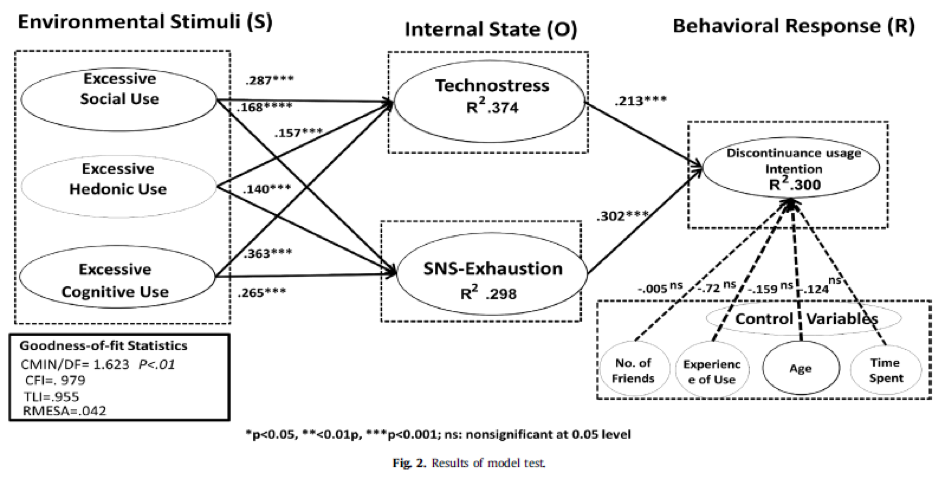
Managerial recommendations:
The SOR model allows actors using social networks to better understand the effects of this use on users. Especially the negative effects that can result from it. In this way it allows the company that manages its networks to improve them and fight against its harmful effects. And for the companies, not to generate abuse while continuing to be involved for the users.
Bibliography :
- The SOR (stimulus-organism-response) paradigm in online learning: an empirical study of students’ knowledge hiding perceptions. (Xuesong Zhai , Minjuan Wang & Usman Ghani)
- Computers in Human Behavior, Empirical investigation of Facebook discontinues usage intentions based on SOR paradigm. (Adeel Luqman, Xiongfei Cao*, Ahmed Ali, Ayesha Masood, Lingling Yu)
Theory of Anthropomorphism
(content created by Xiaoying Ye)
Anthropomorphism is a concept that appeared a long time ago. This concept is used in many different fields and disciplines, such as: religion, theology, psychology, etc. In general, its meaning can be explained as: “Anthropomorphism it’s means attributing human characteristic to inhuman phenomena. “(Guthrie, 1993). Because people feel more kind with humans, so people usually use this theory to make these inhuman concepts have more emotional, more friendly, easier to understand, and easier to produce some sense of identity. Of course, anthropomorphism is also widely used in the marketing field, mainly in the creation of brand image and brand promotion (in advertising).
Here are two scientific articles to illustrate the application of anthropomorphism in the marketing field.
The first scientific article was written by Dwinita Laksmidewi, Harry Susianto and Adi Zakaria Afiff in 2017: “Here are two scientific articles to illustrate the application of Anthropomorphism in the marketing field.”. This article studies the application of anthropomorphism in advertising: When anthropomorphism is used in the advertisement to explain the product, whether it will have a good effect on the consumer’s purchase intention. Anthropomorphism will have a positive impact on consumers’ purchase intentions, which will allow consumers to better understand products and are more willing to buy. Advertising is a very important part in the promotion of goods. When a product uses an anthropomorphic image in the advertisement, it can shorten the distance with consumers, bring a sense of affinity, and help explain some of the brand attitude. Especially when some of the effects are difficult to explain, the method of anthropomorphism can be better explained, because when these inexplicable effects appear and demonstrate in human form, they can be more understood by consumers. There are also some emotional attitudes, such as bravery, enthusiasm and other brand attitudes, which can also be better displayed through anthropomorphism. When a virtual object presents the image of a person, it also becomes more emotional.
The second scientific article was written by Gianluigi Guido and Alessandro M. Peluso in 2015: “Brand anthropomorphism: Conceptualization, measurement, and impact on brand personality and loyalty”. This article mainly studies the influence of anthropomorphism on the brand. The specific content is whether the degree of anthropomorphism of the brand’s product design has an impact on consumer loyalty to the brand and brand personality. The authors create a scale of brand anthropomorphism to study this problem from three different dimensions. The final research results show that anthropomorphism has an impact on brand personalization and consumer loyalty to the brand, and this scale can be used as a prediction. This article shows that anthropomorphism can be used not only in advertising, but also in product design and branding. The stronger the
degree of anthropomorphism, the more individual the brand can be, which can attract more consumers. Because the brand is actually an indescribable concept, so anthropomorphism is a very good tool to help brands become more special and real in the minds of consumers.
From the previous two articles, we can see that anthropomorphism can be applied to advertising and brand image, because brand anthropomorphism has an impact on customers. Then for managerial recommendations, I propose:
1. Brands can design themselves an anthropomorphic “image spokesperson”.
For example: Michelin Man, Ronald McDonald, these are all very successful examples. A successful anthropomorphic image can make people even more impressed with the brand. When we see them, we will associate it with the brand. Michelin Man makes Michelin tires give people a very reliable and vivid image, and Ronald McDonald can also make people feel the joy and lively brand value that McDonald’s wants to convey. However, when designing an anthropomorphic image, a brand needs to find an image that best represents the value the company wants to deliver in order to succeed.
2. Brands can apply anthropomorphism in advertising.
In advertising, brands usually anthropomorphize animals or objects. For example, M&M makes chocolate beans into the image of characters. Not only does it add an anthropomorphic image to the product design, it also uses this image in advertising, this makes people very memorable. The correct use of anthropomorphism in advertisements can make advertisements more vivid, more interesting, and more attractive, making people forget that this is an advertisement, thus being attracted and remembering the brand. But it also needs to be used correctly, the content of the advertisement is also very important, and a positive image needs to be established.
3. Brands can use anthropomorphism in product design.
The most classic example should be The Walt Disney Company. The Walt Disney Company has produced many anthropomorphism movies, which left a very deep impression on people, for example: Zootopia, Finding Nemo, Toy Story etc. And many popular characters, the most popular is Mickey Mouse. These different anthropomorphic characters have attracted a lot of fans. People are willing to buy products made by these images and are willing to go to Disneyland to play. The Walt Disney Company has also successfully distinguished itself from many film productions companies. Innocent is also a very good example. Innocent has launched a kind of juice with a hat. These juice bottles have a woolen hat, and all the hat a different. Innocent anthropomorphism the juice bottle, so that each bottle of juice becomes more special, and also allows customers to be attracted and willing to pick up this special bottle of juice when choosing juice. However, when designing products, brands also need to consider carefully. They can’t make some weird anthropomorphism just to gain attention, it also needs to be combined with the brand’s products and image.
In conclusion, anthropomorphism is a tool that can help brands create a better brand image and acquire more customers, but brands need to use it correctly.
Reference:
1. https://www.ncbi.nlm.nih.gov/pmc/articles/PMC6231421/
2. https://www.researchgate.net/publication/317672358_Anthropomorphism_in_Advertising_The
_Effect_of_Anthropomorphic_Product_Demonstration_on_Consumer_Purchase_Intention
3. https://www.researchgate.net/publication/273287575_Brand_anthropomorphism_Conceptualiza tion_measurement_and_impact_on_brand_personality_and_loyalty
4. http://islamgouda.blogspot.com/2015/12/anthropomorphism-of-brands-humanizing.html
Theory of Attitude toward the Ad Formation
(content created by Malo Boulandet)
I/ Theory description
Attitude is the state of mind that allows us to react to an object, an action, an individual or a group. It was theorized in 1960 in a Tripartite model by Rosenberg and Hovland. According to them, attitude has three components :
➔ Cognitive : it concerns all the beliefs and knowledges that the individual already have toward the object of the attitude.
➔ Affective : it gather all the positive and negative emotions that feel the individual toward the object of the attitude.
➔ Conative : this component relates to the past, present, and future behavior of the individual toward the object of the attitude.
Zanna and Rempel revised this model in 1988, including the fact that knowing the attitude of an individual allow other people to predict his behavior. The Theory of Attitude is a basic in marketing that allows marketers to predict the customer decision journey.
II/ Theory application
A) Empathy for emotional advertisements on social networking sites : the role of social
identity, Marketing Management Journal, Monika Rawal & Jose Luis Saavedra Torres, 2017
The purpose of this study is to analyze the impact of emotionally driven advertising on consumer empathy, and to analyze the role of social identity as a mediator between empathy and engagement.
Emotions have long been an integral part of advertising and are used to attract consumers’ attention. Indeed, according to Stewart and al. (2007), advertising creates emotions that strengthen the bond between the consumer and the products. The desired effect is empathy, a feeling that allows the consumer to identify with the advertisement and create an emotional bond. According to Friestad and Thorson (1993), this emotional bond creates a positive impression on the product and helps the consumer remember the ad.
An important concept in this study is the Social Identity Theory (Tajfel and Turner, 1985) : individuals integrate themselves into social groups using different factors such as age, social class, gender… Therefore, when an individual feels that he belongs to a social group because he shares characteristics with other members, he considers the members of this group to be similar to each other.
According to the results of this study, empathy strongly influences the consumer’s attitude towards the product and advertising in question. In addition, social identity is partly mediating the relationship between engagement and attitude. The emotional appeal of advertising positively influences empathy and attitude, which in turn influences engagement.
Finally, sad emotions are the most efficient in positively influencing consumer engagement.
B) Attitude toward the ad as a mediator of consumer brand choice, Journal of advertising, Shimp, Terence A., 1981
This study focuses on the influence of advertising on consumer behavior. It shows that individuals remember more about the quality of their experience than about the stimuli in themselves, and that individuals in a good mood respond more positively than others to a certain variety of stimuli.
Advertising that generates good mood increases the chances that the customer will carry out the act of buying. However, this positive mood only works if it is regularly activated.
It can therefore be said that the attitude towards advertising is an important factor in consumer behavior.
III/ Managerial recommendations
To conclude, we can say that emotion in advertising is a primary factor in influencing the consumer’s attitude. I advise advertising companies to focus their thinking on the creation of emotions. We saw in the first article that sadness is the most effective emotion to influence the consumer. According to the second article, the emotion must be activated on a regular basis to have a real impact on the customer decision journey.
Sources
-
➔ Classes of Consumer Behavior by Caterina Trizzula, 2nd year of PGE and by Richard Huaman Ramirez, 3rd year of PGE
-
➔ https://www.copadia.com/blog/2019/10/04/representation-schematique-de-la- structure-de-lattitude/
-
➔ https://fr.wikipedia.org/wiki/Attitude_(psychologie)
-
➔ Empathy for emotional advertisements on social networking sites : the role of social
identity, Marketing Management Journal, Monika Rawal & Jose Luis Saavedra Torres,
2017
-
➔ Attitude toward the ad as a mediator of consumer brand choice, Journal of advertising,
Shimp, Terence A., 1981
Theory of Reasoned Action
(content created by Daphne Druelle)
- Theory description
This theory was developed by Martin Fishbein and Icek Ajzen in 1967. It was following the research of the theory of attitude.
The theory of reasoned action is a relevant theoretical framework to explain the formation of purchasing intentions according to attitudes and social environment. The two psychologists show that purchasing intention is a function of two factors.
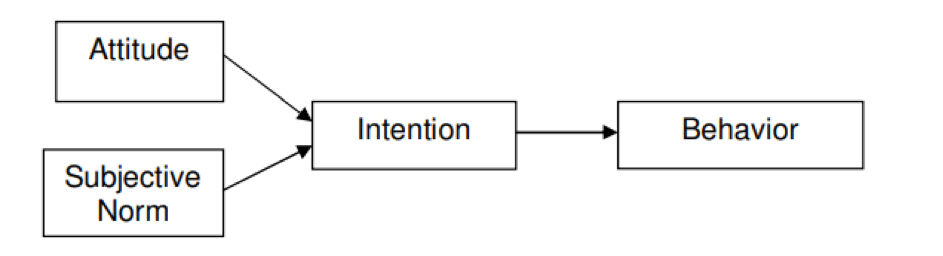
The theory has the goal to explain the relationship between the attitude and the behavior within human action. It is used to see and Predict how individuals will behave, based on their pre-existing attitudes and behavioral intentions. Indeed, when an individual decides to engage in a specific behavior, it is based on the outcomes that the individual hopes to achieve after performing the behavior. It is therefore an explanatory theory of behavior through behavioral intentions.
The model was based on two criteria as a group of variables. The first contains attitudes that are defined as either positive or negative feelings with the achievement of an objective.
The second group of variables contains the subjective norms, meaning the representation of how is perceived by people representation in the relationship to the ability of reaching those goals with the product.
However, after discovering some imperfections in the structure of the theory, Ajzen and Fishbein in 1988 modified the Theory of Reasoned Action by adding a third element. This is perceived behavioral control.
This new theory admits that individuals are unlikely to develop a strong intention to act and behave in a certain way if they believe they lack the resources or opportunities to do so, even if they have favorable attitudes towards the behavior in question and if they believe that those around them would approve of the behavior.
- Theory application
The first article is “An Empirical Study of Instant Messaging (IM) Behavior Using Theory of Reasoned Action” written by Alan Peslak, Wendy Ceccucci and Patricia Sendall. The authors want to understand how influence works on instant messaging behavior.
The four factors which are attitude, subjective norm, intention and behavior are interesting in the model to understand these behaviors.
The theory of reasoned action suggests a significant relationship between attitude and subjective standard and intent. The attitude towards instant messaging is positively associated with intend to use instant messaging ant it have had an impact on intend to use instant messaging. The first hypothesis that proposes a positive association between attitude and intent to use has been supported.
The theory of reasoned action can serve as a model for Instant messaging behavior; indeed, messaging is positively associated with the intention to use instant messaging and so is the subjective standard. These findings on the study do well show the role that the theory of reasoned action can play in a variety of settings.
The authors say that studies can be undertaken to confirm these results but that preliminary results suggest that instant messaging respects the theory of reasoned action and is therefore subject to efforts to improve behavior paying attention to the important influencing factors of attitude, subjective norm, and intention.
The second article is “Application of the Theory of Reasoned Action to On-line Shopping” by Supanat Chuchinprakarn. Here the experience is in the field of online shopping.
The purpose of these experiments explained in the article is to study the behavior of Internet users and the effects key factors about the intention to shop online. The Theory of Reasoned Action has been used to develop the conceptual framework. The population of interest was limited to full-time employees in the Thailand with frequent use of the Internet. The results hypotheses tests have shown that the four key concepts, which are trust, trust in the use of a credit card, subjective norm, and past behavior, had effects on online shopping intentions.
This study attempts to capture the growth of e-commerce by applying the theory of reasoning action on online transactions between online sellers and consumers in Thailand. The results indicate this confidence and past behavior are key factors that affect intention to buy. It is to be hoped by the author that this study will be able to stimulate future research interests in the field e-commerce.
- Managerial recommendation
This theory can be used in a variety of situations. In a managerial situation I will recommend it to understand the consumer’s behavior in his loyalty to the company.
For example, it can be interesting to understand his behavior on a website, to understand the funnel of the sales process. From the moment the customer arrives on the website and what he does on it, if he leaves immediately or if he stays until a purchase. This theory can be used to understand his attitude as well as the subjective norm of social interactions. The subjective standard is an anticipation of the consumer as to how his desires will be perceived by his entourage (encouragement, misunderstanding, mockery…), a standard to which he is inclined to conform. It is a norm because it will influencer behavior (to do or not to do). It is social because it comes from the environment (family, friends, social pressure). It is subjective, because it is not emitted by the environment, but perceived by the consumer.
Marketers can learn several lessons from the theory of reasoned action. when marketing a product to consumers, marketers must associate a purchase with a positive result, and that result must be specific. The theory shows the importance of passing consumers through the sales circuit. Marketers need to understand that the long delays between the original intent and the completion of the action give consumers plenty of time to dissuade themselves from buying or to question the outcome of the purchase.
 PhD. Richard Huaman-Ramirez